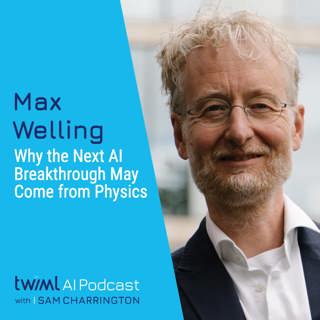
Why the Next AI Breakthrough May Come from Physics with Max Welling - #774
The conventional wisdom in AI is that the next breakthrough will come from more compute, more data, and larger models. But what if the next leap comes from somewhere else? In this episode, Max Wellin...
26 Elo 58min
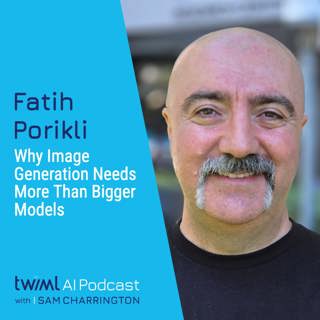
Why Image Generation Needs More Than Bigger Models with Fatih Porikli - #773
Text-to-image models have become remarkably good at producing realistic images. But realism isn’t the same as correctness. Ask for several distinct people, a specific composition, or a high-resolution...
12 Elo 56min
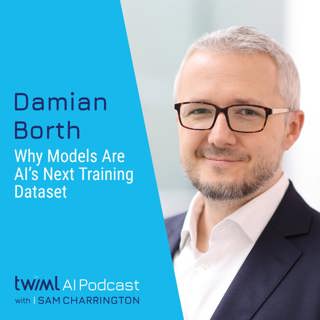
Why Models Are AI’s Next Training Dataset with Damian Borth - #772
For more than a decade, AI has advanced by training ever-larger models on ever-larger datasets. But as high-quality training data becomes harder to find and pretraining grows increasingly expensive, r...
27 Heinä 47min
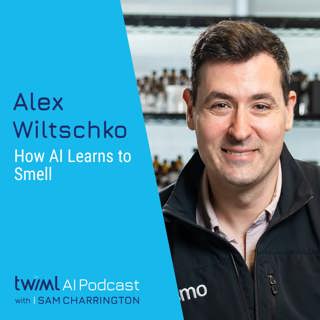
How AI Learns to Smell with Alex Wiltschko - #771
In this episode, Alex Wiltschko, founder and CEO of Osmo, joins the show to discuss his goal of giving computers a sense of smell and what it takes to build olfactory intelligence. We explore the sci...
8 Heinä 59min
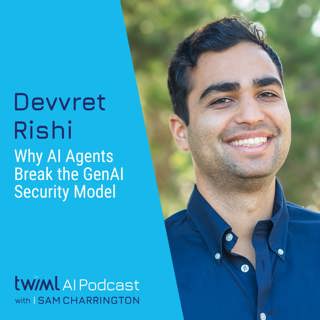
Why AI Agents Break the GenAI Security Model with Devvret Rishi - #770
In this episode, Sam talks with Dev Rishi, GM of AI at Rubrik, about what happens when agents move beyond answering questions and start taking action across tools, systems, and business processes. We...
16 Kesä 56min
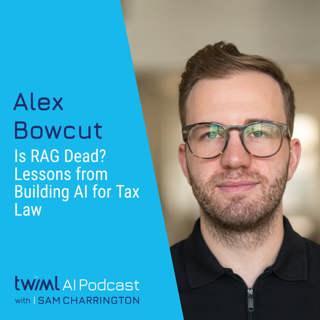
Is RAG Dead? Lessons from Building AI for Tax Law with Alex Bowcut - #769
As context windows grow into the millions of tokens, many AI practitioners are questioning whether retrieval-augmented generation (RAG) is still necessary. If modern models can ingest entire libraries...
9 Kesä 51min
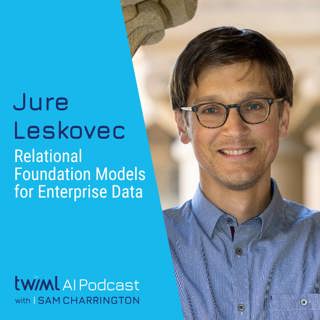
Relational Foundation Models for Enterprise Data with Jure Leskovec - #768
In this episode, Jure Leskovec, co-founder and chief scientist at Kumo and professor of computer science at Stanford, joins us to explore two fronts of his work: AI for science and relational deep lea...
21 Touko 1h 6min
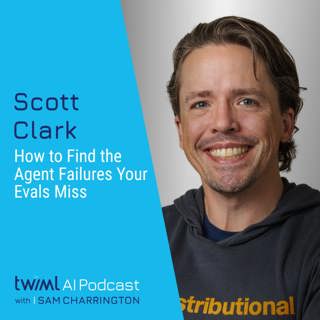
How to Find the Agent Failures Your Evals Miss with Scott Clark - #767
In this episode, Scott Clark, co-founder and CEO of Distributional, joins us to explore how teams can reliably operate and improve complex LLM systems and agents in production. Scott introduces a Masl...
7 Touko 53min