DMND: The First Full SV2 Mining Pool with Alejandro de la Torre | SLP649

DMND: The First Full SV2 Mining Pool with Alejandro de la Torre | SLP649

In this episode, Alejandro de la Torre, CEO and founder of Demand Pool, discusses the launch of their new Stratum V2 mining pool. Alejandro explains the importance of decentralization in Bitcoin mining, the risks associated with traditional mining pools, and how Demand Pool aims to create a fair and transparent system for miners.

The conversation covers the differences between payout structures like FPPS and PPLNS, the innovative Slice payment system, and the role of translation proxies in facilitating mining operations.

Alejandro also addresses the viability of mining pools and the importance of hash rate coordination. He also shares insights on global mining trends, the shift towards liquid cooling, and the challenges of censorship in the mining space.

Takeaways

🔸Demand Pool aims to address decentralization concerns in Bitcoin mining.

🔸Stratum V2 allows miners to build their own blocks, enhancing decentralization.

🔸FPPS payout structure creates centralization risks for miners.

🔸PPLNS is a fairer payout method compared to FPPS.

🔸The Slice payment system ensures fair distribution of transaction fees.

🔸Transparency in payment systems is crucial for miner trust.

🔸Translation proxies are necessary for current mining operations.

🔸Demand Pool focuses on larger miners to achieve operational viability.

🔸Decentralization is essential for Bitcoin's value and ethos.

🔸Alejandro is committed to improving the mining ecosystem. Constant payouts to miners are achievable with sufficient hash rate.

🔸FPPS and PPLNS have significant differences affecting miner payouts.

🔸Security in mining pools is paramount to protect miners' interests.

🔸A good mining pool prioritizes safety and incremental improvements.

🔸Connectivity and latency are critical factors for mining efficiency.

🔸Stratum V2 offers advancements over traditional mining protocols.

🔸FPPS may become obsolete as transaction fees increase in importance.

🔸Global trends show a rise in Bitcoin mining initiatives, especially in Africa.

🔸Liquid cooling presents advantages and challenges compared to air cooling.

🔸Censorship resistance is enhanced with Stratum V2, but challenges remain.

Timestamps:

(00:00) - Intro

(01:00) - What is Demand pool?

(02:24) - What is Stratum V2?; Centralization risks in mining pools

(07:42) - Understanding FPPS payout structure

(12:52) - What is PPLNS ?

(14:44) - What is the Slice payment system?

(18:53) - Difference between Demand Pool & OCEAN or Braiins

(21:05) - Sponsors

(23:35) - The role of translation proxy in mining; Current Stratum V2 support landscape

(27:34) - How much hash rate is required to be viable as a pool?; Mining payouts

(30:24) - Impact of FPPS vs PPLNS on miners

(33:02) - How does Stratum V2 enhance the security of the pool?

(35:06) - What makes a ‘good mining pool’?

(38:34) - The role of good connectivity and latency in mining

(40:13) - Demand Pool vs SRI: A technical comparison

(42:53) - Why do miners choose FPPS over PPLNS?

(45:43) - Sponsors

(47:22) - Global Bitcoin mining trends

(53:52) - Liquid cooling vs Air cooling in Bitcoin mining

(55:50) - Is Stratum V2 censorship resistant?

(59:07) - Closing thoughts

Links:

Sponsors:

Stephan Livera links:

Tämä jakso on lisätty Podme-palveluun avoimen RSS-syötteen kautta eikä se ole Podmen omaa tuotantoa. Siksi jakso saattaa sisältää mainontaa.

Jaksot(766)

Dice Rolls, Entropy, and SeedSigner | Keith Mukai SLP766

Dice Rolls, Entropy, and SeedSigner | Keith Mukai SLP766

In this episode, Keith Mukai of SeedSigner joins to explain why 1.4 percent variance in cheap dice still delivers full 128-bit entropy and how to verify rolls across devices.Timestamps:03:10 — Cheap D...

22 Elo 52min
Jade for Single-Sig or Multisig | Rich SLP765

Jade for Single-Sig or Multisig | Rich SLP765

In this episode, Rich from the team at Blockstream explains Jade, offline dice entropy, blind oracle protection, multisig descriptor recovery and the new Blockstream Swaps beta.Timestamps:00:45 — AI S...

19 Elo 27min
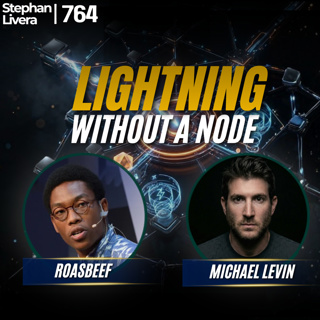
Wavelength Delivers Ark-Based Lightning Without Node Overhead | Roasbeef & Michael Levin SLP764

Wavelength Delivers Ark-Based Lightning Without Node Overhead | Roasbeef & Michael Levin SLP764

Lightning Labs built Wavelength to deliver self-custodial Lightning payments without forcing users to run nodes, manage channels, or handle liquidity.Olaoluwa Osuntokun, CTO and co-founder of Lightnin...

14 Elo 50min

Bitcoin Custody Rules Have Changed | Michael Tanguma SLP763

Bitcoin Custody Rules Have Changed | Michael Tanguma SLP763

Old self-custody approaches collapse once Bitcoin reaches six figures, physical threats rise, and AI tools proliferate. Single hardware wallets and mattress myths no longer match the scale or risks th...

13 Elo 44min
Breez Ships Glow — A Super Simple Bitcoin Wallet | Roy Sheinfeld SLP762

Breez Ships Glow — A Super Simple Bitcoin Wallet | Roy Sheinfeld SLP762

Roy Sheinfeld of Breez returns to walk through Glow, the team's new reference wallet built using Spark. It’s designed so non-custodial Bitcoin feels simple: send, receive, and go.Glow uses passkey onb...

12 Elo 34min
Bitcoin Multi Sig vs Secure Single Sig with Nick Neuman | SLP761

Bitcoin Multi Sig vs Secure Single Sig with Nick Neuman | SLP761

In this episode, Nick Neuman of Casa argues that it’s not the end of self-custody. Instead, it highlights why multisig with multiple vendors provides stronger protection without the hidden complexity ...

7 Elo 36min
Kruw on Wasabi 2.8 and Upcoming Forks | SLP760

Kruw on Wasabi 2.8 and Upcoming Forks | SLP760

Kruw (@kruwed) runs one of the highest-volume WabiSabi coordinators, giving him direct insight into how the protocol handles liquidity, Sybil resistance, and real-world usage.Timestamps:00:42 — Wasabi...

6 Elo 28min
Bitcoin Security Consortium with Mike Schmidt | SLP759

Bitcoin Security Consortium with Mike Schmidt | SLP759

In this episode, Mike Schmidt executive director of Brink, and volunteer coordinator for the consortium, explains how the group formed, autonomy over funding, and how it plans to avoid repeating earli...

28 Heinä 45min