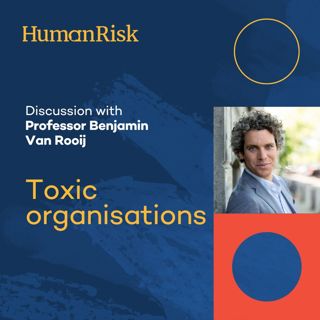
Professor Benjamin Van Rooij on Toxic Organisations

Professor Benjamin Van Rooij on Toxic Organisations

What makes an organisation toxic, and how can we spot the signs before it’s too late? What are the common traits that make seemingly unrelated organisations, ranging from the Catholic Church to corporations, do harm?

On this episode, I’m joined once again by one of my favourite guests — Professor Benjamin van Rooij — for a deep dive into the hidden dangers of organisational life.

Benjamin and his co-author, Professor Nicholas Lord, are working on a new book (working title) Toxic: Organisations Gone Bad, which explores not just headline-grabbing scandals, but the patterns of behaviour and structures that consistently lead organisations to cause harm.

Summary
In our discussion, we unpack how organisational processes — like silencing, secrecy, and the relentless pursuit of unrealistic goals — can multiply risk.

Benjamin explains why organisations, both public and private, can become “toxic” not simply due to bad people or poor oversight, but because of a combination of systemic dynamics and cultural norms that reward silence, over-ambition, and passive harm.

We also discuss why the term “toxic” itself is both useful and problematic, and how understanding these dynamics can help leaders make better decisions before disaster strikes; whether it’s Facebook’s role in spreading misinformation, Wells Fargo’s aggressive sales targets, or the normalization of deviance at Chernobyl and Enron, Benjamin helps us trace the common threads that connect seemingly unrelated crises.

And, true to form, he doesn’t offer simplistic solutions — instead, he gives us tools to ask better questions, challenge dominant narratives, and push for root-cause thinking over box-ticking fixes.

Guest Biography
Benjamin is Professor in Law and Society and Director of Research at the School of Law at the University of Amsterdam, as well as a Global Professor of Law at the University of California, Irvine.

In his academic work, Benjamin specialises in understanding how laws and regulations operate within real-world organisational settings, focusing on compliance, harm, and institutional accountability. He blends criminology, behavioural science, and legal studies to explore why people and institutions obey (or disobey) rules, and what systems best support ethical behaviour.

Previous appearances
On COVID Compliance 🎧 👉 https://www.humanriskpodcast.com/professor-benjamin-van-rooij-on-1/
On Questioning Compliance 🎧 👉 https://www.humanriskpodcast.com/professor-benjamin-van-rooij-on-questioning-compliance/
On The Behavioral Code 🎧 👉 https://www.humanriskpodcast.com/professor-benjamin-van-rooij-on/
On Compliance 2.0 with Professor Danny Sokol 🎧 👉 https://www.humanriskpodcast.com/professors-benjamin-van-rooij/
On Measuring Compliance with Professor Melissa Rorie 🎧 👉 https://www.humanriskpodcast.com/professors-melissa-rorie-benjamin-van-rooij-on-measuring-compliance/

Links
Benjamin's profile at UVA: https://www.uva.nl/en/profile/r/o/b.vanrooij/b.vanrooij.html?cb
The Behavior Code: https://www.penguinrandomhouse.com/books/676270/the-behavioral-code-by-benjamin-van-rooij-and-adam-fine/

AI Generated Timestamped Summary
[00:00:00] Introduction to toxic organisations and examples from Netflix-level scandals
[00:01:00] Benjamin van Rooij’s background and new book with Nicholas Lord
[00:03:00] Organisations as multipliers of harm, active vs passive harm
[00:04:00] The inductive approach — identifying patterns across scandals
[00:05:00] Why the term “toxic” is used despite its flaws
[00:06:00] How scandals like VW, Enron, and Boeing capture our imagination
[00:07:00] How the media and society react to scandals: harm → individuals → system
[00:08:00] Bad apples vs the “orchard” — systems shaping behaviour
[00:10:00] Connecting dots across different kinds of organisations
[00:11:00] Organisational secrecy and silencing — beyond simple fear
[00:13:00] Examples: Chernobyl, 3M, Enron — passive and active silencing
[00:14:00] Leadership failure patterns — neglect and irresponsibility
[00:15:00] Identifying patterns through reading, criminology, and org science
[00:16:00] How case studies were selected and why some were excluded
[00:19:00] Similar patterns across companies, churches, and political parties
[00:20:00] Book opens with contrast: Communist Party famine vs Purdue Pharma
[00:21:00] Unrealistic targets — why they’re the most important insight
[00:23:00] The mismatch between organisational goals and available means
[00:25:00] Scale and complexity: why modern orgs are different
[00:28:00] Limitations of simple solutions — complexity and nuance matter
[00:29:00] Leaders must balance ambition and safety, long-term vs short-term
[00:30:00] Why most harmful processes aren’t illegal — and that’s the problem
[00:32:00] Comparing organisational toxicity to viruses — some survive, some don’t
[00:34:00] Groupthink and cultural dynamics — the dangers of agreement
[00:36:00] Asking questions as a powerful organisational intervention
[00:38:00] Why we often don’t know what’s bad for us — lacking language or insight
[00:41:00] Empowering employees to ask the right questions backed by theory
[00:42:00] Why short-term thinking is embedded in systems and markets
[00:45:00] The overuse and misuse of “culture” as an explanation
[00:47:00] The need for genuine root-cause analysis
[00:48:00] Compliance playbooks vs reality — solutions don’t always fit
[00:51:00] The gap between what we do and what works — “compliance theatre”
[00:54:00] Good times can sow the seeds of harm — ambition blinds risk
[00:56:00] Organisations as overstretched systems — especially with scale
[00:58:00] Social media companies as a case of toxic organisational harm
[01:01:00] Retweet buttons, algorithms and unintended consequences
[01:02:00] Finalising the book and expanding it to include social media
[01:03:00] New project: The US executive branch as a potentially toxic organisation
[01:05:00] Conclusion and final reflections

Tämä jakso on lisätty Podme-palveluun avoimen RSS-syötteen kautta eikä se ole Podmen omaa tuotantoa. Siksi jakso saattaa sisältää mainontaa.

Jaksot(368)

Chloé Valdary on The Theory of Enchantment

Chloé Valdary on The Theory of Enchantment

How can watching Disney movies, help create more inclusive environments?  The answer is in the word Enchantment.On this episode, I'm speaking to Chloé Valdary, the founder of an organisation called Th...

26 Syys 20241h 4min
Morgan Hamel on Moral Polarization

Morgan Hamel on Moral Polarization

How does moral polarization challenge even the most well-intentioned leaders?In this episode, I speak with Morgan Hamel, who talks frankly about her journey from working in business ethics to launchin...

21 Syys 20241h 8min
Chloé Valdary, Morgan Hamel & Peter Stein on De-Polarized Diversity, Equity & Inclusion

Chloé Valdary, Morgan Hamel & Peter Stein on De-Polarized Diversity, Equity & Inclusion

What do you think of when you hear the words Diversity, Equity & Inclusion (DE&I)? If it's something negative, then this is the episode for you; because I'm exploring how we can transform DE&I from so...

14 Syys 202455min
Matt Ottley on Neurodiversity and Creativity

Matt Ottley on Neurodiversity and Creativity

How does neurodiversity impact creativity? On this episode, I explore the challenges of mental health and how it can be both a driver of astonishing creativity and the cause of significant pain. I bel...

7 Syys 20241h 8min
Sharon O'Dea on Navigating the Digital Workspace

Sharon O'Dea on Navigating the Digital Workspace

What makes a digital workplace truly effective? In this episode, I talk to Sharon O'Dea, co-founder of Lithos Partners, about the intricacies of navigating the digital workplace.Sharon brings her weal...

30 Elo 20241h 2min

Announcing the Decision-Making Studio Podcast

Announcing the Decision-Making Studio Podcast

Introducing the Decision-Making Studio Podcast If you’re a regular listener to the show, you’ll know that it’s all about the risks of human decision-making. I try to bring you guests who can help us t...

27 Elo 20245min
Danielle Letayf on building a community

Danielle Letayf on building a community

How can passion and irritation lead to innovation and community building? In this episode, my guest is Danielle Letayf, the founder of Badassery, a dynamic community designed for unconventional though...

24 Elo 20241h 5min

Professor Shannon Vallor on the AI Mirror

Professor Shannon Vallor on the AI Mirror

What if we saw Artificial Intelligence as a mirror rather than as a form of intelligence?That’s the subject of a fabulous new book by Professor Shannon Vallor, who is my guest on this episode.In our d...

16 Elo 20241h 10min

Suosittua kategoriassa Tiede

rss-poliisin-mieli
tiedekulma-podcast
rss-mita-tulisi-tietaa
docemilia
filocast-filosofian-perusteet
menologeja-tutkimusmatka-vaihdevuosiin
rss-duodecim-lehti
rss-tiedetta-vai-tarinaa
sotataidon-ytimessa
rss-lapsuuden-rakentajat-podcast
rss-lihavuudesta-podcast
utelias-mieli
radio-antro
rss-bios-podcast
rss-metsantuntijat-podcast
rss-luontopodi-samuel-glassar-tutkii-luonnon-ihmeita
rss-sosiopodi