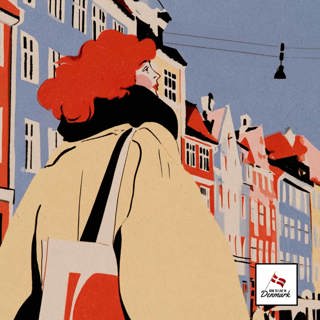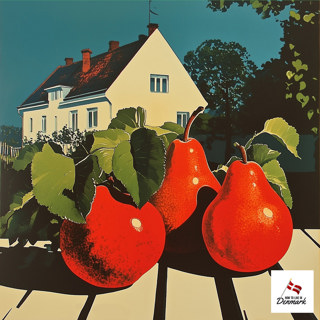

April, Gardening in Denmark, and what it means to be "Pear Danish": The Danish Year Part 4

April, Gardening in Denmark, and what it means to be "Pear Danish": The Danish Year Part 4

As the long Danish winter finally draws to an end, it's time for Danes to start planting their gardens.

Now, in early April, it's rhubarb, parsnips, cabbage. After the risk of frost is gone, in late April, you can put down some beets, and chives, and parsley – all good traditional Danish food.

By May, you can try with the tomatoes, which may or may not ripen depending on whether you get a warm, sunny summer, always a roll of the dice in Denmark. One year we ended up with hard, green tomatoes in September.

Short growing season

The growing season in Denmark is short. If you miss the planting deadlines, you're probably out of luck.

And even if you are in luck, the amount you spend at the garden center will far outstrip the amount it would take you to buy the same foods at the corner market.

But Danes love to garden, they love to touch the Earth. Denmark industrialized fairly late compared to the rest of Europe – really not until the late 19th century – and even then it focused on cooperative agriculture for export. Denmark is still known around the world for its butter and bacon.

The "gaard" is the family farm

Many Danes still carry the name of their family farm in the name they use today.

The Danish word for farm is "gaard", so the names of jewelry designer Ole Lynggaard, or golfer Nicolai Højgaard, or politician Pia Kjærsgaard, all reference what was once the family farm, the "gaard".

This love for nature why weather is always an appropriate topic of conversation among Danes. They're also very good at historical weather. They'll tell you that the rains this April are just like the rains of April 2014, or that we haven't seen this type of wind since the summer of 2006.

Colony gardens

If you live in Denmark with a house in the suburbs with – parcel houses, they're often called – you have lots of room for gardening. But people who live in apartments often have what is called "colony gardens."

Colony gardens are a little patch of land set aside in the cities, or near them, for urban residents to have a garden. They usually build a little house on the plot as well, although you're only allowed to live there during the summer. The electricity and the water usually get switched off during the winter.

The houses are generally wooden, small, cramped, and a little thrown-together. There are often chipped plates and glasses, old chairs with cushions in a grandmotherly fabric, a few board games ready for rainy days. A flag pole and a big Danish flag to put up for holidays. And always, always, they are surrounded by a hedge for privacy.

The colony gardens are run by an association, so you're supposed to be friends with your neighbors, but keep them at a distance. Good fences make good neighbors and all that.

Getting a colony garden requires either buying one or getting on a long, long list to get one, which means that very few of the 15% non-ethnic Danish residents of Denmark have colony gardens. As I mentioned in an earlier podcast, the list of residents tends to look like the 1957 Copenhagen phone book.

The Unity Garden

In my Copenhagen neighborhood, which is extremely diverse, there was initiative to change this a few years ago. A little bit of land freed up by the railroad tracks, and the idea was to create a Unity Garden. Half of the land was set off for people who were not born in Denmark, and half was set off for people who were.

The idea was to meet up, work together, exchange knowledge, have summer picnics, meet across cultures.

Read more at howtoliveindenmark.com

Tämä jakso on lisätty Podme-palveluun avoimen RSS-syötteen kautta eikä se ole Podmen omaa tuotantoa. Siksi jakso saattaa sisältää mainontaa.

Jaksot(150)

Copenhagen vs Berlin

Copenhagen vs Berlin

Copenhagen and Berlin are less than an hour apart by plane, but very different in spirit. Copenhagen is a mostly clean, mostly safe, mostly well-run, mostly get up early in the morning and get to work...

27 Heinä 7min
Brok: The Danish art of petty complaints

Brok: The Danish art of petty complaints

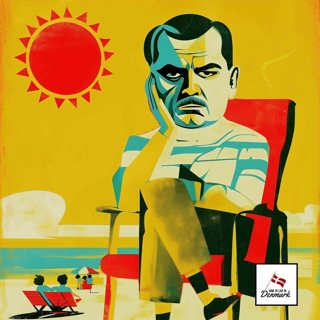
Brok rhymes with clock, and it is a Danish word that describes the petty complaints that are common in one of the happiest countries in the world, and one of the richest. It's complaining as a social ...

24 Kesä 6min
Authenticity and the Danish Summer Light

Authenticity and the Danish Summer Light

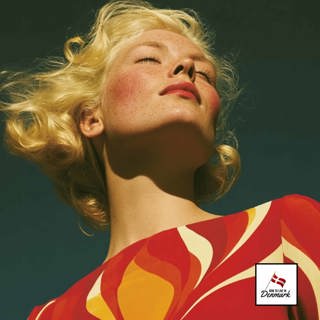
These are the light times in Denmark. In May and June, it's light until 10 or 11 in the evening, and then the sun is back around 4am. It's a nice contrast to the dark times in winter, although all tha...

28 Touko 8min
My Awkward First Year in Denmark

My Awkward First Year in Denmark

One thing no one ever tells you about moving to a new country is the incredible awkwardness of it. As a newcomer, you are constantly doing or saying or planning the wrong thing, something that would b...

29 Huhti 9min
The Scheduled Dane: Why Friendship Needs a Calendar

The Scheduled Dane: Why Friendship Needs a Calendar

Danes usually don't do spontaneous. They do calendars. This episode looks at why a country that can count 8,000 ballots in three hours still needs two weeks' notice for almost everything else. From pe...

30 Maalis 6min
Danish dinner party customs & why it's OK to break your Royal Copenhagen cup

Danish dinner party customs & why it's OK to break your Royal Copenhagen cup

Some might say that the most Danish piece of furniture is the chair. The Swan Chair, the Egg Chair, the Wishbone chair. They're all international design classics. You can buy a poster with 100 of the ...

15 Helmi 7min

Vintage TV and movies as a guide to Danish culture

Vintage TV and movies as a guide to Danish culture

Watching vintage TV and movies is a great way to survive the long Danish winter—and if you're learning Danish or trying to understand Danish culture, it's even better. Many classic Danish films and TV...

22 Tammi 9min

December: Little Nisse, Big Money: The Danish Year Part 12

December: Little Nisse, Big Money: The Danish Year Part 12

The nisse is a centuries-old figure in Danish folklore, and every December these tiny, mischievous spirits take center stage. While Santa Claus makes one big appearance late in the month, the nisse ar...

3 Joulu 20257min

Suosittua kategoriassa Liike-elämä ja talous

sijotuskasti
mimmit-sijoittaa
psykopodiaa-podcast
rss-rahapodi
hyva-paha-johtaminen
ostan-asuntoja-podcast
rss-sami-miettinen-neuvottelija
pomojen-suusta
rss-laakispodi
rss-inderes
rss-hilden-kaira
rss-karon-grilli
rss-ammattipodcast
rss-startup-ministerio
lakicast
rahapuhetta
sijoituspodi
rss-sleekcast
asuntoasiaa-paivakirjat
rss-3-vinkin-podcast