Alan Greenspan: “The man who knew”

Alan Greenspan: “The man who knew”

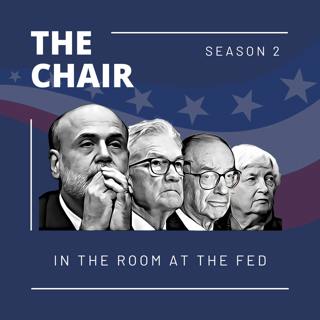
More than any other single institution, the US Federal Reserve drives global capital markets with its decisions and communications. While its interest rates are set by a committee, for almost a century, the Fed’s philosophy and operational approach have been moulded by one person: the Chair of the Board of Governors. In the first series of The Chair, Tim Gwynn Jones talked to authors of books about the Fed's foundational Chairs – Marriner Eccles, Bill Martin, Arthur Burns, and Paul Volcker. In this second series, he covers the people who chaired the Fed through the post-1990 period of financialisation, globalisation, and – perhaps today – deglobalisation. The first episode of the second series explores Alan Greenspan, the chairman who followed Paul Volcker and ran the Fed from 1987 until 2006. Once bestowed with “Maestro” status, Greenspan – who turns 100 in March 2026 – has seen his reputation deflate in the wake of the post-2008 financial crisis. To discuss the fallen Maestro, Tim is joined by Sebastian Mallaby, author of The Man Who Knew: The Life and Times of Alan Greenspan (Bloomsbury, 2016). “Greenspan was the man who knew,” says Mallaby. “He was the man who knew that bubbles were extremely destructive, and yet he was not the man who acted against those bubbles. So, whilst he was great on inflation and on stabilising the price of eggs, he was not good on asset-price inflation or stabilising the price of nest eggs”. A former journalist at The Economist and the Washington Post, Mallaby is the prize-winning author of The World's Banker – a portrait of the World Bank under James Wolfensohn – and More Money Than God: Hedge Funds and the Making of a New Elite. He is now the Paul A. Volcker senior fellow for international economics at the Council on Foreign Relations. Learn more about your ad choices. Visit megaphone.fm/adchoices Support our show by becoming a premium member! https://newbooksnetwork.supportingcast.fm/political-science

Jaksot(1000)

Thomas Hegghammer and Diego Gambetta eds., "Fight, Flight, Mimic: Identity Mimicry in Conflict" (Oxford UP, 2024)

Thomas Hegghammer and Diego Gambetta eds., "Fight, Flight, Mimic: Identity Mimicry in Conflict" (Oxford UP, 2024)

Time spent and words spent—what does each signal? Deceptive mimicry—the manipulation of individual or group identity—includes passing off as a different individual, as a member of a group to which on...

28 Maalis 1h 5min

Sarah James, "The Politics of Failed Policies" (Oxford UP, 2025)

Sarah James, "The Politics of Failed Policies" (Oxford UP, 2025)

The Politics of Failed Policies (Oxford UP, 2025) examines how the interplay of politics and data affects when failed policies get recognized. It shows how compelling data and analysis is an important...

27 Maalis 28min

Maya L. Kornberg, "Stuck: How Money, Media, and Violence Prevent Change in Congress" (JHU Press, 2026)

Maya L. Kornberg, "Stuck: How Money, Media, and Violence Prevent Change in Congress" (JHU Press, 2026)

Why fifty years of changemaking and reform haven't fixed Congress—and what that reveals about American democracy. Congress, the central democratic institution in the United States, is hanging on by a ...

26 Maalis 49min

Tom Wells, "The Kissinger Tapes: Inside His Secretly Recorded Phone Conversations" (Oxford UP, 2026)

Tom Wells, "The Kissinger Tapes: Inside His Secretly Recorded Phone Conversations" (Oxford UP, 2026)

A richly detailed collection of transcripts of Henry Kissinger's secretly recorded phone conversations from his time in the Nixon administration that touch on every important issue of Kissinger's day ...

26 Maalis 34min

On Trump as a “World Historical Individual” with author John B. Judis

On Trump as a “World Historical Individual” with author John B. Judis

The philosopher G.W.F. Hegel “viewed history as consisting of stages punctuated by times of upheaval,” the author John B. Judis wrote in a recent essay for NOTUS, and “assigned to what he called ‘worl...

25 Maalis 34min

How Authoritarians Exploit Gender

How Authoritarians Exploit Gender

Gender is becoming a central battleground in contemporary authoritarian politics, but how do autocrats manipulate these debates to their own advantage? Some regimes now pursue a double strategy of sim...

25 Maalis 22min

Lucia Motolinia, "Unity through Particularism: How Electoral Reforms Influence Parties and Legislative Behavior" (Cambridge UP, 2026)

Lucia Motolinia, "Unity through Particularism: How Electoral Reforms Influence Parties and Legislative Behavior" (Cambridge UP, 2026)

Why do supposedly accountability-enhancing electoral reforms often fail in young democracies? How can legislators serve their constituents when parties control the necessary resources? Unity through P...

24 Maalis 28min

Stephen G. Brooks, "The Political Economy of Security" (Princeton UP, 2026)

Stephen G. Brooks, "The Political Economy of Security" (Princeton UP, 2026)

In his new book, The Political Economy of Security (Princeton University Press, 2026), Stephen Brooks provides a systematic empirical and theoretical examination of how economic factors influence secu...

22 Maalis 49min

Suosittua kategoriassa Tiede

tiedekulma-podcast
rss-poliisin-mieli
rss-mita-tulisi-tietaa
rss-tiedetta-vai-tarinaa
rss-duodecim-lehti
rss-lihavuudesta-podcast
hippokrateen-vastaanotolla
utelias-mieli
radio-antro
filocast-filosofian-perusteet
rss-sosiopodi
university-of-eastern-finland
koodikahvit
rss-astetta-parempi-elama-podcast
rss-metsantuntijat-podcast
rss-ylistys-elaimille
rss-tervetta-skeptisyytta
rss-kasvikutsut