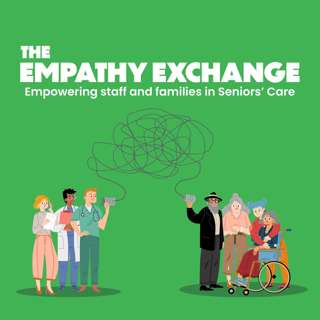
The Empathy Exchange: Close the Expectation Gap and Minimize Disappointments in Seniors’ Care

The Empathy Exchange: Close the Expectation Gap and Minimize Disappointments in Seniors’ Care

In today’s solo episode, you’ll be getting a masterclass in how to better navigate and manage expectations, from both the perspective of staff and families in seniors’ care.


I’ll break down the formula of Disappointment = Expectations – Reality (from Chip Conley, Emotional Equations book) and how we can reframe “unrealistic expectations” into a perspective that you can better work with.


We cover a lot of information in this podcast so have provided references here:


From Atlas of the Heart by Brene Brown:

“Disappointment is unmet expectations. The more significant the expectations, the more significant the disappointment. Every day, sometimes every hour, we are consciously and unconsciously setting expectations of ourselves and the people in our lives, especially those closest to us. The unconscious, unexamined, and unexpressed expectations are the most dangerous and often turn into disappointment. In fact, the research tells us that disappointment is one of the most frequently experienced emotions and it tends to be experienced at a high level of intensity.”


“When we develop expectations, we paint a picture in our head of how things are going to be and how they're going to look. We set expectations based not only on how we fit in that picture, but also on what those around us are doing in that picture. This means that our expectations are often set on outcomes totally beyond our control. Like what other people think, what they feel or how they're going to react. The movie in our mind is wonderful but no one else knows their parts, their lines or what it means to us. Disappointment takes a toll on us and our relationships. It requires considerable emotional bandwidth.”


Questions staff can ask families:

  • What is your understanding of how our home and care supports work?
  • Have you had previous experiences with fill in the blank, ie long term care?
  • What are your perceptions about fill in the blank, ie assisted living?
  • Tell us a bit about what your expectations are?
  • What are you most worried about moving your loved one into our home?
  • What do you need to feel more comfortable or confident with this decision of moving your loved one into our home?
  • What's most important to you?
  • What are you most hoping for?
  • What would you appreciate the most from us?
  • And what support do you need or want from us?


For families, these questions can help you review and assess the expectations you have coming into seniors’ care:

  • Why is this your expectation?
  • How reasonable do you think this expectation is?
  • How much are you relying on things outside of your control to meet that expectation?
  • How will you feel if this isn't met?
  • What needs are you trying to get met with this expectation?
  • How important is this to you? Is there knowledge that you're missing that if provided could change this expectation?


I referenced these questions from Brene Brown’s book Atlas from the Heart:

  • What expectations do you have going into this?
  • What do you want to happen and why?
  • What will that mean to you?
  • Do you have a movie in your head?
  • Are you setting goals and expectations that are completely outside of your control?


Check out Episode 2 “Bridging Gaps in Admission Anxiety: A Family and Staff perspective to hear more about the Knowledge, Emotion and Identity Gaps.


Here are the 20 misconceptions that are from Now What? Managing the Emotional Journey of Long Term Care for Families, and in the book I share information and clarification with these misconceptions.

  1. I thought my loved one was going to get 24/7 one on one care.
  2. I thought clothing wouldn't get lost or damaged. After all, they're labeled.
  3. I should always be able to call and speak to a care team member right away.
  4. I felt my loved one would have the same people taking care of them. Every day.
  5. If there's a care plan, then everything on that care plan should be done every day.
  6. The only way to get respect and resolve a problem is to be the squeaky wheel and escalate it to the highest level seven.
  7. If I complain the staff will take it out on my loved one.
  8. Now that they're in long term care, my loved one is going to improve or get better (otherwise known as the “I expect the staff to work miracles”.
  9. Staff should know where my loved one is when I call or visit.
  10. I thought I'd feel more settled and relieved now that my loved one is in long term care or I thought the adjustment would take longer.
  11. I should be able to get a parking spot when I come to visit
  12. I thought I'd get regular detailed updates about my loved ones activities participation, medical information, eating habits, etc.
  13. I thought our care conference would be more comprehensive with information updates and be easier to get scheduled.
  14. I thought it would be easier to connect with other families at the home.
  15. I thought the staff would be more proactive and alerting me to additional issues, for example, foot care or changes to their habits or behaviors.
  16. I thought the room would be secure.
  17. I thought we would have more than just 24 hours to clean the room out after our loved one passes away.
  18. If I'm the POA (Power of Attorney) for Health that I should be able to make all the decisions on behalf of my loved one.
  19. I didn't think residents in long term care would or should be sexually active and
  20. My loved one should be getting more care than they're getting given how much we're paying.


If you’d like to purchase a copy of Now What? Managing the Emotional Journey of Long Term Care for Families, visit my website DeborahBakti.com. You can also purchase from Amazon.


You can find out more about me and the work I do at DeborahBakti.com or email me at Deborah@DeborahBakti.com. I’d love to hear from you!

Tämä jakso on lisätty Podme-palveluun avoimen RSS-syötteen kautta eikä se ole Podmen omaa tuotantoa. Siksi jakso saattaa sisältää mainontaa.

Jaksot(24)

What Fuels Creative Teams: A Relational Approach with Amy Climer

What Fuels Creative Teams: A Relational Approach with Amy Climer

What if creativity isn’t something a few people are born with but a skill that every team can learn and apply?In today's episode, Dr. Amy Climer invites us to rethink what it means to be creative, and...

8 Heinä 202531min
What If a 15-Second Story Could Change Everything? A Relational Approach with Marsha Shandur

What If a 15-Second Story Could Change Everything? A Relational Approach with Marsha Shandur

What if connection was as simple as sharing a 15-second story?In this episode of The Relational Approach Podcast, Marsha Shandur guides us into the world of storytelling, not just as entertainment, bu...

24 Kesä 202531min
High Performance Starts with Presence: A Relational Conversation with Dr. Liane Davey

High Performance Starts with Presence: A Relational Conversation with Dr. Liane Davey

What if high performance in seniors’ care starts not with doing more but with showing up differently?In this episode of The Relational Approach Podcast, Dr. Liane Davey introduces us to the concept of...

10 Kesä 202533min
From Fatigue to Connection: A Relational Approach with Denise Brown

From Fatigue to Connection: A Relational Approach with Denise Brown

What if supporting caregivers wasn’t about having all the answers… but simply making space to listen?In today's episode, Denise Brown shares a powerful reminder: presence isn’t a soft skill, it’s the ...

27 Touko 202531min
Building Trust Through Family Councils: A Relational Conversation with Lisa Dawson

Building Trust Through Family Councils: A Relational Conversation with Lisa Dawson

What if family councils could become a bridge instead of a battleground?In this episode of The Relational Approach Podcast, Lisa Dawson shares what it really takes to build trust between care teams an...

13 Touko 202526min
Residents Who Shape Culture: The Relational Approach with Rose Lamb and Lou Watson

Residents Who Shape Culture: The Relational Approach with Rose Lamb and Lou Watson

What if the most powerful voice in the hiring process isn’t the manager but the resident?In today’s episode, Rose Lamb and Lou Watson show us what it looks like when residents aren’t just living in a ...

29 Huhti 202530min
Purposeful Work and Deep Alignment: A Relational Approach with Dr. Katie Keller Wood

Purposeful Work and Deep Alignment: A Relational Approach with Dr. Katie Keller Wood

What if it’s not about balance at all, but alignment?In this episode of The Relational Approach Podcast, Dr. Katie Keller Wood brings a Montessori-inspired lens to caregiving, offering gentle wisdom o...

15 Huhti 202533min
Taming Fear and Building Trust: A Relational Approach with Mindy Spigel

Taming Fear and Building Trust: A Relational Approach with Mindy Spigel

What if the real barrier to connection in seniors’ care isn’t communication, but fear?In today's episode, Mindy Spigel helps us reframe how we respond to families in moments of fear, stress, and uncer...

1 Huhti 202533min

Suosittua kategoriassa Koulutus

rss-murhan-anatomia
psykopodiaa-podcast
voi-hyvin-meditaatiot-2
rss-niinku-asia-on
rss-vapaudu-voimaasi
kesken
rss-liian-kuuma-peruna
leikitaanko-laakaria
rss-laadukasta-ensihoitoa
solu-ja-molekyylibiologian-perusteet
adhd-podi
puhutaan-koiraa
rss-synapselingo-opi-englantia
rss-palautumista-ilman-joogahousuja
rss-narsisti
rss-duodecim-lehti
aamukahvilla
rss-luonnollinen-synnytys-podcast
koulu-podcast-2
rss-arkea-ja-aurinkoa-podcast-espanjasta