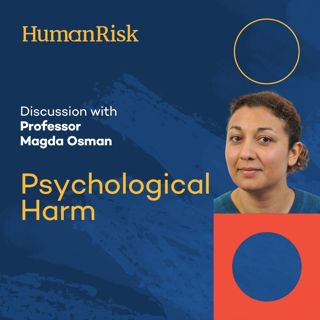
Professor Magda Osman on Psychological Harm

Professor Magda Osman on Psychological Harm

What is psychological harm, and can we really regulate it? Should an AI-companion app be allowed to dump the person who is using it?

📝 Episode Summary
On this episode, I’m joined once again by Professor Magda Osman, someone who’s been on the show several times before, who always has something compelling to say.

This time, we're talking about psychological harm, a term you’ve probably heard, but which remains vague, slippery, and surprisingly unhelpful when it comes to actually protecting people.

Together, we explore what psychological harm really means, why defining it matters, and why regulating it, especially in digital contexts, is so tricky.

We draw comparisons to physical harm, ask whether some emotional distress might be necessary, and consider what kinds of harm are moral rather than measurable.

The conversation touches on loneliness, AI companions, consent, and even chainsaws!

👤 Guest Biography
Magda is a Principal Research Associate at the Judge Business School, University of Cambridge, and holds a Professorial position at Leeds Business School, University of Leeds, where she supports policy impact.

She describes herself as a psychologist by training, with specific interests in decision-making under risk and uncertainty, folk beliefs in the unconscious, and behavioural change effectiveness.

Magda works at the intersection of behavioural science, regulation, and public policy, offering practical insights that challenge assumptions and bring clarity to complex issues.

⏱️ AI-Generated Timestamped Summary
[00:00:00] Introduction and framing of psychological harm

[00:02:00] The conceptual problems with defining psychological harm

[00:05:00] Psychological harm and the precautionary principle in digital regulation

[00:08:00] Social context, platform functions, and why generalisations don’t work

[00:12:00] The idea of rites of passage and unavoidable suffering

[00:15:00] AI companion apps and emotional dependency

[00:17:00] Exploitation, data harvesting, and moral transparency


[00:22:00] Frustration as normal vs. actual psychological damage

[00:26:00] The danger of regulating the trivial and the need for precision

[00:29:00] Why causal links are necessary for meaningful intervention

[00:33:00] Legal obligations and holding tech companies to account

[00:38:00] What users actually care about: privacy, data, trust

[00:42:00] Society’s negotiation of what counts as tolerable harm

[00:45:00] Why this isn’t an unprecedented problem — and how we’ve faced it before

[00:50:00] The risk of bad definitions leading to bad regulation

[00:54:00] Two contrasting examples of online services and their impacts

[00:57:00] What kind of regulation might we actually need?

[00:59:00] The case for rethinking how regulation itself is structured

[01:01:00] Where to find Magda’s work and final reflections

🔗 Links
Magda's LinkedIn profile: https://www.linkedin.com/in/magda-osman-11165138/

Her website: https://www.magdaosman.com/

Magda’s previous appearances on the show exploring:

Behavioural Interventions that fail:
https://www.humanriskpodcast.com/dr-magda-osman-on-behavioural/


Unconscious Bias: what is it, and can we train people not to show it?
https://www.humanriskpodcast.com/dr-magda-osman-on-unconscious/

Compliance, Coercion & Competence
https://www.humanriskpodcast.com/professor-magda-osman-on-compliance-coercion-competence/

Misinformation
https://www.humanriskpodcast.com/professor-magda-osman-on-misinformation/

Risk Prioritisation
https://www.humanriskpodcast.com/professor-magda-osman-on-risk-prioritisation/

Tämä jakso on lisätty Podme-palveluun avoimen RSS-syötteen kautta eikä se ole Podmen omaa tuotantoa. Siksi jakso saattaa sisältää mainontaa.

Jaksot(368)

Kirby Ferguson on Why Everything Is A Remix

Kirby Ferguson on Why Everything Is A Remix

Is there such a thing as an original idea? What if everything were actually a remix?Episode Summary In this episode, I'm exploring the fascinating concept of creativity with filmmaker, educator, and s...

10 Elo 20241h 12min

Simon Parker on Cycling 4000 Miles Across America

Simon Parker on Cycling 4000 Miles Across America

What would motivate someone to cycle 4,000 miles across America, and what stories might they uncover along the way?Episode SummaryOn this episode, I speak with travel writer Simon Parker, who recently...

3 Elo 202458min

Victoria Sena on Saving The Surprise

Victoria Sena on Saving The Surprise

How do you get 𝟲𝟮,𝟬𝟬𝟬 𝗽𝗲𝗼𝗽𝗹𝗲 to keep a 𝘀𝗲𝗰𝗿𝗲𝘁? By not calling it a secret.With the opening ceremony of the Paris 2024 Olympics later today, on this episode, I'm looking back 12 years ...

25 Heinä 202452min

Shabnaz Habib on Airplane Mode

Shabnaz Habib on Airplane Mode

Why do we travel? Obviously, sometimes we do it to go to work or visit family.  But lots of us also do it for fun, becuase we can.  And we naturally presume that’ it’s an unalloyed good.  But is it? M...

21 Heinä 20241h 8min

Fergus Flanagan and Neb Maciver on Talking Magic

Fergus Flanagan and Neb Maciver on Talking Magic

What can we learn from magic?  On this episode, I’m joined by two magicians, Fergus Flanagan and Neb Maciver, founders of Talk Magic and both accomplished magicians in their own right, who join me to ...

14 Heinä 20241h 17min

Koen Smets & Dr Bart Derre on Solving Wicked Problems

Koen Smets & Dr Bart Derre on Solving Wicked Problems

How can we solve 'wicked problems' within complex organisations?  A wicked problem is a social or cultural problem that's difficult or impossible to solve because of its complex and interconnected nat...

4 Heinä 202459min

Paul Orlando on 'Why Now?' - how good timing makes great products

Paul Orlando on 'Why Now?' - how good timing makes great products

Why do some great ideas succeed while others fail despite having everything else in place?On this episode, we welcome back Paul Orlando, an expert on unintended consequences and systems thinking.Paul ...

23 Kesä 20241h 3min

Dr Ludmila Praslova on The Canary Code

Dr Ludmila Praslova on The Canary Code

What can canaries in coalmines teach us about diversity and inclusion? In this episode, I’m speaking to an academic who has some fascinating ideas and insights into how we can create more inclusive wo...

14 Kesä 20241h 4min

Suosittua kategoriassa Tiede

rss-poliisin-mieli
tiedekulma-podcast
rss-mita-tulisi-tietaa
docemilia
filocast-filosofian-perusteet
menologeja-tutkimusmatka-vaihdevuosiin
rss-duodecim-lehti
rss-tiedetta-vai-tarinaa
sotataidon-ytimessa
rss-lapsuuden-rakentajat-podcast
rss-lihavuudesta-podcast
utelias-mieli
radio-antro
rss-bios-podcast
rss-metsantuntijat-podcast
rss-luontopodi-samuel-glassar-tutkii-luonnon-ihmeita
rss-sosiopodi