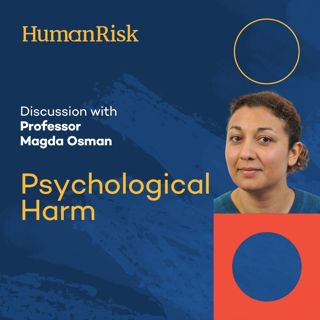
Professor Magda Osman on Psychological Harm

Professor Magda Osman on Psychological Harm

What is psychological harm, and can we really regulate it? Should an AI-companion app be allowed to dump the person who is using it?

📝 Episode Summary
On this episode, I’m joined once again by Professor Magda Osman, someone who’s been on the show several times before, who always has something compelling to say.

This time, we're talking about psychological harm, a term you’ve probably heard, but which remains vague, slippery, and surprisingly unhelpful when it comes to actually protecting people.

Together, we explore what psychological harm really means, why defining it matters, and why regulating it, especially in digital contexts, is so tricky.

We draw comparisons to physical harm, ask whether some emotional distress might be necessary, and consider what kinds of harm are moral rather than measurable.

The conversation touches on loneliness, AI companions, consent, and even chainsaws!

👤 Guest Biography
Magda is a Principal Research Associate at the Judge Business School, University of Cambridge, and holds a Professorial position at Leeds Business School, University of Leeds, where she supports policy impact.

She describes herself as a psychologist by training, with specific interests in decision-making under risk and uncertainty, folk beliefs in the unconscious, and behavioural change effectiveness.

Magda works at the intersection of behavioural science, regulation, and public policy, offering practical insights that challenge assumptions and bring clarity to complex issues.

⏱️ AI-Generated Timestamped Summary
[00:00:00] Introduction and framing of psychological harm

[00:02:00] The conceptual problems with defining psychological harm

[00:05:00] Psychological harm and the precautionary principle in digital regulation

[00:08:00] Social context, platform functions, and why generalisations don’t work

[00:12:00] The idea of rites of passage and unavoidable suffering

[00:15:00] AI companion apps and emotional dependency

[00:17:00] Exploitation, data harvesting, and moral transparency


[00:22:00] Frustration as normal vs. actual psychological damage

[00:26:00] The danger of regulating the trivial and the need for precision

[00:29:00] Why causal links are necessary for meaningful intervention

[00:33:00] Legal obligations and holding tech companies to account

[00:38:00] What users actually care about: privacy, data, trust

[00:42:00] Society’s negotiation of what counts as tolerable harm

[00:45:00] Why this isn’t an unprecedented problem — and how we’ve faced it before

[00:50:00] The risk of bad definitions leading to bad regulation

[00:54:00] Two contrasting examples of online services and their impacts

[00:57:00] What kind of regulation might we actually need?

[00:59:00] The case for rethinking how regulation itself is structured

[01:01:00] Where to find Magda’s work and final reflections

🔗 Links
Magda's LinkedIn profile: https://www.linkedin.com/in/magda-osman-11165138/

Her website: https://www.magdaosman.com/

Magda’s previous appearances on the show exploring:

Behavioural Interventions that fail:
https://www.humanriskpodcast.com/dr-magda-osman-on-behavioural/


Unconscious Bias: what is it, and can we train people not to show it?
https://www.humanriskpodcast.com/dr-magda-osman-on-unconscious/

Compliance, Coercion & Competence
https://www.humanriskpodcast.com/professor-magda-osman-on-compliance-coercion-competence/

Misinformation
https://www.humanriskpodcast.com/professor-magda-osman-on-misinformation/

Risk Prioritisation
https://www.humanriskpodcast.com/professor-magda-osman-on-risk-prioritisation/

Tämä jakso on lisätty Podme-palveluun avoimen RSS-syötteen kautta eikä se ole Podmen omaa tuotantoa. Siksi jakso saattaa sisältää mainontaa.

Jaksot(368)

Stefan Gaillard on the importance of Trial & Error

Stefan Gaillard on the importance of Trial & Error

Why is it so hard for us to admit mistakes? That's what my guest Stefan Gaillard & I explore in this episode. Stefan is the Editor of The Journal of Trial & Error, a project that seeks to promote the...

18 Marras 20201h 1min

Stuart Tootal & Greg Davies on the lessons for business from military decision-making

Stuart Tootal & Greg Davies on the lessons for business from military decision-making

What can the military teach business? Much as companies often talk about 'wars' (most obviously when it comes to talent) and 'battles' (usually for market share), it's not obvious that the two have mu...

14 Marras 202055min

John Sutherland on mitigating Board Level Human Risk

John Sutherland on mitigating Board Level Human Risk

If you were looking for a sector that had lots of examples of Human Risk, then you'd probably pick banking? And if you were trying to understand why some of the senior people within banking hadn't be...

7 Marras 202058min

Luca Dellanna on Ergodicity: why the way we often view the world, can lead to bad decisions

Luca Dellanna on Ergodicity: why the way we often view the world, can lead to bad decisions

What is ergodicity? If it's a new term to you, then listen to my guest Luca Dellanna explain why ergodic thinking is often at the heart of much of our flawed decision-making. This is Luca's second ap...

29 Loka 20201h 1min

Leanne Spencer on Wellbeing: why it matters & how we can improve it.

Leanne Spencer on Wellbeing: why it matters & how we can improve it.

We often think of our body and our mind as being somehow distinct, yet there is a strong linkage between mental health and physical wellbeing. That's what I explore with my guest Leanne Spencer on th...

27 Loka 202045min

Multi-million selling Singer Songwriter Dr Glenn Medeiros on Human Risk in the Music Industry

Multi-million selling Singer Songwriter Dr Glenn Medeiros on Human Risk in the Music Industry

On this episode, I'm exploring an industry whose product we all sample daily, but probably don't fully understand: music. In the late 1980s and early 1990s, my guest, Dr Glenn Medeiros, was a global ...

22 Loka 20201h

Professor Don Moore on Confidence and how it impacts our decision-making

Professor Don Moore on Confidence and how it impacts our decision-making

We all understand the idea of Confidence and that having it can help us succeed. Equally, not having it can also paralyse us into inaction. So what is the optimal level of confidence?That's what my ...

15 Loka 202051min

Dr Thomas Roulet on Negative Social Evaluations: the science behind the ways we judge each other

Dr Thomas Roulet on Negative Social Evaluations: the science behind the ways we judge each other

We all instinctively know the impact negative reviews have on individuals and organizations; whether TripAdvisor ratings or publicly administered regulatory sanctions. It's not good. Yet there are ma...

8 Loka 202057min

Suosittua kategoriassa Tiede

rss-poliisin-mieli
tiedekulma-podcast
rss-mita-tulisi-tietaa
docemilia
filocast-filosofian-perusteet
rss-tiedetta-vai-tarinaa
rss-lapsuuden-rakentajat-podcast
sotataidon-ytimessa
menologeja-tutkimusmatka-vaihdevuosiin
rss-duodecim-lehti
rss-lihavuudesta-podcast
radio-antro
rss-bios-podcast
rss-metsantuntijat-podcast
rss-luontopodi-samuel-glassar-tutkii-luonnon-ihmeita