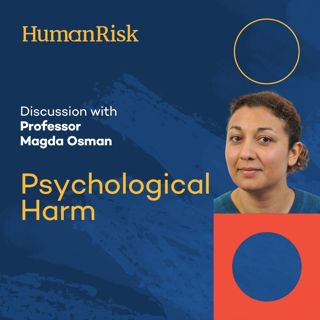
Professor Magda Osman on Psychological Harm

Professor Magda Osman on Psychological Harm

What is psychological harm, and can we really regulate it? Should an AI-companion app be allowed to dump the person who is using it?

📝 Episode Summary
On this episode, I’m joined once again by Professor Magda Osman, someone who’s been on the show several times before, who always has something compelling to say.

This time, we're talking about psychological harm, a term you’ve probably heard, but which remains vague, slippery, and surprisingly unhelpful when it comes to actually protecting people.

Together, we explore what psychological harm really means, why defining it matters, and why regulating it, especially in digital contexts, is so tricky.

We draw comparisons to physical harm, ask whether some emotional distress might be necessary, and consider what kinds of harm are moral rather than measurable.

The conversation touches on loneliness, AI companions, consent, and even chainsaws!

👤 Guest Biography
Magda is a Principal Research Associate at the Judge Business School, University of Cambridge, and holds a Professorial position at Leeds Business School, University of Leeds, where she supports policy impact.

She describes herself as a psychologist by training, with specific interests in decision-making under risk and uncertainty, folk beliefs in the unconscious, and behavioural change effectiveness.

Magda works at the intersection of behavioural science, regulation, and public policy, offering practical insights that challenge assumptions and bring clarity to complex issues.

⏱️ AI-Generated Timestamped Summary
[00:00:00] Introduction and framing of psychological harm

[00:02:00] The conceptual problems with defining psychological harm

[00:05:00] Psychological harm and the precautionary principle in digital regulation

[00:08:00] Social context, platform functions, and why generalisations don’t work

[00:12:00] The idea of rites of passage and unavoidable suffering

[00:15:00] AI companion apps and emotional dependency

[00:17:00] Exploitation, data harvesting, and moral transparency


[00:22:00] Frustration as normal vs. actual psychological damage

[00:26:00] The danger of regulating the trivial and the need for precision

[00:29:00] Why causal links are necessary for meaningful intervention

[00:33:00] Legal obligations and holding tech companies to account

[00:38:00] What users actually care about: privacy, data, trust

[00:42:00] Society’s negotiation of what counts as tolerable harm

[00:45:00] Why this isn’t an unprecedented problem — and how we’ve faced it before

[00:50:00] The risk of bad definitions leading to bad regulation

[00:54:00] Two contrasting examples of online services and their impacts

[00:57:00] What kind of regulation might we actually need?

[00:59:00] The case for rethinking how regulation itself is structured

[01:01:00] Where to find Magda’s work and final reflections

🔗 Links
Magda's LinkedIn profile: https://www.linkedin.com/in/magda-osman-11165138/

Her website: https://www.magdaosman.com/

Magda’s previous appearances on the show exploring:

Behavioural Interventions that fail:
https://www.humanriskpodcast.com/dr-magda-osman-on-behavioural/


Unconscious Bias: what is it, and can we train people not to show it?
https://www.humanriskpodcast.com/dr-magda-osman-on-unconscious/

Compliance, Coercion & Competence
https://www.humanriskpodcast.com/professor-magda-osman-on-compliance-coercion-competence/

Misinformation
https://www.humanriskpodcast.com/professor-magda-osman-on-misinformation/

Risk Prioritisation
https://www.humanriskpodcast.com/professor-magda-osman-on-risk-prioritisation/

Tämä jakso on lisätty Podme-palveluun avoimen RSS-syötteen kautta eikä se ole Podmen omaa tuotantoa. Siksi jakso saattaa sisältää mainontaa.

Jaksot(368)

Professor Tom Schössler on deploying Behavioural Science in a Museum

Professor Tom Schössler on deploying Behavioural Science in a Museum

How can Behavioural Science help museums to encourage more visitors?In this episode, I speak to Professor Tom Schössler who is the Managing Director of the Weserburg Museum of International Contempora...

28 Huhti 202033min

Pooj Morjaria on holding companies to account under COVID

Pooj Morjaria on holding companies to account under COVID

How will companies be held to account for their actions under COVID?On this episode, I speak with Pooj Morjaria, the founder of www.didtheyhelp.com, a website that tracks the good and bad things that ...

25 Huhti 202059min

Steve Martin & Joe Marks on Messengers

Steve Martin & Joe Marks on Messengers

On this episode, I speak with Steve Martin and Joe Marks, the authors of a book called Messengers: Who We Listen To, Who We Don't and Why. For more on the book, to see videos of key concepts it conta...

20 Huhti 202046min

Human Risk Webinar Recording: Managing Ethics in a Disrupted World

Human Risk Webinar Recording: Managing Ethics in a Disrupted World

This episode is the audio recording from a webinar I co-hosted with Ruth Steinholtz on "Managing Ethics in a Disrupted World". Our aim in hosting it was to highlight the fact that in the current envi...

18 Huhti 202055min

Eggsy on going viral during a pandemic

Eggsy on going viral during a pandemic

What do you do when you think your government isn't doing enough to protect you from the risk of COVID-19? On this episode, I speak to Eggsy, a 22-year-old graphic design student. She noticed that he...

15 Huhti 202055min

'Behind The Spine' with Mark Heywood

'Behind The Spine' with Mark Heywood

This episode of the Human Risk podcast isn't really an episode of the Human Risk podcast. It's the very first episode of a new podcast called "Behind The Spine". But it is about Human Risk. Mark He...

14 Huhti 202029min

Alison Taylor on Ethics - what is it & why does it matter?

Alison Taylor on Ethics - what is it & why does it matter?

What do we mean by Ethics & why does it matter?On this episode, I speak with Alison Taylor who is the Executive Director of Ethical Systems, a collaboration based at NYU Stern School of Business. She...

13 Huhti 202046min

Jez Groom & April Vellacott on Ripple: The Big Effects of Small Behaviour Changes

Jez Groom & April Vellacott on Ripple: The Big Effects of Small Behaviour Changes

On this episode I speak to Jez Groom and April Vellacott, the authors of a new BeSci book called "Ripple". Jez and April talk about their journeys in BeSci, provide some fascinating insights from the...

8 Huhti 202054min

Suosittua kategoriassa Tiede

rss-poliisin-mieli
tiedekulma-podcast
rss-mita-tulisi-tietaa
docemilia
filocast-filosofian-perusteet
menologeja-tutkimusmatka-vaihdevuosiin
rss-duodecim-lehti
rss-tiedetta-vai-tarinaa
sotataidon-ytimessa
rss-lapsuuden-rakentajat-podcast
rss-lihavuudesta-podcast
utelias-mieli
radio-antro
rss-bios-podcast
rss-metsantuntijat-podcast
rss-luontopodi-samuel-glassar-tutkii-luonnon-ihmeita
rss-sosiopodi