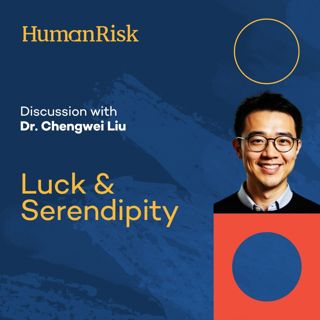
Dr Chengwei Liu on Luck & Serendipity

Dr Chengwei Liu on Luck & Serendipity

Have you ever wondered how much of your success is down to luck? What if the world is far less fair and predictable than we’d like to think?

On this episode, I explore the complex and fascinating role of luck in our lives and decisions with Dr. Chengwei Liu, Associate Professor of Strategy and Behavioural Science at Imperial College London. Chengwei shares how his research challenges our assumptions about skill, effort, and fairness – and why the outcomes we see are often far more random than we’d like to believe.

We discuss why many successful strategies and best practices are built on shaky ground, and how our tendency to downplay luck creates illusions of control and reinforces unfair systems. Chengwei explains how beliefs in fairness – like the ‘just world’ hypothesis – shape everything from business cultures to political systems, and how luck and misperceptions of it can create cycles of privilege or disadvantage.

Chengwei also shares practical insights on how to become a smart contrarian: someone who can harness the power of randomness and serendipity while avoiding the pitfalls of bias and overconfidence. From the dangers of blindly following the ‘successful’ to the need to look inward and embrace uniqueness, it’s a thought-provoking conversation that will change the way you think about risk, decision-making, and what it really means to get ahead.

Guest Biography
Dr. Chengwei Liu is an Associate Professor of Strategy and Behavioural Science at Imperial College London. He describes himself as someone fascinated by how luck, randomness, and human biases shape success and failure – both in business and in broader society.

Chengwei’s work challenges mainstream management thinking and explores how much of what we attribute to skill is actually the result of random factors.

His book, Luck: A Key Idea for Business and Society, examines these dynamics and how we can learn to navigate them.

Beyond his academic roles, Chengwei has also worked as a management consultant, drawing on his experience in both research and practice to uncover how to harness luck and uncertainty.

AI-Generated Timestamped Summary
[00:00:00] Introduction

[00:02:00] Chengwei explains his research focus on randomness and variance in firm performance

[00:04:00] The overlooked 50% of variance in outcomes: luck and randomness

[00:06:00] Defining luck as what lies beyond our control and foresight

[00:08:00] The conflict between fairness beliefs and the reality of luck

[00:10:00] Luck’s societal implications: why fairness perceptions differ across countries

[00:11:00] Skill versus luck – how we confuse the two in our narratives

[00:13:00] Why successful people over-attribute their success to skill

[00:15:00] Managers vs entrepreneurs: how they differ in acknowledging luck

[00:17:00] The challenges of researching an elusive concept like luck

[00:18:00] Using mathematical models to understand Black Swan events

[00:20:00] Why successful predictions of Black Swan events don’t indicate forecasting skill

[00:23:00] The problem with best practices from ‘successful’ firms

[00:26:00] Selection bias in business books and the danger of survivor bias

[00:29:00] The ‘too good to be true’ heuristic as a guide

[00:31:00] Contrarian thinking as a survival strategy for uncertainty

[00:33:00] The replication crisis and the problem with social science predictability

[00:35:00] Human curiosity: the power of moderate surprises

[00:37:00] The difference between luck and serendipity

[00:39:00] How to encourage serendipity in our lives

[00:41:00] Embracing uniqueness and avoiding conformity

[00:44:00] Lessons for the age of AI and human creativity

[00:46:00] The dangers of ignoring randomness: when biases become destructive

[00:48:00] Exploiting others’ biases for strategic advantage

[00:50:00] Why ‘smart contrarian’ thinking is more important than ever

[00:53:00] Testing contrarian ideas like a scientist

[00:56:00] The limits of trial and error: learning from mistakes

[00:58:00] Chengwei’s ongoing research: minority decision-making in venture capital

[01:00:00] How passion and variance link to VC investment strategies

[01:02:00] Wrapping up with reflections on luck, curiosity, and human creativity

LinksDr. Chengwei Liu’s book, Luck: A Key Idea for Business and Society: https://www.routledge.com/Luck-A-Key-Idea-for-Business-and-Society/Liu/p/book/9781138094260?

Chengwei Liu’s Imperial College faculty webpage: https://profiles.imperial.ac.uk/c.liu

Tämä jakso on lisätty Podme-palveluun avoimen RSS-syötteen kautta eikä se ole Podmen omaa tuotantoa. Siksi jakso saattaa sisältää mainontaa.

Jaksot(368)

Giles Oakley on The Art & Science of Tea

Giles Oakley on The Art & Science of Tea

What does tea have to do with human behaviour? A lot more than you might think.  On this epusoed, I'm exploring one of the world's most popular drinks and what we can learn from it.SummaryMy guest is ...

15 Helmi 202549min

Pav Gill on Whistleblowing that works

Pav Gill on Whistleblowing that works

How do we create systems that encourage whistleblowing without incentivizing malicious reporting? Should we reward whistleblowers financially? Why is closure important, both for whistleblowers and the...

1 Helmi 20251h 11min
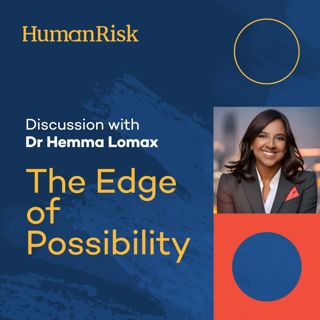
Dr Hemma Lomax on The Edge of Possibility

Dr Hemma Lomax on The Edge of Possibility

What is the edge of possibility and how can storytelling help us to find it?  My guest isn't a storyteller — she's a lawyer, working in compliance — but she's got some fascinating insights to share ab...

25 Tammi 20251h 3min
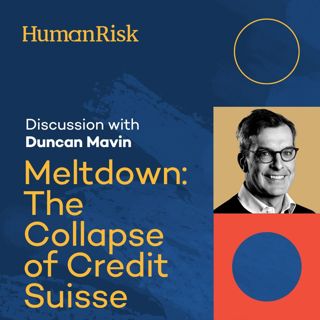
Duncan Mavin on Meltdown: The Collapse of Credit Suisse

Duncan Mavin on Meltdown: The Collapse of Credit Suisse

How does a major global bank keep surviving crises; until it doesn't?Episode SummaryOn this episode, I’m joined by Duncan Mavin, author of Meltdown: Scandal, Sleaze, and the Collapse of Credit Suisse....

12 Tammi 20251h 1min

Kit Holden on Played in Germany -  a footballing journey through a nation's soul

Kit Holden on Played in Germany -  a footballing journey through a nation's soul

What can we learn about a country from its favourite sport?  A lot. Particularly when that country has a history and culture like Germany.  Which is what I'm exploring on this episode.Even if you're n...

5 Tammi 202556min
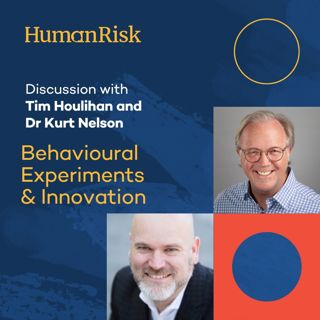
Tim Houlihan & Dr Kurt Nelson on Behavioural Experiments, Podcasting, and Innovation

Tim Houlihan & Dr Kurt Nelson on Behavioural Experiments, Podcasting, and Innovation

What role does experimentation play in making big life and creative decisions? What lessons can podcasters teach us about effective communication in business?Show Summary To answer these questions, in...

27 Joulu 20241h 32min
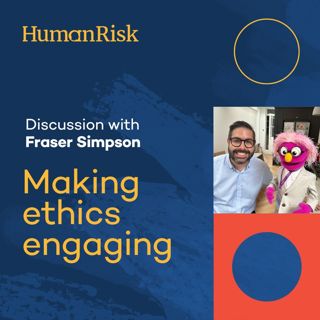
Fraser Simpson on Making Ethics Engaging

Fraser Simpson on Making Ethics Engaging

What does a pink puppet called Connie have to do with ethics? More than you might think. On this episode, I'm speaking with a lawyer, whose innovative approach to getting employees to engage in ethics...

21 Joulu 20241h 38min

Jono Hey on Sketchplanations

Jono Hey on Sketchplanations

Can you distill a complex concept into a single sketch? Jono Hey can and on this episode, he joins me to talk about Sketchplanations —a project that explains the world, one sketch at a time.SummaryI’v...

6 Joulu 20241h 7min

Suosittua kategoriassa Tiede

rss-poliisin-mieli
tiedekulma-podcast
rss-mita-tulisi-tietaa
docemilia
filocast-filosofian-perusteet
menologeja-tutkimusmatka-vaihdevuosiin
rss-duodecim-lehti
rss-tiedetta-vai-tarinaa
sotataidon-ytimessa
rss-lapsuuden-rakentajat-podcast
rss-lihavuudesta-podcast
utelias-mieli
radio-antro
rss-bios-podcast
rss-metsantuntijat-podcast
rss-luontopodi-samuel-glassar-tutkii-luonnon-ihmeita
rss-sosiopodi