The Four Principles of Open Space

The Four Principles of Open Space

Whoever. Whatever. Whenever. It's Over. That's what makes it all work.

My elevator pitch on Open Space goes something like this:

"You know how regular conventions give you a program that tells you who's going to talk, what they're going to talk about, and exactly how long they're going to let you think about it before they'll stop talking?

Open space is the opposite of that. People show up, and we ask them "What do you want to talk about right now? How long do you need?" And then we give them that space."

I've found it works pretty well, but some people still get a whiff of anarchy about it. One person put it politely: "So…it's like a study hall?"

So the elevator pitch is still a work in progress, and meanwhile I can talk about the Four Principles that make the whole thing magic.

1. Whoever shows up are the right people.

There is no slate of presenters at an Open Space. Professionals who deal with ADHD folks might show up (I'd be surprised if they didn't). Sometimes even Big Names show up - I'd be delighted if Jessica McCabe showed up arm-in-arm with Ned Hallowell!

But if they did, I'd emphasize to them that unlike the other conventions they speak at, in an Open Space they are not expected to do anything more (or less) than anyone else.

They can think of this as a vacation, or, if they prefer, an opportunity. Suddenly they have the chance to present on that weird topic that's been in the back of their mind, or even (OMG!) just be participants at an event!

Meanwhile, people who have wanted a chance to present an idea or pose a question for the group get the opportunity in a cooperative, low-pressure and supportive environment.

2. Whenever it starts is the right time.

I started doing Open Spaces about fifteen years before I learned I had ADHD, so now I understand why this principle was always my favorite.

There will be a definite start time for the ADHDOS, probably 9 or 10am. That's when everyone meets and plans the day's agenda (more on that later). There will also be a closing circle, probably about 5pm, where we come together and close out the day.

Aside from that? There is no fixed schedule. There are 30 minute blocks set up across the top of the agenda wall — but those are guideposts, not rules. People are not forced to either fill or cut short their presentations to fit.

Instead, they guesstimate how long they think they'll need, and they start their session when they are ready. If that's the time they picked, cool — but if they're immersed in some other conversation at that time, I let them decide what their priority is.

Want to start it later? Fine. Want to cancel it, or let it happen without you? Also fine. My job as a facilitator is simply to give them that choice, and let everyone else know about it. Usually that means a lot of shuffling taped pieces of paper and moving the "NOW-ish" sign.

It makes the day into a fluid, exciting, and unique learning environment.

3. Whatever happens is the only thing that could have.

Remember how I said at the beginning there is no agenda?

There really is no agenda. So if no one decides to put up a session — nothing will happen.

Now, that's never happened, in well over a hundred open space events. But it's still worth reminding the attendees: they have a measure of responsibility that is different than most conferences.

It also means that if, after the open space, there is something you wish would have been discussed, covered, explored - you have no one to blame but yourself.

3. When it's over, it's over

This is the other half of that second principle.

Remember how those half-hour blocks are just guideposts? If a class topic takes 15 minutes to cover, take that 15 minutes and do something else. If it takes 5 minutes, it takes 5 minutes. We don't ask you to fill time if you're done.

If, on the other hand, a discussion needs 4 hours to adequately cover (which is rare, but has happened) then we make that time available. That's another part of my job as a facilitator — you may need to move the session to a different place, but you can keep doing it until you decide it's done.

This principle also reminds us that everything does have an end, including the availability of an open space location. We do call everyone together at the end of the time in the space to have a "closing circle." Open space attendees discover that a day filled with people sharing things that matter personally and passionately can be exhausting. We take a very short time to celebrate the unexpected connections and new friendships.

Every Open Space is a unique combination of people, and a unique coming-together of knowledge and talents, that will never happen again. We choose to focus on the great and cool stuff that happens because of this, and not say "Damn, I wish such-and-such had happened!" In the end, it's up to us. - the Author, somewhere at a past open space.

That's the four principles. Tomorrow I'll talk about the one dangerously addictive and immensely fun Law of Open Space.

Jaksot(20)

The Maxims of ADHD

The Maxims of ADHD

A lot of maxims, truisms, corollaries, and such got left on the metaphorical cutting room floor. In the interest of completeness and inclusion, here are some of the related phenomena that have epitomi...

29 Joulu 202513min

The Axioms of ADHD

The Axioms of ADHD

Originally published as an article on Medium.com . For the last few months I've been writing down things that help me function with ADHD. These were short phrases, kind of like mantras: hurrying is k...

27 Maalis 202524min

Grace & Discipline with ADHD (Part Two)

Grace & Discipline with ADHD (Part Two)

originally written for Medium • Photo by Jackson Simmer on Unsplash If you know, you know. And that changes pretty much everything. "Suddenly, so much of my life made so much more sense." Th...

7 Helmi 202519min

Grace and Discipline with ADHD (Part one)

Grace and Discipline with ADHD (Part one)

originally written for Medium.com • Photo by Keagan Henman on Unsplash The Deeper Long-Term Effects of Late-Diagnosis ADHD I was interviewed recently by the hosts of a decluttering podcast (link to c...

3 Helmi 202511min
Your Productivity Tools and Hacks Are Useless Without This One Thing.

Your Productivity Tools and Hacks Are Useless Without This One Thing.

originally published on Medium.com I learned the hard way, so maybe you won't have to. I write a lot about productivity tools and methods. I've written about time management and project planning and ...

31 Tammi 20257min
How TIIMO Can Help You Manage Your Time and Relieve ADHD Anxiety

How TIIMO Can Help You Manage Your Time and Relieve ADHD Anxiety

Raise your hand if any of these phrases sound familiar: "Oh, %$#@, it started five minutes ago!" "Wait — that was today?" "This is taking forever. How can it not be over yet?" "Guess I'm just ...

28 Loka 202416min
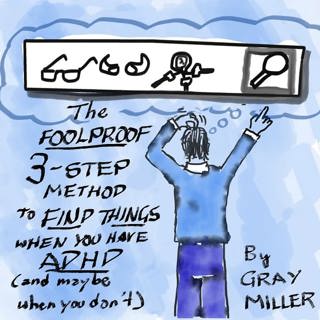
The 3-Step Foolproof Way to Find Lost Things When You Have ADHD

The 3-Step Foolproof Way to Find Lost Things When You Have ADHD

drawing by the author using Adobe Fresco #byHumansForHumans #noAI Raise your hand if you've ever found yourself rummaging through drawers, wandering through room after room in your house, checking bac...

28 Loka 202425min

Five Things You're Guaranteed to Get at the ADHD Open Space

Five Things You're Guaranteed to Get at the ADHD Open Space

Transcript: Welcome to the ADHD Open Space Podcast. My name is Gray Miller, and I will be your host and facilitator as we explore ideas, workarounds, accommodations, and other aspects of being ...

16 Joulu 202336min

Suosittua kategoriassa Terveys ja hyvinvointi

unicast
voi-hyvin-meditaatiot-2
psykopodiaa-podcast
rss-hanna-tikander
tiedenaiset-podcast
rss-pitaisko-erota
vakeva-elama-viisaampi-mieli-vahvempi-keho
rss-narsisti
puhu-muru
terapiassa
junnut-pelissa
meditaatiot-suomeksi
rss-kuumilla-aalloilla
aamukahvilla
selviytyjat-tarinoita-elamasta
rss-pt-paahtio
paaasia-podcast
paritellen
rss-uplevel-by-sonja-hannus
rss-kyykkya-ja-kuoharia