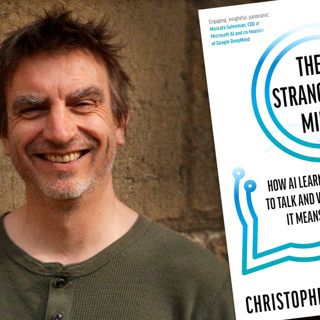

How AI Learned to Talk and What It Means - Prof. Christopher Summerfield

How AI Learned to Talk and What It Means - Prof. Christopher Summerfield

We interview Professor Christopher Summerfield from Oxford University about his new book "These Strange New Minds: How AI Learned to Talk and What It". AI learned to understand the world just by reading text - something scientists thought was impossible. You don't need to see a cat to know what one is; you can learn everything from words alone. This is "the most astonishing scientific discovery of the 21st century."People are split: some refuse to call what AI does "thinking" even when it outperforms humans, while others believe if it acts intelligent, it is intelligent. Summerfield takes the middle ground - AI does something genuinely like human reasoning, but that doesn't make it human.Sponsor messages:========Google Gemini: Google Gemini features Veo3, a state-of-the-art AI video generation model in the Gemini app. Sign up at https://gemini.google.comTufa AI Labs are hiring for ML Engineers and a Chief Scientist in Zurich/SF. They are top of the ARCv2 leaderboard! https://tufalabs.ai/========Prof. Christopher Summerfieldhttps://www.psy.ox.ac.uk/people/christopher-summerfieldThese Strange New Minds: How AI Learned to Talk and What It Meanshttps://amzn.to/4e26BVaTable of Contents:Introduction & Setup00:00:00 Superman 3 Metaphor - Humans Absorbed by Machines00:02:01 Book Introduction & AI Debate Context00:03:45 Sponsor Segments (Google Gemini, Tufa Labs)Philosophical Foundations00:04:48 The Fractured AI Discourse00:08:21 Ancient Roots: Aristotle vs Plato (Empiricism vs Rationalism)00:10:14 Historical AI: Symbolic Logic and Its LimitsThe Language Revolution00:12:11 ChatGPT as the Rubicon Moment00:14:00 The Astonishing Discovery: Learning Reality from Words Alone00:15:47 Equivalentists vs Exceptionalists DebateCognitive Science Perspectives00:19:12 Functionalism and the Duck Test00:21:48 Brain-AI Similarities and Computational Principles00:24:53 Reconciling Chomsky: Evolution vs Learning00:28:15 Lamarckian AI vs Darwinian Human LearningThe Reality of AI Capabilities00:30:29 Anthropomorphism and the Clever Hans Effect00:32:56 The Intentional Stance and Nature of Thinking00:37:56 Three Major AI Worries: Agency, Personalization, DynamicsSocietal Risks and Complex Systems00:37:56 AI Agents and Flash Crash Scenarios00:42:50 Removing Frictions: The Lawfare Example00:46:15 Gradual Disempowerment Theory00:49:18 The Faustian Pact of TechnologyHuman Agency and Control00:51:18 The Crisis of Authenticity00:56:22 Psychology of Control vs Reward01:00:21 Dopamine Hacking and Variable ReinforcementFuture Directions01:02:27 Evolution as Goal-less Optimization01:03:31 Open-Endedness and Creative Evolution01:06:46 Writing, Creativity, and AI-Generated Content01:08:18 Closing RemarksREFS:Academic References (Abbreviated)Essential Books"These Strange New Minds" - C. Summerfield [00:02:01] - Main discussion topic"The Mind is Flat" - N. Chater [00:33:45] - Summerfield's favorite on cognitive illusions"AI: A Guide for Thinking Humans" - M. Mitchell [00:04:58] - Host's previous favorite"Principia Mathematica" - Russell & Whitehead [00:11:00] - Logic Theorist reference"Syntactic Structures" - N. Chomsky (1957) [00:13:30] - Generative grammar foundation"Why Greatness Cannot Be Planned" - Stanley & Lehman [01:04:00] - Open-ended evolutionKey Papers & Studies"Gradual Disempowerment" - D. Duvenaud [00:46:45] - AI threat model"Counterfeit People" - D. Dennett (Atlantic) [00:52:45] - AI societal risks"Open-Endedness is Essential..." - DeepMind/Rocktäschel/Hughes [01:03:42]Heider & Simmel (1944) [00:30:45] - Agency attribution to shapesWhitehall Studies - M. Marmot [00:59:32] - Control and health outcomes"Clever Hans" - O. Pfungst (1911) [00:31:47] - Animal intelligence illusionHistorical References

<trunc, see https://youtu.be/35r0iSajXjA>

Tämä jakso on lisätty Podme-palveluun avoimen RSS-syötteen kautta eikä se ole Podmen omaa tuotantoa. Siksi jakso saattaa sisältää mainontaa.

Jaksot(271)

What Most People Get Wrong About Evolution | Akarsh Kumar

What Most People Get Wrong About Evolution | Akarsh Kumar

A lot of people in AI treat evolution as a dumb fallback, basically random search for when you can't take a gradient. Akarsh Kumar thinks that is wrong. Selection hangs on to partial solutions, so mut...

10 Loka 47min

How a Voice Agent Learns the Rhythm of Conversation — Shawn Wen

How a Voice Agent Learns the Rhythm of Conversation — Shawn Wen

Tsung-Hsien (Shawn) Wen, CTO of PolyAI, tells Tim Scarfe why voice agents are harder than text agents. Voice adds time, and a good conversation depends on adapting to the person on the line, not just ...

1 Loka 1h 10min

Who Checks a Proof No Human Can Read? — Leo de Moura

Who Checks a Proof No Human Can Read? — Leo de Moura

Leonardo de Moura created Lean and co-created Z3. ---This episode is sponsored by Parallel.Parallel, where agents find answers: web search, extraction and deep research APIs built for AI agents.Start ...

30 Syys 1h 14min

When AI Research Starts Moving Faster Than Human Research - Zhengyao Jiang

When AI Research Starts Moving Faster Than Human Research - Zhengyao Jiang

Weco let an AI coding agent rewrite the harness around another agent for eight days: its code, prompts and tools, while the underlying language model stayed fixed. Tim Scarfe asks Weco co-founder Zhen...

26 Syys 43min

How Deep Learning Finally Cracked Messy Tables - Frank Hutter

How Deep Learning Finally Cracked Messy Tables - Frank Hutter

Frank Hutter, co-founder of Prior Labs, talks about TabPFN, a tabular foundation model that makes predictions in a single forward pass, and the research behind it.TabPFN is pre-trained on synthetic da...

23 Syys 1h 53min

Why Scaling Prediction Cannot Create Intelligence - Alexander Mattick

Why Scaling Prediction Cannot Create Intelligence - Alexander Mattick

Alexander Mattick is a researcher at Fraunhofer IIS and a PhD researcher at the University of Technology Nuremberg (UTN), and a regular on Yannic Kilcher's Discord. He first came on MLST in 2022, afte...

21 Syys 2h 14min

How Physical AI Learns Across Language, Video and Action — Ming-Yu Liu

How Physical AI Learns Across Language, Video and Action — Ming-Yu Liu

The car making a left turn at the start of this episode was never filmed. Cosmos 3 generated it. Ming-Yu Liu, who leads the Cosmos research at NVIDIA, explains how one model can describe a video, gene...

15 Syys 25min

Speech Recognition Is Not a Solved Problem — Pavan Kumar Reddy

Speech Recognition Is Not a Solved Problem — Pavan Kumar Reddy

Pavan Kumar Reddy leads audio research at Mistral AI. He joins Tim Scarfe for a deep technical tour of Voxtral — and explains why the frontier of deployed voice is still a cascade of specialised model...

14 Syys 1h 42min