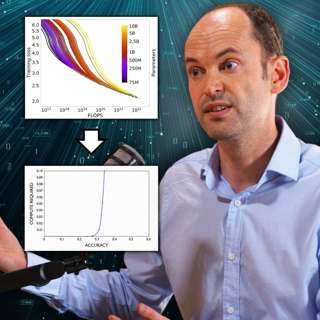

#219 – Toby Ord on graphs AI companies would prefer you didn't (fully) understand

#219 – Toby Ord on graphs AI companies would prefer you didn't (fully) understand

The era of making AI smarter just by making it bigger is ending. But that doesn’t mean progress is slowing down — far from it. AI models continue to get much more powerful, just using very different methods, and those underlying technical changes force a big rethink of what coming years will look like.

Toby Ord — Oxford philosopher and bestselling author of The Precipice — has been tracking these shifts and mapping out the implications both for governments and our lives.

Links to learn more, video, highlights, and full transcript: https://80k.info/to25

As he explains, until recently anyone can access the best AI in the world “for less than the price of a can of Coke.” But unfortunately, that’s over.

What changed? AI companies first made models smarter by throwing a million times as much computing power at them during training, to make them better at predicting the next word. But with high quality data drying up, that approach petered out in 2024.

So they pivoted to something radically different: instead of training smarter models, they’re giving existing models dramatically more time to think — leading to the rise in “reasoning models” that are at the frontier today.

The results are impressive but this extra computing time comes at a cost: OpenAI’s o3 reasoning model achieved stunning results on a famous AI test by writing an Encyclopedia Britannica’s worth of reasoning to solve individual problems at a cost of over $1,000 per question.

This isn’t just technical trivia: if this improvement method sticks, it will change much about how the AI revolution plays out, starting with the fact that we can expect the rich and powerful to get access to the best AI models well before the rest of us.

Toby and host Rob discuss the implications of all that, plus the return of reinforcement learning (and resulting increase in deception), and Toby's commitment to clarifying the misleading graphs coming out of AI companies — to separate the snake oil and fads from the reality of what's likely a "transformative moment in human history."

Recorded on May 23, 2025.

Chapters:

  • Cold open (00:00:00)
  • Toby Ord is back — for a 4th time! (00:01:20)
  • Everything has changed (and changed again) since 2020 (00:01:37)
  • Is x-risk up or down? (00:07:47)
  • The new scaling era: compute at inference (00:09:12)
  • Inference scaling means less concentration (00:31:21)
  • Will rich people get access to AGI first? Will the rest of us even know? (00:35:11)
  • The new regime makes 'compute governance' harder (00:41:08)
  • How 'IDA' might let AI blast past human level — or not (00:50:14)
  • Reinforcement learning brings back 'reward hacking' agents (01:04:56)
  • Will we get warning shots? Will they even help? (01:14:41)
  • The scaling paradox (01:22:09)
  • Misleading charts from AI companies (01:30:55)
  • Policy debates should dream much bigger (01:43:04)
  • Scientific moratoriums have worked before (01:56:04)
  • Might AI 'go rogue' early on? (02:13:16)
  • Lamps are regulated much more than AI (02:20:55)
  • Companies made a strategic error shooting down SB 1047 (02:29:57)
  • Companies should build in emergency brakes for their AI (02:35:49)
  • Toby's bottom lines (02:44:32)


Tell us what you thought! https://forms.gle/enUSk8HXiCrqSA9J8

Video editing: Simon Monsour
Audio engineering: Ben Cordell, Milo McGuire, Simon Monsour, and Dominic Armstrong
Music: Ben Cordell
Camera operator: Jeremy Chevillotte
Transcriptions and web: Katy Moore

Tämä jakso on lisätty Podme-palveluun avoimen RSS-syötteen kautta eikä se ole Podmen omaa tuotantoa. Siksi jakso saattaa sisältää mainontaa.

Jaksot(334)

#140 – Bear Braumoeller on the case that war isn't in decline

#140 – Bear Braumoeller on the case that war isn't in decline

Is war in long-term decline? Steven Pinker's The Better Angels of Our Nature brought this previously obscure academic question to the centre of public debate, and pointed to rates of death in war to a...

8 Marras 20222h 47min

#139 – Alan Hájek on puzzles and paradoxes in probability and expected value

#139 – Alan Hájek on puzzles and paradoxes in probability and expected value

A casino offers you a game. A coin will be tossed. If it comes up heads on the first flip you win $2. If it comes up on the second flip you win $4. If it comes up on the third you win $8, the fourth y...

28 Loka 20223h 38min
Preventing an AI-related catastrophe (Article)

Preventing an AI-related catastrophe (Article)

Today’s release is a professional reading of our new problem profile on preventing an AI-related catastrophe, written by Benjamin Hilton. We expect that there will be substantial progress in AI in t...

14 Loka 20222h 24min

#138 – Sharon Hewitt Rawlette on why pleasure and pain are the only things that intrinsically matter

#138 – Sharon Hewitt Rawlette on why pleasure and pain are the only things that intrinsically matter

What in the world is intrinsically good — good in itself even if it has no other effects? Over the millennia, people have offered many answers: joy, justice, equality, accomplishment, loving god, wisd...

30 Syys 20222h 24min

#137 – Andreas Mogensen on whether effective altruism is just for consequentialists

#137 – Andreas Mogensen on whether effective altruism is just for consequentialists

Effective altruism, in a slogan, aims to 'do the most good.' Utilitarianism, in a slogan, says we should act to 'produce the greatest good for the greatest number.' It's clear enough why utilitarians ...

8 Syys 20222h 21min

#136 – Will MacAskill on what we owe the future

#136 – Will MacAskill on what we owe the future

People who exist in the future deserve some degree of moral consideration.The future could be very big, very long, and/or very good.We can reasonably hope to influence whether people in the future exi...

15 Elo 20222h 54min

#135 – Samuel Charap on key lessons from five months of war in Ukraine

#135 – Samuel Charap on key lessons from five months of war in Ukraine

After a frenetic level of commentary during February and March, the war in Ukraine has faded into the background of our news coverage. But with the benefit of time we're in a much stronger position to...

8 Elo 202254min

#134 – Ian Morris on what big-picture history teaches us

#134 – Ian Morris on what big-picture history teaches us

Wind back 1,000 years and the moral landscape looks very different to today. Most farming societies thought slavery was natural and unobjectionable, premarital sex was an abomination, women should obe...

22 Heinä 20223h 41min

Suosittua kategoriassa Koulutus

rss-murhan-anatomia
voi-hyvin-meditaatiot-2
psykopodiaa-podcast
adhd-podi
psykologia
rss-rahamania
rahapuhetta
kesken
rss-liian-kuuma-peruna
rss-tietoinen-yhteys-podcast-2
rss-hereilla
rss-niinku-asia-on
rss-vapaudu-voimaasi
kehossa
jari-sarasvuo-podcast
rss-valo-minussa-2
filocast-filosofian-perusteet
rss-elamankoulu
rss-koira-haudattuna
rss-arkea-ja-aurinkoa-podcast-espanjasta