
#219 – Toby Ord on graphs AI companies would prefer you didn't (fully) understand

#219 – Toby Ord on graphs AI companies would prefer you didn't (fully) understand

The era of making AI smarter just by making it bigger is ending. But that doesn’t mean progress is slowing down — far from it. AI models continue to get much more powerful, just using very different methods, and those underlying technical changes force a big rethink of what coming years will look like.

Toby Ord — Oxford philosopher and bestselling author of The Precipice — has been tracking these shifts and mapping out the implications both for governments and our lives.

Links to learn more, video, highlights, and full transcript: https://80k.info/to25

As he explains, until recently anyone can access the best AI in the world “for less than the price of a can of Coke.” But unfortunately, that’s over.

What changed? AI companies first made models smarter by throwing a million times as much computing power at them during training, to make them better at predicting the next word. But with high quality data drying up, that approach petered out in 2024.

So they pivoted to something radically different: instead of training smarter models, they’re giving existing models dramatically more time to think — leading to the rise in “reasoning models” that are at the frontier today.

The results are impressive but this extra computing time comes at a cost: OpenAI’s o3 reasoning model achieved stunning results on a famous AI test by writing an Encyclopedia Britannica’s worth of reasoning to solve individual problems at a cost of over $1,000 per question.

This isn’t just technical trivia: if this improvement method sticks, it will change much about how the AI revolution plays out, starting with the fact that we can expect the rich and powerful to get access to the best AI models well before the rest of us.

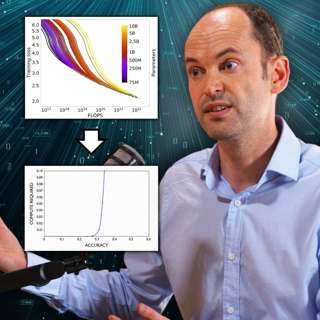
Toby and host Rob discuss the implications of all that, plus the return of reinforcement learning (and resulting increase in deception), and Toby's commitment to clarifying the misleading graphs coming out of AI companies — to separate the snake oil and fads from the reality of what's likely a "transformative moment in human history."

Recorded on May 23, 2025.

Chapters:

  • Cold open (00:00:00)
  • Toby Ord is back — for a 4th time! (00:01:20)
  • Everything has changed (and changed again) since 2020 (00:01:37)
  • Is x-risk up or down? (00:07:47)
  • The new scaling era: compute at inference (00:09:12)
  • Inference scaling means less concentration (00:31:21)
  • Will rich people get access to AGI first? Will the rest of us even know? (00:35:11)
  • The new regime makes 'compute governance' harder (00:41:08)
  • How 'IDA' might let AI blast past human level — or not (00:50:14)
  • Reinforcement learning brings back 'reward hacking' agents (01:04:56)
  • Will we get warning shots? Will they even help? (01:14:41)
  • The scaling paradox (01:22:09)
  • Misleading charts from AI companies (01:30:55)
  • Policy debates should dream much bigger (01:43:04)
  • Scientific moratoriums have worked before (01:56:04)
  • Might AI 'go rogue' early on? (02:13:16)
  • Lamps are regulated much more than AI (02:20:55)
  • Companies made a strategic error shooting down SB 1047 (02:29:57)
  • Companies should build in emergency brakes for their AI (02:35:49)
  • Toby's bottom lines (02:44:32)


Tell us what you thought! https://forms.gle/enUSk8HXiCrqSA9J8

Video editing: Simon Monsour
Audio engineering: Ben Cordell, Milo McGuire, Simon Monsour, and Dominic Armstrong
Music: Ben Cordell
Camera operator: Jeremy Chevillotte
Transcriptions and web: Katy Moore

Jaksot(324)

Rob Wiblin on how he ended up the way he is

Rob Wiblin on how he ended up the way he is

This is a crosspost of an episode of the Eureka Podcast. The interviewer is Misha Saul, a childhood friend of Rob's, who he has known for over 20 years. While it's not an episode of our own show, we...

3 Helmi 20211h 57min

#90 – Ajeya Cotra on worldview diversification and how big the future could be

#90 – Ajeya Cotra on worldview diversification and how big the future could be

You wake up in a mysterious box, and hear the booming voice of God: “I just flipped a coin. If it came up heads, I made ten boxes, labeled 1 through 10 — each of which has a human in it. If it ca...

21 Tammi 20212h 59min

Rob Wiblin on self-improvement and research ethics

Rob Wiblin on self-improvement and research ethics

This is a crosspost of an episode of the Clearer Thinking Podcast: 022: Self-Improvement and Research Ethics with Rob Wiblin. Rob chats with Spencer Greenberg, who has been an audience favourite in...

13 Tammi 20212h 30min

#73 - Phil Trammell on patient philanthropy and waiting to do good [re-release]

#73 - Phil Trammell on patient philanthropy and waiting to do good [re-release]

Rebroadcast: this episode was originally released in March 2020. To do good, most of us look to use our time and money to affect the world around us today. But perhaps that's all wrong. If you too...

7 Tammi 20212h 41min

#75 – Michelle Hutchinson on what people most often ask 80,000 Hours [re-release]

#75 – Michelle Hutchinson on what people most often ask 80,000 Hours [re-release]

Rebroadcast: this episode was originally released in April 2020. Since it was founded, 80,000 Hours has done one-on-one calls to supplement our online content and offer more personalised advice. We ...

30 Joulu 20202h 14min

#89 – Owen Cotton-Barratt on epistemic systems and layers of defense against potential global catastrophes

#89 – Owen Cotton-Barratt on epistemic systems and layers of defense against potential global catastrophes

From one point of view academia forms one big 'epistemic' system — a process which directs attention, generates ideas, and judges which are good. Traditional print media is another such system, and we...

17 Joulu 20202h 38min

#88 – Tristan Harris on the need to change the incentives of social media companies

#88 – Tristan Harris on the need to change the incentives of social media companies

In its first 28 days on Netflix, the documentary The Social Dilemma — about the possible harms being caused by social media and other technology products — was seen by 38 million households in about 1...

3 Joulu 20202h 35min

Benjamin Todd on what the effective altruism community most needs (80k team chat #4)

Benjamin Todd on what the effective altruism community most needs (80k team chat #4)

In the last '80k team chat' with Ben Todd and Arden Koehler, we discussed what effective altruism is and isn't, and how to argue for it. In this episode we turn now to what the effective altruism comm...

12 Marras 20201h 25min

Suosittua kategoriassa Koulutus

rss-murhan-anatomia
voi-hyvin-meditaatiot-2
rss-narsisti
psykopodiaa-podcast
rss-vapaudu-voimaasi
rss-uskonto-on-tylsaa
psykologia
rss-liian-kuuma-peruna
rss-duodecim-lehti
aamukahvilla
rss-valo-minussa-2
kesken
rss-niinku-asia-on
adhd-podi
koulu-podcast-2
jari-sarasvuo-podcast
rss-xamk-podcast
rss-luonnollinen-synnytys-podcast
rss-laiska-joogi
rss-opi-espanjaa