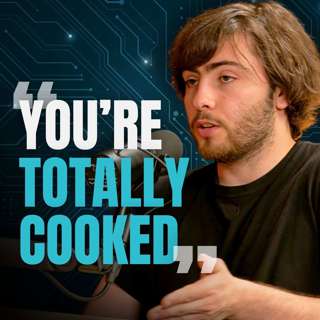

#220 – Ryan Greenblatt on the 4 most likely ways for AI to take over, and the case for and against AGI in <8 years

#220 – Ryan Greenblatt on the 4 most likely ways for AI to take over, and the case for and against AGI in <8 years

Ryan Greenblatt — lead author on the explosive paper “Alignment faking in large language models” and chief scientist at Redwood Research — thinks there’s a 25% chance that within four years, AI will be able to do everything needed to run an AI company, from writing code to designing experiments to making strategic and business decisions.

As Ryan lays out, AI models are “marching through the human regime”: systems that could handle five-minute tasks two years ago now tackle 90-minute projects. Double that a few more times and we may be automating full jobs rather than just parts of them.

Will setting AI to improve itself lead to an explosive positive feedback loop? Maybe, but maybe not.

The explosive scenario: Once you’ve automated your AI company, you could have the equivalent of 20,000 top researchers, each working 50 times faster than humans with total focus. “You have your AIs, they do a bunch of algorithmic research, they train a new AI, that new AI is smarter and better and more efficient… that new AI does even faster algorithmic research.” In this world, we could see years of AI progress compressed into months or even weeks.

With AIs now doing all of the work of programming their successors and blowing past the human level, Ryan thinks it would be fairly straightforward for them to take over and disempower humanity, if they thought doing so would better achieve their goals. In the interview he lays out the four most likely approaches for them to take.

The linear progress scenario: You automate your company but progress barely accelerates. Why? Multiple reasons, but the most likely is “it could just be that AI R&D research bottlenecks extremely hard on compute.” You’ve got brilliant AI researchers, but they’re all waiting for experiments to run on the same limited set of chips, so can only make modest progress.

Ryan’s median guess splits the difference: perhaps a 20x acceleration that lasts for a few months or years. Transformative, but less extreme than some in the AI companies imagine.

And his 25th percentile case? Progress “just barely faster” than before. All that automation, and all you’ve been able to do is keep pace.

Unfortunately the data we can observe today is so limited that it leaves us with vast error bars. “We’re extrapolating from a regime that we don’t even understand to a wildly different regime,” Ryan believes, “so no one knows.”

But that huge uncertainty means the explosive growth scenario is a plausible one — and the companies building these systems are spending tens of billions to try to make it happen.

In this extensive interview, Ryan elaborates on the above and the policy and technical response necessary to insure us against the possibility that they succeed — a scenario society has barely begun to prepare for.

Summary, video, and full transcript: https://80k.info/rg25

Recorded February 21, 2025.

Chapters:

  • Cold open (00:00:00)
  • Who’s Ryan Greenblatt? (00:01:10)
  • How close are we to automating AI R&D? (00:01:27)
  • Really, though: how capable are today's models? (00:05:08)
  • Why AI companies get automated earlier than others (00:12:35)
  • Most likely ways for AGI to take over (00:17:37)
  • Would AGI go rogue early or bide its time? (00:29:19)
  • The “pause at human level” approach (00:34:02)
  • AI control over AI alignment (00:45:38)
  • Do we have to hope to catch AIs red-handed? (00:51:23)
  • How would a slow AGI takeoff look? (00:55:33)
  • Why might an intelligence explosion not happen for 8+ years? (01:03:32)
  • Key challenges in forecasting AI progress (01:15:07)
  • The bear case on AGI (01:23:01)
  • The change to “compute at inference” (01:28:46)
  • How much has pretraining petered out? (01:34:22)
  • Could we get an intelligence explosion within a year? (01:46:36)
  • Reasons AIs might struggle to replace humans (01:50:33)
  • Things could go insanely fast when we automate AI R&D. Or not. (01:57:25)
  • How fast would the intelligence explosion slow down? (02:11:48)
  • Bottom line for mortals (02:24:33)
  • Six orders of magnitude of progress... what does that even look like? (02:30:34)
  • Neglected and important technical work people should be doing (02:40:32)
  • What's the most promising work in governance? (02:44:32)
  • Ryan's current research priorities (02:47:48)

Tell us what you thought! https://forms.gle/hCjfcXGeLKxm5pLaA

Video editing: Luke Monsour, Simon Monsour, and Dominic Armstrong
Audio engineering: Ben Cordell, Milo McGuire, and Dominic Armstrong
Music: Ben Cordell
Transcriptions and web: Katy Moore

Jaksot(318)

#208 – Elizabeth Cox on the case that TV shows, movies, and novels can improve the world

#208 – Elizabeth Cox on the case that TV shows, movies, and novels can improve the world

"I think stories are the way we shift the Overton window — so widen the range of things that are acceptable for policy and palatable to the public. Almost by definition, a lot of things that are going...

21 Marras 20242h 22min
#207 – Sarah Eustis-Guthrie on why she shut down her charity, and why more founders should follow her lead

#207 – Sarah Eustis-Guthrie on why she shut down her charity, and why more founders should follow her lead

"I think one of the reasons I took [shutting down my charity] so hard is because entrepreneurship is all about this bets-based mindset. So you say, “I’m going to take a bunch of bets. I’m going to tak...

14 Marras 20242h 58min

Parenting insights from Rob and 8 past guests

Parenting insights from Rob and 8 past guests

With kids very much on the team's mind we thought it would be fun to review some comments about parenting featured on the show over the years, then have hosts Luisa Rodriguez and Rob Wiblin react to t...

8 Marras 20241h 35min

#206 – Anil Seth on the predictive brain and how to study consciousness

#206 – Anil Seth on the predictive brain and how to study consciousness

"In that famous example of the dress, half of the people in the world saw [blue and black], half saw [white and gold]. It turns out there’s individual differences in how brains take into account ambie...

1 Marras 20242h 33min

How much does a vote matter? (Article)

How much does a vote matter? (Article)

If you care about social impact, is voting important? In this piece, Rob investigates the two key things that determine the impact of your vote:The chances of your vote changing an election’s outcome....

28 Loka 202432min

#205 – Sébastien Moro on the most insane things fish can do

#205 – Sébastien Moro on the most insane things fish can do

"You have a tank split in two parts: if the fish gets in the compartment with a red circle, it will receive food, and food will be delivered in the other tank as well. If the fish takes the blue trian...

23 Loka 20243h 11min

#204 – Nate Silver on making sense of SBF, and his biggest critiques of effective altruism

#204 – Nate Silver on making sense of SBF, and his biggest critiques of effective altruism

Rob Wiblin speaks with FiveThirtyEight election forecaster and author Nate Silver about his new book: On the Edge: The Art of Risking Everything.Links to learn more, highlights, video, and full transc...

16 Loka 20241h 57min

#203 – Peter Godfrey-Smith on interfering with wild nature, accepting death, and the origin of complex civilisation

#203 – Peter Godfrey-Smith on interfering with wild nature, accepting death, and the origin of complex civilisation

"In the human case, it would be mistaken to give a kind of hour-by-hour accounting. You know, 'I had +4 level of experience for this hour, then I had -2 for the next hour, and then I had -1' — and you...

3 Loka 20241h 25min

Suosittua kategoriassa Koulutus

rss-murhan-anatomia
psykopodiaa-podcast
voi-hyvin-meditaatiot-2
rss-niinku-asia-on
kesken
rss-liian-kuuma-peruna
rss-narsisti
adhd-podi
psykologia
rss-duodecim-lehti
ihminen-tavattavissa-tommy-hellsten-instituutti
rss-psykalab
aamukahvilla
aloita-meditaatio
rss-honest-talk-with-laurrenna
rss-luonnollinen-synnytys-podcast
rss-tietoinen-yhteys-podcast-2
rahapuhetta
puhutaan-koiraa
rss-elamankoulu