Dr Kiran Bhatti & Professor Thomas Roulet on Wellbeing Intelligence

Dr Kiran Bhatti & Professor Thomas Roulet on Wellbeing Intelligence

What if we treated mental health like a capability instead of a crisis? On this episode, I'm talking to a business school professor and a counselling psychologist about their new book that looks at practical ways we can manage mental health. Not after it manifests itself, but beforehand.

Episode Summary
Mental health has become part of the workplace conversation, but all too often, that conversation stops at slogans and superficial gestures. On this episode, I explore what it really means to build mental wellbeing into the culture of an organisation with two guests who bring very different — and deeply complementary — perspectives.

Dr. Kiran Bhatti is a counselling psychologist working one-on-one with individuals experiencing anxiety, trauma, and burnout. Professor Thomas Roulet is an organisational sociologist at the University of Cambridge who researches the social dynamics of modern workplaces.

Together, they've written Wellbeing Intelligence, a book that offers a smarter, more integrated approach to mental health at work. Our conversation blends the clinical and the organisational.

We talk about why mental health needs to be treated not just as an emergency response but as a proactive skillset, why high performers are often the most vulnerable, and why grand programmes can fall flat if they don’t feel human. Kiran explains how physical symptoms can mask deeper emotional struggles, and Thomas highlights the invisible tensions that can shape how teams feel and function.

We unpack how leaders can signal care without being intrusive, and how a culture of safety is built more through micro-interactions than policies. This episode is for anyone trying to build workplaces that support — rather than erode — human wellbeing. It’s full of practical insight, honest reflection, and just the right amount of theory to make it stick. You’ll also hear what parenting a newborn has taught them about emotional intelligence and stress, and why the best mental health support often starts with listening, not fixing.

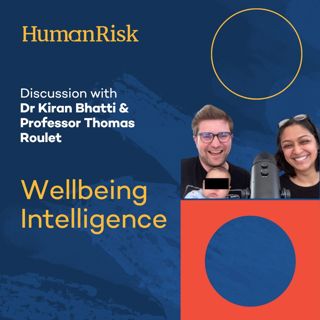
And we break new ground on the show. Not just by having the first couple on as guests, but also because we're joined by their newborn son, who plays his part in making the show more human!

Guest Biographies
Dr. Kiran Bhatti is a counselling psychologist with over 15 years of experience working with individuals and organisations on issues related to mental health, trauma, and emotional wellbeing. She describes herself as someone who works at the intersection of science and soul — blending evidence-based psychological techniques with a deep respect for human complexity. In her practice, she focuses on empowering clients to make sense of their experiences and build sustainable emotional resilience.

Professor Thomas Roulet is a Professor of Organisational Sociology and Leadership at Cambridge Judge Business School and a Fellow at King's College, University of Cambridge. His research explores the social dynamics of organisations, including topics like stigma, conformity, culture, and leadership. He’s published widely on how organisations manage tensions, and how individuals navigate identity and meaning at work. His writing has appeared in Harvard Business Review, The Conversation, and major academic journals.

Together, they co-authored Wellbeing Intelligence: Building Better Mental Health at Work, combining their clinical and organisational expertise to offer a fresh approach to workplace wellbeing that moves beyond tokenistic initiatives.

AI-Generated Timestamped Summary
[00:00:00] Introduction and the concept of "wellbeing intelligence"
[00:03:52] Why mental health should be viewed as a spectrum, not a binary
[00:07:10] The limitations of performative wellbeing initiatives
[00:09:24] How leaders can signal real care without being intrusive
[00:13:17] The interplay between physical and emotional symptoms
[00:16:45] Why psychological safety needs to be lived, not just stated
[00:21:06] What makes high performers especially vulnerable to burnout
[00:26:08] Cultural tensions: hybrid work, visibility, and presenteeism
[00:29:33] Real-life stories of clients struggling in 'healthy' work cultures
[00:34:12] What we can learn from parenting a newborn about stress response
[00:38:05] Thomas on data vs experience in mental health measurement
[00:41:52] Kiran on the role of micro-connections in building trust
[00:44:30] Why middle managers are often the most squeezed and unsupported
[00:48:17] The risk of "outsourcing" care via tech or tools
[00:52:01] Final thoughts on how to embed wellbeing into everyday leadership
[00:55:12] Outro and links to the book and guest profiles

Links
Dr Khiran Bhatti - https://www.drkiranbhatti.com/

Professor Thomas Roulet - https://www.thomasroulet.com/

Wellbeing Intelligence - https://profilebooks.com/work/wellbeing-intelligence/

Thomas' previous appearance on the show on Negative Social Evaluations - https://www.humanriskpodcast.com/dr-thomas-roulet-on-negative/


Tämä jakso on lisätty Podme-palveluun avoimen RSS-syötteen kautta eikä se ole Podmen omaa tuotantoa. Siksi jakso saattaa sisältää mainontaa.

Jaksot(368)

Kirby Ferguson on Why Everything Is A Remix

Kirby Ferguson on Why Everything Is A Remix

Is there such a thing as an original idea? What if everything were actually a remix?Episode Summary In this episode, I'm exploring the fascinating concept of creativity with filmmaker, educator, and s...

10 Elo 20241h 12min

Simon Parker on Cycling 4000 Miles Across America

Simon Parker on Cycling 4000 Miles Across America

What would motivate someone to cycle 4,000 miles across America, and what stories might they uncover along the way?Episode SummaryOn this episode, I speak with travel writer Simon Parker, who recently...

3 Elo 202458min

Victoria Sena on Saving The Surprise

Victoria Sena on Saving The Surprise

How do you get 𝟲𝟮,𝟬𝟬𝟬 𝗽𝗲𝗼𝗽𝗹𝗲 to keep a 𝘀𝗲𝗰𝗿𝗲𝘁? By not calling it a secret.With the opening ceremony of the Paris 2024 Olympics later today, on this episode, I'm looking back 12 years ...

25 Heinä 202452min

Shabnaz Habib on Airplane Mode

Shabnaz Habib on Airplane Mode

Why do we travel? Obviously, sometimes we do it to go to work or visit family.  But lots of us also do it for fun, becuase we can.  And we naturally presume that’ it’s an unalloyed good.  But is it? M...

21 Heinä 20241h 8min

Fergus Flanagan and Neb Maciver on Talking Magic

Fergus Flanagan and Neb Maciver on Talking Magic

What can we learn from magic?  On this episode, I’m joined by two magicians, Fergus Flanagan and Neb Maciver, founders of Talk Magic and both accomplished magicians in their own right, who join me to ...

14 Heinä 20241h 17min

Koen Smets & Dr Bart Derre on Solving Wicked Problems

Koen Smets & Dr Bart Derre on Solving Wicked Problems

How can we solve 'wicked problems' within complex organisations?  A wicked problem is a social or cultural problem that's difficult or impossible to solve because of its complex and interconnected nat...

4 Heinä 202459min

Paul Orlando on 'Why Now?' - how good timing makes great products

Paul Orlando on 'Why Now?' - how good timing makes great products

Why do some great ideas succeed while others fail despite having everything else in place?On this episode, we welcome back Paul Orlando, an expert on unintended consequences and systems thinking.Paul ...

23 Kesä 20241h 3min

Dr Ludmila Praslova on The Canary Code

Dr Ludmila Praslova on The Canary Code

What can canaries in coalmines teach us about diversity and inclusion? In this episode, I’m speaking to an academic who has some fascinating ideas and insights into how we can create more inclusive wo...

14 Kesä 20241h 4min

Suosittua kategoriassa Tiede

rss-poliisin-mieli
tiedekulma-podcast
rss-mita-tulisi-tietaa
docemilia
filocast-filosofian-perusteet
menologeja-tutkimusmatka-vaihdevuosiin
rss-duodecim-lehti
rss-tiedetta-vai-tarinaa
sotataidon-ytimessa
rss-lapsuuden-rakentajat-podcast
rss-lihavuudesta-podcast
utelias-mieli
radio-antro
rss-bios-podcast
rss-metsantuntijat-podcast
rss-luontopodi-samuel-glassar-tutkii-luonnon-ihmeita
rss-sosiopodi