

Ep. 201 – Mapping the World, or how Germans invented America

Ep. 201 – Mapping the World, or how Germans invented America

When you enter the great hall of the Thomas Jefferson building at the Library of Congress in Washington, the first exhibit you will be facing is their Gutenberg Bible. And it is one of the finest Gutenberg bibles around, one of only three surviving pristine copies on vellum. This was the kind of bible that was so expensive to produce, it bankrupted Gutenberg. When the Library of Congress bought it in 1930, they paid $375,000, roughly $7.5m in today’s money.

But this is not the most expensive piece in the library’s collection. That would a work by two Germans, Martin Waldseemüller and Matthias Ringmann. And it is not even a book, but a map. Not a small map, it is 2.3m or 91 inches wide and 1.3m or 50 inches tall.

And this map, printed in 1507 claimed to be:

A DESCRIPTION OF THE WHOLE WORLD ON BOTH

A GLOBE AND A FLAT SURFACE WITH THE INSERTION

OF THOSE LANDS UNKNOWN TO PTOLEMY

DISCOVERED BY RECENT MEN

And the authors wrote that the three continents known since antiquity, Europe, Africa and Asis, quote "have in fact now been more widely explored, and a fourth part has been discovered by Amerigo Vespucci (as will be heard in what follows). Since both Asia and Africa received their names from women, I do not see why anyone should rightly prevent this [new part] from being called Amerigen—the land of Amerigo, as it were—or America, after its discoverer, Americus, a man of perceptive character." End quote.

This fourth part, they said was “surrounded on all sides by the ocean”. And indeed, in the left lower corner we find a fourth continent, a thin, stretched thing, with few place names and a western shore that hints at the Peruvian bulge, unmistakably, South America and then to north of it a very indistinguishable blob of land.

This map, proudly displayed as America’s Birth Certificate, is full of the most intriguing mysteries. How did Waldseemüller and Ringmann know that the Americas had a western shore, when it was only in 1513, 6 years later, that a European first glanced the Pacific?

How did the name America stick though Amerigo Vespucci had neverled an expedition, not even commanded a ship? But most of all, why was this first map of America drawn not by a Spanish or Portuguese navigator, but by two Germans in the employ of the duke of Lorraine, working in St. Die, which is as far away from the sea as one can get in Western Europe.

And then, more generally, what did the Germans have to do with the discoveries, the maps and globes that told the world about them? That is what we will explore in this episode.

The music for the show is Flute Sonata in E-flat major, H.545 by Carl Phillip Emmanuel Bach (or some claim it as BWV 1031 Johann Sebastian Bach) performed and arranged by Michel Rondeau under Common Creative Licence 3.0.

As always:

Homepage with maps, photos, transcripts and blog: www.historyofthegermans.com

If you wish to support the show go to: Support • History of the Germans Podcast

For do it yourself merchandise go to: Merchandise • History of the Germans Podcast

Facebook: @HOTGPod

Threads: @history_of_the_germans_podcast

Bluesky: @hotgpod.bsky.social

Instagram: history_of_the_germans

Twitter: @germanshistory

To make it easier for you to share the podcast, I have created separate playlists for some of the seasons that are set up as individual podcasts. they have the exact same episodes as in the History of the Germans, but they may be a helpful device for those who want to concentrate on only one season.

So far I have:

The Ottonians

Salian Emperors and Investiture Controversy

Fredrick Barbarossa and Early Hohenstaufen

Frederick II Stupor Mundi

Saxony and Eastward Expansion

The Hanseatic League

The Teutonic Knights

The Holy Roman Empire 1250-1356

The Reformation before the Reformation

The Empire in the 15th century

The Fall and Rise of the Habsburgs

Jaksot(246)

Ep. 233: Maximilian I (1493-1519) - Last Days and Legacy

Ep. 233: Maximilian I (1493-1519) - Last Days and Legacy

The last decade of emperor Maximilian’s reign was overshadowed by all three challenges to the emerging Habsburg empire gaining strength. The Ottoman empire was piling on resources by taking over Syria...

16 Huhti 39min
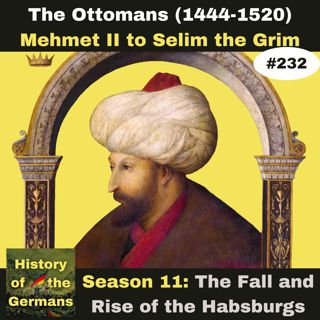
Ep. 232: The Ottomans – From Mehmet the Conqueror to Selim the Grim (1444-1520)

Ep. 232: The Ottomans – From Mehmet the Conqueror to Selim the Grim (1444-1520)

These last dozen or so episodes we have examined the genesis of two of the three major strategic preoccupations of the Habsburg empire, the rivalry with the French kings and the relationship with the ...

9 Huhti 38min

Ep. 231: Maximilian I (1493-1519) - Marrying Bohemia and Hungary

Ep. 231: Maximilian I (1493-1519) - Marrying Bohemia and Hungary

You have almost certainly seen the image in today’s episode artwork before. It is a family portrait showing Maximilian, his first wife Marie of Burgundy, his son, Philip the Handsome and three childre...

2 Huhti 41min

Ep.230: Margaret of Austria (1480-1530) - The League of Cambrai

Ep.230: Margaret of Austria (1480-1530) - The League of Cambrai

Another Thursday and another episode dealing with another epic fail of our hero, Maximilian I. But despite a military campaign that once again failed for all the usual reasons, no money, no strategy, ...

26 Maalis 43min

Ep. 229: Joanna the (not?) Mad (1504-1555) - How the Habsburgs gained Spain

Ep. 229: Joanna the (not?) Mad (1504-1555) - How the Habsburgs gained Spain

“Bella gerant alii, tu felix Austria nube" – ‘Let others wage war; thou, happy Austria, marry’ is one of the few terms that almost anyone with a cursory interest in European history knows, only rivall...

19 Maalis 48min
Ep. 228: Maximilian I (1493-1519) - The Princes and the Emperor.

Ep. 228: Maximilian I (1493-1519) - The Princes and the Emperor.

If there was one group that consistently thwarted Maximilian’s grand plans for world domination, it was the princes of the Holy Roman Empire. He had given in to their demands for Imperial Reform, had ...

12 Maalis 26min
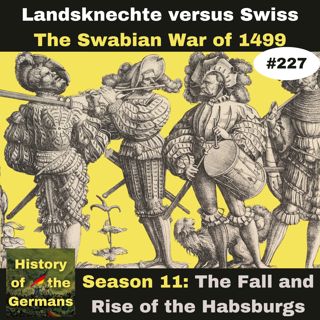
Ep. 227: Landsknechte vs. Swiss Mercenaries – The Swabian (Swiss) War of 1499

Ep. 227: Landsknechte vs. Swiss Mercenaries – The Swabian (Swiss) War of 1499

Why are the Swiss called the Swiss? After all, Schwyz in only of 26 cantons, and not one of the largest ones. How did the proud and prosperous citizens of Zurich or Berne, mighty city states in their ...

5 Maalis 38min

Ep. 226: Maximilian I (1493-1519) - A Grand Plan for a Great War

Ep. 226: Maximilian I (1493-1519) - A Grand Plan for a Great War

Europe's political landscape is shifting fundamentally. No longer are wars fought between kings and their vassals, and emperors against popes - it is all about the balance of power. and this balaance ...

26 Helmi 36min

Suosittua kategoriassa Koulutus

rss-murhan-anatomia
voi-hyvin-meditaatiot-2
psykopodiaa-podcast
psykologia
adhd-podi
rss-rahamania
rss-valo-minussa-2
rss-tietoinen-yhteys-podcast-2
rss-narsisti
kesken
rss-liian-kuuma-peruna
rss-duodecim-lehti
rahapuhetta
rss-vapaudu-voimaasi
rss-niinku-asia-on
rss-psykalab
rss-luonnollinen-synnytys-podcast
leikitaanko-laakaria
filocast-filosofian-perusteet
rss-monarch-talk-with-alexandra-alexis