
New Horizons: Celebrating a decade since the Pluto flyby

New Horizons: Celebrating a decade since the Pluto flyby

On July 14, 2015, NASA’s New Horizons spacecraft made its historic flyby of Pluto, transforming our understanding of this distant world. Ten years later, we’re celebrating that iconic moment and the mission that made it possible.

We begin with Alan Stern, principal investigator of the New Horizons mission, who reflects on the mission’s origins, its most surprising discoveries, and what comes next as New Horizons continues its journey through the Kuiper Belt.

Then we check in with Adeene Denton, NASA postdoctoral program fellow at the Southwest Research Institute, who just returned from the “Progress in Understanding the Pluto System: 10 Years After Flyby” conference held at the Johns Hopkins University Applied Physics Laboratory. Adeene shares highlights from the event, which brought together scientists to explore new results from New Horizons, JWST, Hubble, and ground-based observatories on Pluto, Charon, and the broader Kuiper Belt.

Finally, Planetary Society Director of Government Relations Jack Kiraly joins us with a major update on the ongoing fight to protect NASA science from devastating budget cuts.

And don’t miss What’s Up with our Chief Scientist, Bruce Betts. We’re talking Arrokoth, the most distant Kuiper Belt object New Horizons visited after Pluto.

Discover more at: https://www.planetary.org/planetary-radio/2025-new-horizons-pluto-flyby-10th-anniversary

See omnystudio.com/listener for privacy information.

Jaksot(1312)

Space Policy Edition: China’s growing space science ambitions

Space Policy Edition: China’s growing space science ambitions

If the United States is indeed in a space race with China, then we cannot abandon space science. That’s the claim made by Maxwell Zhu and The Planetary Society’s chief of space policy, Casey Dreier, i...

3 Loka 202548min
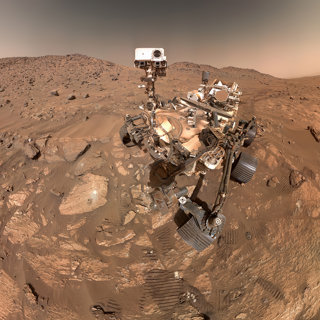
Perseverance finds potential biosignatures in Jezero Crater

Perseverance finds potential biosignatures in Jezero Crater

NASA’s Perseverance rover has made one of its most intriguing discoveries yet in Jezero Crater. A rock sample called Sapphire Canyon, drilled from the Bright Angel formation, contains unusual chemical...

1 Loka 20251h

Bill Nye: A star in Hollywood, a voice for NASA

Bill Nye: A star in Hollywood, a voice for NASA

Bill Nye, CEO of The Planetary Society, has officially joined the Hollywood Walk of Fame. In this episode, we speak with Bill about what this rare honor means to him and to science communication. Then...

24 Syys 202556min

Book Club Edition: Cosmos Award–winning author Dava Sobel

Book Club Edition: Cosmos Award–winning author Dava Sobel

Only six people have received The Planetary Society’s Cosmos Award for Outstanding Public Presentation of Science. We were honored to present it to author and historian Dava Sobel in May of 2025. She ...

19 Syys 202550min

A cosmic travel guide: 111 Places in Space That You Must Not Miss

A cosmic travel guide: 111 Places in Space That You Must Not Miss

Pack your cosmic suitcase. This week on Planetary Radio, host Sarah Al-Ahmed is joined by Mark McCaughrean, astronomer, science communicator, and former Senior Advisor for Science & Exploration at the...

17 Syys 20251h 7min

International Observe the Moon Night 2025

International Observe the Moon Night 2025

This week on Planetary Radio, we look forward to International Observe the Moon Night on October 4, 2025. Host Sarah Al-Ahmed speaks with Staci Horvath, outreach coordinator for NASA’s Solar System Ex...

10 Syys 202559min

Space Policy Edition: Does the rise of Elon mean the decline of NASA?

Space Policy Edition: Does the rise of Elon mean the decline of NASA?

NASA, the crown jewel of 20th-century technocratic liberalism, was the first to land humans on the Moon but now depends on SpaceX for its access to space. Atlantic writer Franklin Foer believes this r...

5 Syys 20251h

Uranus revealed: Solving the ice giant’s heat mystery

Uranus revealed: Solving the ice giant’s heat mystery

For decades, Uranus has puzzled scientists. Unlike the other giant planets, Voyager 2’s 1986 flyby suggested the ice giant emitted no excess heat. Now, thanks to new analyses of Voyager data, decades ...

3 Syys 202556min

Suosittua kategoriassa Tiede

rss-mita-tulisi-tietaa
rss-poliisin-mieli
rss-lihavuudesta-podcast
docemilia
rss-duodecim-lehti
tiedekulma-podcast
utelias-mieli
mielipaivakirja
rss-tervetta-skeptisyytta
koodikahvit
rss-ranskaa-raakana
rss-metsa
rss-ammamafia
rss-mental-race
rss-ylistys-elaimille
rss-luontopodi-samuel-glassar-tutkii-luonnon-ihmeita