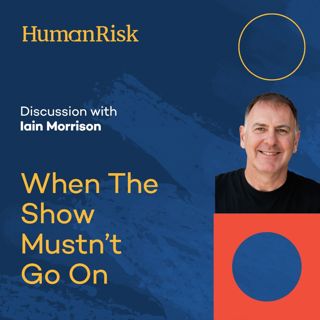
Iain Morrison on When The Show Mustn't Go On

Iain Morrison on When The Show Mustn't Go On

We’ve all heard the phrase ‘the show must go on’. But when shouldn’t the show go on? To help me answer that, I’m speaking to someone who has spent 35 years managing some of Australia’s most iconic large-scale events — from Taylor Swift concerts to public city spectacles with crowds over 200,000, and corporate experiences — and has often faced the question: when should the show really stop?

My guest is Iain Morrison, wh,o as well as having a background in events, is now the CEO of a startup that builds hyper‑accurate 3D and VR plans for event venues.

Episode Summary
In this episode, I dig into what happens when the entertainment world’s credo — “the show must go on” — becomes a liability, and what it feels like backstage to carry that kind of responsibility.

Iain explains the importance of having show‑stop protocols long before trouble arrives — whether it’s crowd crush, heart attacks in the crowd, or approaching severe weather. He explains how event organisers need to make decisions in advance so that nobody freezes under pressure, and ensure everyone is aligned on who can stop the show, and how and when to restart it.

We also delve into the emotional toll of the event industry — the brutal hours, constant touring, adrenaline highs, and the realities of burnout. Ian talks candidly about putting people at risk by cutting critical breaks and how easily event teams can burn out.

Finally, he walks me through his pivot: building a tech startup that uses 3D planning and virtual models to give event teams a fully visual planning tool — reducing surprises, improving safety, and supporting better decisions from the very first draft.

GUEST BIOGRAPHY
Iain is an event manager with over three decades of experience in running major concerts, festivals, and public spectacles across Australia. He has helped deliver live shows for acts like Taylor Swift, U2, Foo Fighters, major public events on the Sydney Harbour Bridge and Domain Concert series, with crowds ranging from 5,000 to over 200,000.

From high school theatre beginnings to early work at Opera Australia and the Sydney Opera House, Ian transitioned into corporate events, the Olympics, and large public outdoor events. He has worked in high-pressure environments where crowd safety, terrorism threats, public order, and weather call-offs were part of the job on a daily basis.

About two years ago, he moved from event delivery to event technology — as CEO and co‑founder of The Imagination Collaborative, Ian now leads a startup building hyper‑accurate 3D and VR planning tools. These digital twins help event teams visualise venue layouts, crowd flows, sightlines, signage, camera positions, evacuation routes and more—before anything is built on site.

AI-GENERATED TIMESTAMPED SUMMARY
[00:00:00] Introduction

[00:02:00] Ian’s backstory: school theatre → university → Opera House → major events

[00:05:00] Scale of events: from 5,000 attendees to crowds of over 200,000

[00:08:00] Types of risk at live events: crowd crush, terrorism threats, medical events

[00:12:00] Why events remain largely unregulated worldwide

[00:15:00] Concept of a “show stop”: planning for what enables safe cancellation or pause

[00:20:00] Decision‑making under stress: protocols versus ego-based pressure

[00:25:00] Real scenarios: thunderstorms, crowd reaction, and restart challenges

[00:28:00] Emotional cost on crews: burnout, long hours, compressed touring schedules

[00:32:00] Industry taboo around mental health and burnout; making it safer for staff

[00:36:00] Ian’s use of social media to spark conversations on stress, safety and standards

[00:40:00] Introduction to Ian’s startup: detailed planning with 3D environments and VR

[00:44:00] How the tool works: drone scans, venue models, client interaction in virtual space

[00:48:00] Benefits: fewer surprises, better sightlines, optimised signage, cost savings

[00:51:00] Future plans: integrating crowd simulation, digital twin models, global expansion

[00:55:00] Final reflections: the trade‑offs of delivering magic vs ensuring safety

[00:57:00] Wrap‑up

LINKS
Iain on LinkedIn - https://www.linkedin.com/in/iainmorrison1/

Iain’s website - https://iainmorrison.global/

Iain’s startup, The Imagination Collaborative - https://www.theimaginationcollaborative.com/

Tämä jakso on lisätty Podme-palveluun avoimen RSS-syötteen kautta eikä se ole Podmen omaa tuotantoa. Siksi jakso saattaa sisältää mainontaa.

Jaksot(368)

Christian Hunt on Human Risk: what is it & how can we mitigate it?

Christian Hunt on Human Risk: what is it & how can we mitigate it?

What is Human Risk? What does 'Bringing Behavioural Science to Ethics & Compliance' mean in practice? On this episode, I'm cross-casting an episode of the Ethical Experts podcast that explores Human R...

2 Loka 202047min

Rob Chesnut on how companies can help their employees to work with Integrity

Rob Chesnut on how companies can help their employees to work with Integrity

How can organizations ensure they are ethical? We all understand the principle, but what does it mean in practice? As Ethics becomes a more significant factor in how employees, customers and regulat...

29 Syys 20201h

Christian Hunt on what COVID has taught us about Human Behaviour

Christian Hunt on what COVID has taught us about Human Behaviour

What, if anything, have we learned about human behaviour from COVID? That's what I'm exploring in this episode. Six months ago, my friend Mark Heywood invited me onto the first episode of Behind The S...

26 Syys 202034min

Jérôme Tagger on Preventable Surprises - effecting change through influence

Jérôme Tagger on Preventable Surprises - effecting change through influence

Why are there so many entirely preventable financial disasters? And why don't the people behind the companies that suffer them, prevent them from happening?That's what my guest Jérôme Tagger and I exp...

24 Syys 202057min

Dr Johannes Lohse on Active vs Passive Risk: how doing nothing can also cause risk.

Dr Johannes Lohse on Active vs Passive Risk: how doing nothing can also cause risk.

When we think of risk, it is usually in the context of 'risk-taking'; in other words, an active decision to do something. But it is equally possible to take risk by doing nothing; passive risk. What...

17 Syys 202057min

Dr Andrew Ishak on Communication in High-Pressure Situations

Dr Andrew Ishak on Communication in High-Pressure Situations

As academic establishments continue to adjust from face to face teaching to being primarily online experiences, how are academics adjusting? That's the start point for my discussion in this episode w...

9 Syys 20201h

Travis Waugh on delivering more effective training

Travis Waugh on delivering more effective training

What do you think of when you read the phrase 'Compliance Training'? Something dull that you're either forced to give (if you're in Compliance) or endure (if you're not)? If so, you're not alone. Bu...

4 Syys 20201h 3min

Professor Olivier Sibony on Why we all make Mistakes and how to avoid them.

Professor Olivier Sibony on Why we all make Mistakes and how to avoid them.

Why do even the smartest and most savvy business people make mistakes? It's not because they're stupid. Instead, it's because of the way our brains work. That's what Professor Olivier Sibony, my guest...

1 Syys 20201h

Suosittua kategoriassa Tiede

rss-poliisin-mieli
tiedekulma-podcast
rss-mita-tulisi-tietaa
docemilia
filocast-filosofian-perusteet
rss-tiedetta-vai-tarinaa
rss-lapsuuden-rakentajat-podcast
sotataidon-ytimessa
menologeja-tutkimusmatka-vaihdevuosiin
rss-duodecim-lehti
rss-lihavuudesta-podcast
radio-antro
rss-bios-podcast
rss-metsantuntijat-podcast
rss-luontopodi-samuel-glassar-tutkii-luonnon-ihmeita