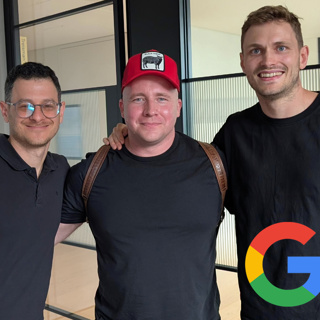

DeepMind Genie 3 [World Exclusive] (Jack Parker Holder, Shlomi Fruchter)

DeepMind Genie 3 [World Exclusive] (Jack Parker Holder, Shlomi Fruchter)

This episode features Shlomi Fuchter and Jack Parker Holder from Google DeepMind, who are unveiling a new AI called Genie 3. The host, Tim Scarfe, describes it as the most mind-blowing technology he has ever seen. We were invited to their offices to conduct the interview (not sponsored).Imagine you could create a video game world just by describing it. That's what Genie 3 does. It's an AI "world model" that learns how the real world works by watching massive amounts of video. Unlike a normal video game engine (like Unreal or the one for Doom) that needs to be programmed manually, Genie generates a realistic, interactive, 3D world from a simple text prompt.**SPONSOR MESSAGES***Prolific: Quality data. From real people. For faster breakthroughs.https://prolific.com/mlst?utm_campaign=98404559-MLST&utm_source=youtube&utm_medium=podcast&utm_content=script-gen***Here’s a breakdown of what makes it so revolutionary:From Text to a Virtual World: You can type "a drone flying by a beautiful lake" or "a ski slope," and Genie 3 creates that world for you in about three seconds. You can then navigate and interact with it in real-time.It's Consistent: The worlds it creates have a reliable memory. If you look away from an object and then look back, it will still be there, just as it was. The guests explain that this consistency isn't explicitly programmed in; it's a surprising, "emergent" capability of the powerful AI model.A Huge Leap Forward: The previous version, Genie 2, was a major step, but it wasn't fast enough for real-time interaction and was much lower resolution. Genie 3 is 720p, interactive, and photorealistic, running smoothly for several minutes at a time.The Killer App - Training Robots: Beyond entertainment, the team sees Genie 3 as a game-changer for training AI. Instead of training a self-driving car or a robot in the real world (which is slow and dangerous), you can create infinite simulations. You can even prompt rare events to happen, like a deer running across the road, to teach an AI how to handle unexpected situations safely.The Future of Entertainment: this could lead to a "YouTube version 2" or a new form of VR, where users can create and explore endless, interconnected worlds together, like the experience machine from philosophy.While the technology is still a research prototype and not yet available to the public, it represents a monumental step towards creating true artificial worlds from the ground up.Jack Parker Holder [Research Scientist at Google DeepMind in the Open-Endedness Team]https://jparkerholder.github.io/Shlomi Fruchter [Research Director, Google DeepMind]https://shlomifruchter.github.io/TOC:[00:00:00] - Introduction: "The Most Mind-Blowing Technology I've Ever Seen"[00:02:30] - The Evolution from Genie 1 to Genie 2[00:04:30] - Enter Genie 3: Photorealistic, Interactive Worlds from Text[00:07:00] - Promptable World Events & Training Self-Driving Cars[00:14:21] - Guest Introductions: Shlomi Fuchter & Jack Parker Holder[00:15:08] - Core Concepts: What is a "World Model"?[00:19:30] - The Challenge of Consistency in a Generated World[00:21:15] - Context: The Neural Network Doom Simulation[00:25:25] - How Do You Measure the Quality of a World Model?[00:28:09] - The Vision: Using Genie to Train Advanced Robots[00:32:21] - Open-Endedness: Human Skill and Prompting Creativity[00:38:15] - The Future: Is This the Next YouTube or VR?[00:42:18] - The Next Step: Multi-Agent Simulations[00:52:51] - Limitations: Thinking, Computation, and the Sim-to-Real Gap[00:58:07] - Conclusion & The Future of Game EnginesREFS:World Models [David Ha, Jürgen Schmidhuber]https://arxiv.org/abs/1803.10122POEThttps://arxiv.org/abs/1901.01753[Akarsh Kumar, Jeff Clune, Joel Lehman, Kenneth O. Stanley]The Fractured Entangled Representation Hypothesishttps://arxiv.org/pdf/2505.11581TRANSCRIPT:https://app.rescript.info/public/share/Zk5tZXk6mb06yYOFh6nSja7Lg6_qZkgkuXQ-kl5AJqM

Tämä jakso on lisätty Podme-palveluun avoimen RSS-syötteen kautta eikä se ole Podmen omaa tuotantoa. Siksi jakso saattaa sisältää mainontaa.

Jaksot(271)

What Most People Get Wrong About Evolution | Akarsh Kumar

What Most People Get Wrong About Evolution | Akarsh Kumar

A lot of people in AI treat evolution as a dumb fallback, basically random search for when you can't take a gradient. Akarsh Kumar thinks that is wrong. Selection hangs on to partial solutions, so mut...

10 Loka 47min

How a Voice Agent Learns the Rhythm of Conversation — Shawn Wen

How a Voice Agent Learns the Rhythm of Conversation — Shawn Wen

Tsung-Hsien (Shawn) Wen, CTO of PolyAI, tells Tim Scarfe why voice agents are harder than text agents. Voice adds time, and a good conversation depends on adapting to the person on the line, not just ...

1 Loka 1h 10min

Who Checks a Proof No Human Can Read? — Leo de Moura

Who Checks a Proof No Human Can Read? — Leo de Moura

Leonardo de Moura created Lean and co-created Z3. ---This episode is sponsored by Parallel.Parallel, where agents find answers: web search, extraction and deep research APIs built for AI agents.Start ...

30 Syys 1h 14min

When AI Research Starts Moving Faster Than Human Research - Zhengyao Jiang

When AI Research Starts Moving Faster Than Human Research - Zhengyao Jiang

Weco let an AI coding agent rewrite the harness around another agent for eight days: its code, prompts and tools, while the underlying language model stayed fixed. Tim Scarfe asks Weco co-founder Zhen...

26 Syys 43min

How Deep Learning Finally Cracked Messy Tables - Frank Hutter

How Deep Learning Finally Cracked Messy Tables - Frank Hutter

Frank Hutter, co-founder of Prior Labs, talks about TabPFN, a tabular foundation model that makes predictions in a single forward pass, and the research behind it.TabPFN is pre-trained on synthetic da...

23 Syys 1h 53min

Why Scaling Prediction Cannot Create Intelligence - Alexander Mattick

Why Scaling Prediction Cannot Create Intelligence - Alexander Mattick

Alexander Mattick is a researcher at Fraunhofer IIS and a PhD researcher at the University of Technology Nuremberg (UTN), and a regular on Yannic Kilcher's Discord. He first came on MLST in 2022, afte...

21 Syys 2h 14min

How Physical AI Learns Across Language, Video and Action — Ming-Yu Liu

How Physical AI Learns Across Language, Video and Action — Ming-Yu Liu

The car making a left turn at the start of this episode was never filmed. Cosmos 3 generated it. Ming-Yu Liu, who leads the Cosmos research at NVIDIA, explains how one model can describe a video, gene...

15 Syys 25min

Speech Recognition Is Not a Solved Problem — Pavan Kumar Reddy

Speech Recognition Is Not a Solved Problem — Pavan Kumar Reddy

Pavan Kumar Reddy leads audio research at Mistral AI. He joins Tim Scarfe for a deep technical tour of Voxtral — and explains why the frontier of deployed voice is still a cascade of specialised model...

14 Syys 1h 42min