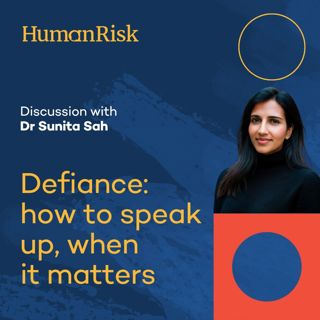
Dr Sunita Sah on Defiance - how to speak up when it matters

Dr Sunita Sah on Defiance - how to speak up when it matters

Why do we follow orders or go along with things that feel wrong? Why might defiance be better than compliance? And how can we go about becoming more defiant?

Episode Summary
I’ve always been fascinated by why people obey, even when it clashes with their instincts or values. In this conversation, I’m joined by Dr Sunita Sah — a physician-turned-organisational psychologist whose work explores the hidden social, cultural, and psychological forces behind compliance.

Drawing from her research and personal journey, Sunita reframes defiance as alignment with our true values, not reckless rebellion. We unpack concepts like “insinuation anxiety” — the discomfort of signalling someone else might be wrong — and explore her five-stage model of defiance, from recognising tension to taking decisive action. Sunita explains why compliance is often mistaken for consent, why both have distinct definitions, and why many of us have never practised saying “no” skillfully.

Along the way, she shares vivid examples from medicine, aviation, parenting, and history, including the calculated defiance of Rosa Parks. For leaders, Sunita offers a challenge: create environments where dissent is safe and effective, and treat defiance as valuable feedback.

For all of us, she suggests starting small — practising low-stakes resistance to build our “defiance muscle.” Whether you’re a rule-maker, rule-follower, or both, this episode invites you to rethink the stories you tell yourself about compliance, and to see saying “no” as a powerful tool for living with integrity.

Guest Bio Self-Description:
Dr Sunita Sah is a physician-turned-organisational psychologist and Professor of Management Studies at Cornell University. Her research examines the social, organisational, and psychological forces that influence decision-making, particularly in contexts involving authority, conflicts of interest, and ethical dilemmas.

She is the author of Defy: The Power of No in a World That Demands Yes (US title: Defy: How to Speak Up When It Matters), a book that reframes defiance as a vital life skill.

AI-Generated Timestamped Summary
[00:00:00] Opening & why we obey even when it feels wrong
[00:02:00] Sunita’s career journey: medicine to organisational psychology
[00:05:00] Personal experiences shaping her research
[00:07:00] Redefining compliance vs. consent
[00:10:00] The five elements of informed consent
[00:11:00] Introducing “insinuation anxiety”
[00:14:00] High-stakes and low-stakes examples of silence
[00:18:00] Why people resist defiance — lack of skill and practice
[00:20:00] New definition of defiance as value alignment
[00:23:00] Tension as the first stage of defiance
[00:25:00] Stage 3: asking clarification questions
[00:27:00] Scripts for skilful defiance
[00:30:00] Practising in low-stakes situations
[00:33:00] Speaking up for others vs. for oneself
[00:36:00] Defiance as a skill, not a personality
[00:38:00] Calculating safety and effectiveness of defiance
[00:41:00] Costs of compliance vs. costs of defiance
[00:44:00] Clarifying values to lower stress and improve integrity
[00:46:00] Leadership responsibility for safe dissent
[00:48:00] Performative vs. genuine speak-up systems
[00:50:00] Defiance as contagious behaviour
[00:52:00] The role of mischief and playful resistance
[00:56:00] Saying yes when the world expects no
[00:58:00] Advice for compliance officers and leaders
[01:00:00] Upcoming courses on defiance and decision-making

Links
Sunita's website: https://www.sunitasah.com
Defy: The Power of No in a World That Demands Yes — https://www.sunitasah.com/defy

Sunita's Cornell University faculty profile — https://www.johnson.cornell.edu/faculty-research/faculty/sunitasah/


Tämä jakso on lisätty Podme-palveluun avoimen RSS-syötteen kautta eikä se ole Podmen omaa tuotantoa. Siksi jakso saattaa sisältää mainontaa.

Jaksot(368)

Gabriella Braun on Human Risk At Work

Gabriella Braun on Human Risk At Work

What happens when we bring all of ourselves to work? That’s not something we do by choice. As my guest on this episode, Gabriella Braun, explains, we can’t leave part of ourselves at home when we go t...

21 Tammi 20231h 5min

Professor Sander van der Linden on Misinformation

Professor Sander van der Linden on Misinformation

Why do people fall for misinformation, and what can we do to prevent it? On this episode, I’m speaking to Professor Sander van der Linden of Cambridge University. He’s the author of a new book called ...

14 Tammi 20231h

Paul Armstrong on Technology, Behaviour & Data

Paul Armstrong on Technology, Behaviour & Data

What do technology, behaviour and data have in common? My guest, Paul Armstrong, runs a conference called TBD and is a thought leader in how the three topics interconnect. As technology becomes smarte...

7 Tammi 20231h 5min

Kirsten Morehouse on Stereotypes

Kirsten Morehouse on Stereotypes

How can stereotypes — particularly those relating to gender and ethnicity — drive us to draw the wrong conclusions? If I say the word American, you’re more likely to think of a white person. If I say...

30 Joulu 20221h 6min

Jon Worth on Rail Activism

Jon Worth on Rail Activism

What is Rail Activism? My guest, Jon Worth, is a proponent of Cross Border Rail within Europe. On this episode, I’m exploring why Jon thinks this is important and how he’s getting his message across...

23 Joulu 20221h 13min

Hilary Sutcliffe on Trust

Hilary Sutcliffe on Trust

What do we mean when we say we trust a person or an organisation? It’s a word we use a lot that we intuitively understand. Trust plays a vital part in how we interact with others. If we trust someone,...

19 Joulu 202258min

Professor Aaron Ahuvia on Why We Love Things

Professor Aaron Ahuvia on Why We Love Things

Why is it that when we really like an object, brand or activity, we say that we ‘love’ it? How can we fall in love with brands, things and experiences?I’m an Apple fanboy, I love my Peloton bike, and ...

12 Joulu 20221h 3min

David Robson on The Expectation Effect

David Robson on The Expectation Effect

How do our expectations impact our experiences? More than you might think. On this very special episode of the Human Risk podcast, I’m speaking with David Robson, author of ‘The Expectation Effect’.Jo...

2 Joulu 202254min

Suosittua kategoriassa Tiede

rss-mita-tulisi-tietaa
rss-poliisin-mieli
tiedekulma-podcast
docemilia
rss-tiedetta-vai-tarinaa
utelias-mieli
rss-duodecim-lehti
rss-totuuden-liepeilla
university-of-eastern-finland
filocast-filosofian-perusteet
rss-duokkari-ekstra
rss-laakaripodi
rss-lapsuuden-rakentajat-podcast
rss-lihavuudesta-podcast