
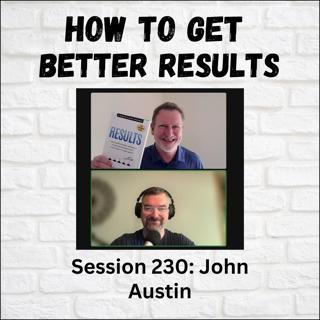
How to Get Better Results: Session 230 with John Austin
Today's guest is Dr. John Austin, who has been in the OBM trenches as a student, professor, and frontline consultant for over 20 years. Before continuing with the usual opening remarks, I'm going to make a rare ask of you. Two asks actually. This is perhaps one of the most actionable podcasts I've published. If you listen to this show and act on some of the suggestions, you can improve your practice right away. And that's not hyperbole. So the first ask is to make sure you listen to the show in its entirety, and go to reachingresults.com/results-toolkit for additional support. The second ask is that you take a few minutes and share this episode with friends and colleagues. In your workplace, you might even consider discussing this episode, and more importantly, John's book Results: The Science-Based Approach to Better Productivity, Profitability, and Safety, in your staff meetings. In this episode, we cover: The evolution of OBM practice over the last few decades. Why OBM consulting in ABA organizations can be more difficult than other settings. How to form better relationships with the people you work with. Ways to pinpoint and measure your interactions with colleagues and supervisees. The importance of asking questions. Agreeing on, instead of setting expectations. Why the book Atomic Habits irks me. John's conceptualization of Burnout and Psychological Safety. What is a Mastermind, and why might you consider joining one. Other resources mentioned include: The Fearless Organization by Amy Edmonson. Building a Psychologically Safe Workplace, a TedTalk by Amy Edmonson. Teaching Employees How to Receive Feedback: A Preliminary Investigation (Ehrlich et al., 2020). ABA on Reddit here and here. Radical Candor: Fully Revised & Updated Edition: Be a Kick-Ass Boss Without Losing Your Humanity by Kim Scott. HBR article: Good Leadership Is About Asking Good Questions. John's interview with Dr. Paulie Gavoni. My interview with Dr. Aubrey Daniels. Rapid Change: Immediate Action for the Impatient Leader, by Joe Laipple. This podcast is brought to you by: Behavior University. Their mission is to provide university quality professional development for the busy Behavior Analyst. Learn about their CEU offerings, including their 8-hour Supervision Course, as well as their RBT offerings over at behavioruniversity.com/observations. And check out the Leadership CEU I mentioned here. ACE Approved CEUs from .... Behavioral Observations. That's right, get your CEUs while driving, walking your dog, doing the dishes, or whatever else you might have going on, all while learning from your favorite podcast guests!
16 Kesä 20231h 31min
Fifty Years in Behavior Analysis: Session 229 with Jose Rios
This is a conversation I've really been looking forward to sharing with you. Jose Rios is a legend in our field, particularly if you're a behavior analyst in California, where he's based out of. In this conversation, Jose recounts his more than 50 year career in providing ABA services to individuals with developmental disabilities. We cover the following: How he got started in the field at the tender age of 17. What the field of ABA was like in the early 70s. What it takes to provide amazing experiences for group home residents and staff. The founding of the Latino Association for Behavior Analysis. The evolution of behavior support plans over the years. Jose's intense mentoring program. What makes for good presentations. Jose is an avid reader, and we spent almost a half hour talking about our favorite fiction authors before hitting the record button. In the interview itself however, we do mention a few books and other resources that are more pertinent to the topic of Behavior Analysis, including: The various works of Dr. Gary LaVigna. The various works of Dr. John Lutzker. Teaching dating skills to individuals with disabilities (Cuvo et al., 1985). Vollmer et al. (1992). A content analysis of written behavior management programs. Resonate, by Nancy Duarte. Presentation Zen: Simple Ideas on Presentation Design and Delivery (Voices That Matter) 3rd Edition, by Garr Reynolds. The Last Lecture, by Randy Pausch. The Supervisor's Guidebook: Evidence-Based Strategies for Promoting Work Quality and Enjoyment Among Human Service Staff, Reid & Parsons. This conversation is like a lesson in the history of Applied Behavior Analysis, and I hope you enjoy it as much as I did. This podcast is brought to you by: ACE Approved CEUs from .... Behavioral Observations. That's right, get your CEUs while driving, walking your dog, doing the dishes, or whatever else you might have going on, all while learning from your favorite podcast guests! HRIC Recruiting. Barb Voss has been placing BCBAs in permanent positions throughout the US for just about a decade, and has been in the business more generally for 30 years. When you work with HRIC, you work directly with Barb, thereby accessing highly personalized service. So if you're about to graduate, you're looking for a change of pace, or you just want to know if the grass really is greener on the other side, head over to HRIColorado.com to schedule a confidential chat right away.
8 Kesä 20231h 37min
From Clinician to Leader: Apollo CSS 8 with Kristen Vaughn
The Apollo Case Study Series returns with a conversation that many Behavior Analysts will likely resonate with. In this episode, I speak with Kristen Vaughn, Vice President of Clinical Operations of Apollo Behavior. We discuss her career arc, and focus on her transition from providing mainly clinical services to her current role in executive management. We cover her early clinical experiences, what it's like to get direct and perhaps difficult to hear feedback, the challenges of letting go of clinical duties, and what it's like to work with a leadership coach. If you're a BCBA, or an aspiring one, chances are, you'll have to supervise the work of others in some capacity, so there are many great lessons in this episode for you. Related to this, we talked about the book, Motivating human service staff: Supervisory strategies for maximizing work effort and work enjoyment, by Reid and Parsons. It, along with The Supervisor's Guidebook: Evidence-Based Strategies for Promoting Work Quality and Enjoyment Among Human Service Staff, should be considered must-reads for those in supervisory positions. Click here to check out previous Apollo Case Study Series podcasts, and to learn about all the fun employee engagement activities they're up to, follow them on Instagram.
1 Kesä 202356min
Decreasing Social Media Use with Contingency Management: Inside JABA 15
In the 15th installment of the Inside JABA Series, Editor and Chief Dr. John Borrero and I chat with Drs. Lesleigh Stinson and Jesse Dallery about their novel application of a Contingency Management intervention. In this case, they used CM procedures to reduce excessive social media use. Lesleigh is a Postdoctoral Researcher at the University of Florida's Center for Behavioral Economic Health Research, and Jesse is a Professor of Psychology, also at UF. If you're not sure what Contingency Management is, don't worry, Lesleigh and Jesse cover the basics of it in this show. For additional information, you can also check out Jesse's previous appearance on the Inside JABA Series, where he and his colleagues used smartphone mediated technologies in conjunction with CM to reduce cigarette smoking. This is a truly "Under the Dome" paper, and in our discussion of it, we touch on topics that include Internet Addiction, the recent APA Health Advisory on social media use, motivational interviewing, stages of change, and the benefits of single-case designs. This podcast, as with all other Inside JABA Series shows, is available for continuing education. To learn more about that, click here. If you want to subscribe to JABA, click here. We mentioned many resources and studies during this podcast. I've done my best to list them all below: Center for Behavioral Economic Health Research Jesse Dallery's lab: BHaT Lab Reducing problematic social media use via a package intervention (Stinson and Dallery, 2023) APA Health advisory on social media use in adolescence N of 1 collaborative Screen Sanity (great resources for families) A behavior-analytic account of motivational interviewing (Christopher and Dougher, 2009) "I's" on the prize: A systematic review of individual differences in Contingency Management treatment response (Forster et al., 2020) Toward an era of impact of digital contingency management in the treatment of substance use disorders (Dallery et al., 2023) A Preliminary Evaluation of the Effects of a Contingency Management + Deposit Contract Intervention on Problematic Smartphone Use With College Students (Williams-Buttari et al., 2023) Contingency management for smartphone and social media use: a feasibility study (Stanley et al., 2021) The association between social media use and sleep disturbance among young adults (Levenson et al., 2016) How Motivational Interviewing Helps Reduce Alcohol Use Problems in Young Adults: Session 158 with Jim Murphy
25 Touko 20231h 3min
Problemas Pediátricos de la Alimentación: BOP en Español 4 con la Dra Varsovia Hernández Eslava
Problemas Pediátricos de la Alimentación con la Dra Varsovia Hernández Eslava Aunque el tema de este episodio se centra en problemas pediátricos de la alimentación, la Dra Varsovia Hernandez Eslava nos comparte una muy interesante trayectoria profesional y un panorama e historia del análisis de la conducta en México. De aquella mirada inicial pasamos a una nueva panorámica muy detallada de los problemas pediátricos de la alimentación empezando por describir qué son y de ahí a conocer los procesos de evaluación y sus subsecuentes intervenciones. Son importantes los detalles y aclaraciones que la Dra Varsovia nos ofrece acerca del proceso evaluativo como también los varios componentes y etapas durante la intervención (los dejamos con intriga para que lo escuchen con detenimiento). Fue fascinante apreciar todas las sutilezas que un profesional competente considera a nivel clínico y de validez social. Esa importancia de las experiencias supervisadas, el obtener y mantener competencias fue claramente enfatizado. Dado el profesionalismo y responsabilidad que describe la Dra Varsovia para con las partes interesadas, no fue sorpresa escuchar de los altos niveles de adherencia, participación y satisfacción para aquellos que han interactuado con ella en estos contextos. Un modelo para nosotros seguir. Nos deja con la reflexión de buscar mentores y una búsqueda constante por nuevos y más profundos aprendizajes; de ser éticos y humildes. Pediatric Feeding Issues with Dr. Varsovia Hernández Eslava Although the theme of this episode focuses on pediatric feeding problems, Dr. Varsovia Hernandez Eslava shares with us a very interesting professional career and an overview and history of behavior analysis in Mexico. From that initial look, we move on to a new, very detailed overview of pediatric feeding problems, beginning by describing what they are and from there, learning about the evaluation processes and their subsequent interventions. The details and clarifications that Dr. Varsovia suggests that the evaluation process is important, as are the various components and stages during the intervention (we leave you intrigued so that you are prompted to listen carefully). It was fascinating to appreciate all the subtleties that a competent professional considers at a clinical and socially validity level. The importance of supervised experiences, obtaining and maintaining competencies was clearly emphasized. Given the professionalism and responsibility that Dr. Varsovia describes with regard to the relationship with stakeholders, it was not surprising to hear of the high levels of adherence, participation, and satisfaction for those who have interacted with her in these contexts. A model for us to follow. It leaves us with the reflection of looking for mentors and a constant search for new and deeper learning; to be ethical and humble.
22 Touko 20231h 14min
Recognizing Your Personal Biases: Session 225 with How To ABA
In Session 225, Shira Karpel and Shayna Gaunt from How To ABA return to the show to discuss a recent webinar that they provided for their online community (note: see here for their first appearance on the podcast). Their talk discussed code element 1.10, from the Behavior Analysis Certification Board's Ethics Codes for Behavior Analysts. For a quick recap, it reads as follows: 1.10 Awareness of Personal Biases and Challenges • Behavior analysts maintain awareness that their personal biases or challenges (e.g., mental or physical health conditions; legal, financial, marital/relationship challenges) may interfere with the effectiveness of their professional work. • Behavior analysts take appropriate steps to resolve interference, ensure that their professional work is not compromised, and document all actions taken in this circumstance and the eventual outcomes. In the spirit of this code element, Shira and Shayna discuss how they define these biases, and how they can potentially occur in practice. More importantly, they discuss steps for detecting and responding to such biases when they do surface. This podcast will be available for BACB Continuing Education (1.0 Ethics Credits). To learn more about how to obtain, click here. If you want to learn more about the great community that Shira and Shayna are leading, click here. In the meantime, be sure to check out their blog, free resources, and podcast. If you decide to join their community, use the promo code, BOP, when signing up to save on your membership!
15 Touko 202354min
Myths and Misconceptions About Verbal Behavior: Session 224 with Andy Bondy
Many-time guest Dr. Andy Bondy returns to the podcast for a fun chat. Our conversation centered around a recent talk he gave which was titled, "Verbal Behavior: Myths and Misconceptions." What myths and misconceptions are we talking about here? Well, I certainly don't want to spoil the podcast, but we did manage to cover a wide variety of topics, including: PECS' Certified Classroom process. The conceptual rather than data-based nature of the Verbal Behavior book itself. Recall versus recognition. Aided versus unaided communication systems. Selection versus topography-based communication systems. The more subtle aspects of the autoclitic. Whether PECS limits improvised communication. The topic of Matching-to-sample vs. Tacting in PECS. The nature of prompts. Constructional aspects of learning. As many of my chats with Andy have gone, this is a podcast that could've been twice as long. Good news though: we've already scheduled a follow up interview for later on in the summer. If you have questions based on this podcast, perhaps we can feature an "Ask Andy Anything," segment. Keep an eye on the BOP emails for future announcements. Andy grounded his points in many empirical studies (and of course the OG text, Verbal Behavior). I've done my best to capture all of them below: Kuhn's, The Structure of Scientific Revolutions. Potter and Brown (1997). A review of studies examining the nature of selection-based and topography-based verbal behavior. Tincani (2004). Comparing the Picture Exchange Communication System and Sign Language Training for Children with Autism. Tincani et al. (2006). The Picture Exchange Communication System: Effects on Manding and Speech Development for School-Aged Children with Autism. Marckel et al. (2006). A preliminary analysis of teaching improvisation with the picture exchange communication system to children with autism. Chaabane et al. (2009). The effects of parent-implemented PECS training on improvisation of mands by children with autism. Schreibman and Stahmer (2014). A randomized trial comparison of the effects of verbal and pictorial naturalistic communication strategies on spoken language for young children with autism. See here for Andy's previous appearances on the BOP. Find out more about PECS' services, products, and trainings here. The University of Cincinnati Online. UC Online designed a Master of Education in Behavior Analysis program that is 100% online and asynchronous, meaning you log on when it works for you. Want to learn more? Go to online.uc.edu and click the "request info" button. Behavior University. Their mission is to provide university quality professional development for the busy Behavior Analyst. Learn about their CEU offerings, including their 8-hour Supervision Course, as well as their RBT offerings over at behavioruniversity.com/observations. ACE Approved CEUs from .... Behavioral Observations. That's right, get your CEUs while driving, walking your dog, doing the dishes, or whatever else you might have going on, all while learning from your favorite podcast guests!
5 Touko 20231h 8min
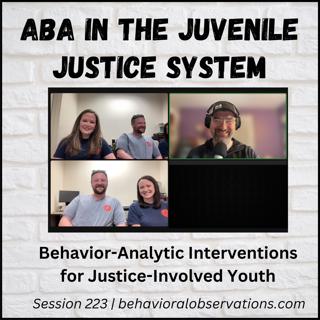
ABA in the Juvenile Justice System: Session 223
This is a fun conversation to share, not only because it involves chatting with three very smart grad students from my alma mater, Auburn University, but also because the topic tackles an issue that is outside of what we might consider the "mainstream" of Applied Behavior Analysis. A few months ago, Ashley Anderson, Daniel Sheridan, and Anna Kate Edgemon reached out to me, and informed me of the great work they're doing supporting justice-involved youth in a juvenile detention setting. As I learned, there is some history of behavior analysts practicing in this area, and these grad students, led by Dr. John Rapp and colleagues, have been developing effective interventions in these settings. And when I say effective, I'm talking about incredibly low recidivism rates... But I'm getting ahead of myself. If this is unfamiliar territory for you, don't worry. We go over enough introductory terms and definitions to get you up to speed straight away. Also, there are some great meta-lessons embedded in this conversation about rapport building, staff training, cultural competence, teaching real-life skills, and more. So even if this specific topic is not your thing, there are parts of this interview that I think will apply to your practice. I left this conversation really inspired by the somewhat untapped potential for our field, and I hope the intervention strategies these guests and their colleagues are publishing become adopted at a much wider scale! This research group has been prolific, and here are some of not only their papers, but others in this space that you might find helpful: Related to Juvenile Justice (History & Review): Morris (1980) Apel & Diller (2017) Children/Persons in Need of Supervision (CHINS). Mack (1909). The Juvenile Court. Auburn's Partnership & Related Research: Luna et al. (2022) Brogan et al. (2018). Sheridan et al. (2023). Bush et al. (in press). Coon et al. (2022). Brogan et al. (2020). Edgemon et al. (2020). What does "War Eagle!" mean? This session of Behavioral Observations is brought to you by the following: How to ABA - their goal is to make you feel supported and confident while helping your clients make real progress! In their membership community, you will find all the assessments, programs, data sheets, and materials you need so that your job is just a little easier. To learn more about their thriving and supportive online community, CEU events, support materials, and more, go to howtoaba.com/join, and use code BOP at checkout to get 10% off a yearly subscription. ACE Approved CEUs from .... Behavioral Observations. That's right, get your CEUs while driving, walking your dog, doing the dishes, or whatever else you might have going on, all while learning from your favorite podcast guests! The University of Cincinnati Online. UC Online designed a Master of Education in Behavior Analysis program that is 100% online and asynchronous, meaning you log on when it works for you. Want to learn more? Go to online.uc.edu and click the "request info" button. Behavior University. Their mission is to provide university quality professional development for the busy Behavior Analyst. Learn about their CEU offerings, including their brand new 8-hour Supervision Course, as well as their RBT offerings over at behavioruniversity.com/observations.
17 Huhti 20231h 20min