
Inside JABA #5: SEAB Statement of Concern Issued for Rekers and Lovaas (1974); Session 135
The latest issue of JABA starts off with an editorial by the Society for the Experimental Analysis of Behavior's (SEAB) board in which it issued a statement of concern for the controversial paper titled, Behavioral treatment of deviant sex-role behaviors in a male child. This paper described a case study conducted by George Rekers and Ivar Lovaas, and was published in the pages of JABA in 1974. To get right to the point, let me read you the editorial's abstract: In an early study in the Journal of Applied Behavior Analysis, Rekers and Lovaas (1974) evaluated the Behavioral Treatment of Deviant Sex-role Behaviors in a Male Child. They investigated the use of reinforcement and punishment to target non-gender conforming behaviors of a 5-year-old male child. This study was considered by some to be controversial and concerning, even near the time of publication (Nordyke et al. 1977; Winkler, 1977). The concerns focused on the ethicality of selecting non-gender conforming behavior as a target response and the use of punishment for this type of response, particularly at the behest of parents when the young child was not seemingly distressed. The study has subsequently been used as empirical support for conversion therapy creating concerns about misinterpretation of the original article and harm to the LGBTQ+ community. This editorial reviews the concerns originally presented by Nordyke et al. and Winkler and issues an official Expression of Concern about the various harms that have been associated with this paper. I first heard about this paper many years ago, but it was to my attention again at the 2019 NH ABA conference. At that event, Dr. Sarah Campeau did a great job reviewing this paper, along with cataloging the devastating effects the study had on the participant later on in his life. So in this episode of the podcast, Drs. Linda Leblanc and Henry Roane discuss the rationale behind the statement of concern. In doing so, they talk about why the statement was written now versus earlier in the history of JABA, and what exactly a Statement of Concern is, and why issuing the statement was the specific action taken instead of other options, such as retracting the paper altogether. We also get into the actual shortcomings of the study, particularly in light of the ethical and moral standards of modern times. Linda and Hank close the podcast by giving some advice for practitioners on how to respond to concerns of stakeholders if or when they bring up this or other studies that are not consistent with more modern ethics and values. I should also note that our Zoom connection was spotty here and there, and I apologize if it interferes with the audio quality that you've come to expect from the show. That said, I don't think it poor connection detracted from the substance of the conversation. Dr. Roane is a new voice in the Inside JABA Series, so by way of introduction, Hank is the Gregory S. Liptak MD Professor of Child Development in the Department of Pediatrics at Upstate Medical University in Syracuse NY. In this capacity, he serves as the Chief of the Division of Development, Behavior and Genetics where he directs medical and behavior analysis clinics that provide treatment services for children affected by autism and related disorders. Hank is also the Chair of the Behavior Analysis Studies program in the College of Health Professions at Upstate. As we mention during the conversation, Hank is also the Treasurer of SEAB. In keeping with the previous Inside JABA Series podcasts, there are no ads or sponsors on this episode. However, this episode is eligible for BACB Continuing Education. We also felt that the conversation touched on many code elements in the Professional and Ethical Compliance Code, and as such, it can be counted as an Ethics CEU. Lastly, 50% of the proceeds from sales of the Inside JABA Series CEUs are donated to SEAB. So for more information on the Inside JABA Series CEUs, or any other CEUs that are available through Behavioral Observations, click here. I've also set up a Link Tree across all my social media platforms where you can access all the different podcast offerings, including episode shownotes. For example, if you follow the show on Instagram (@behavioralobservations), just go to the link in the bio, and you'll have many podcast-related links at your fingertips. Here are the links to the resources that were discussed in this episode: Editor's Note: Societal changes and expression of concern about Rekers and Lovaas' (1974) Behavioral Treatment of Deviant Sex‐Role Behaviors in a Male Child. The Rekers and Lovaas (1974) study. Nordyke, Baer, Etzel, and LeBlanc (1977), response to Rekers and Lovaas. Winkler (1977), response to Rekers and Lovaas. Rekers' response to Nordyke et al. and Winkler (1977). The Anderson Cooper four-part expose on the long term effects on the participant in Rekers and Lovaas. Committee on Publication Ethics (COPE) website. Retraction Watch. CEU opportunities from Behavioral Observations. BOP linktr.ee (clearinghouse of podcast-related links).
22 Loka 202055min
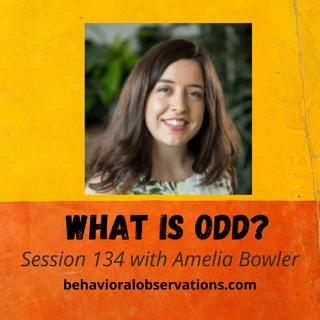
What is Oppositional Defiant Disorder? Session 134 with Amelia Bowler
Amelia Bowler, author of The Parent's Guide to Oppositional Defiant Disorder: Your Questions Answered, joins me in Session 134 to talk about her work and personal experiences in supporting individuals with ODD. In this podcast, Amelia demystifies the term ODD and distinguishes it from other emotional/behavioral disorders. She also discusses the importance of developing relationships with individuals with ODD prior to applying first/then or if/then contingencies. We finish the show by discussing some strategies that may be more successful for individuals with ODD, as well as provide suggestions for further reading. Here are the links to the resources that were discussed: Amelia's aforementioned book*. Amelia's website, AmeliaBehaviour.com. ADHD Does Not Exist: The Truth About Attention Deficit Hyperactivity Disorder*, by Richard Saul. Patterson (1982). Coercive Family Process*. Russell Barkley website (ADHD resource). Emotion Coaching (Gottman Institute). Optimistic Parenting* by Mark Durand. Neurotribes: The Legacy of Autism and the Future of Neurodiversity* by Steve Silberman. Ross Greene's appearance on The Controversial Exchange. Additude.com (ADHD resource site). Tiltparenting.com (another parenting website). Mona Delahooke (another blog/popular press resource, the book Amelia mentioned here*). Rundown of the Stillface Experiment (short video here). Session 134 is brought to you by the following sponsors: Behavior University. Their mission is to provide university quality professional development for the busy Behavior Analyst. Learn about their CEU offerings, including their brand new 8-hour Supervision Course, as well as their RBT offerings over at behavioruniversity.com/observations. Gateway Learning Group, and their Autism Leadership Academy. Designed for new Regional Directors, the Autism Leadership Academy develops motivated BCBAs into successful leaders in the autism field. If you're interested in running your own regional center and want to learn the skills to do so successfully, check out gatewaylg.com/BOP. Market Your ABA Practice Like a Pro: A Digital Marketing Masterclass with Rich Brooks. That's right, our favorite marketing guru, Rich Brooks and I are teaming up for a fantastic learning opportunity. During this event, you'll discover marketing strategies that will allow you to get your ABA practice get in front of ideal stakeholders. Rich and I are still working out the details and I'll have a site to direct you to shortly. What I can tell you is that you're going to want to block off some time on November 9th. *denotes Amazon Affiliate link
16 Loka 20201h 10min
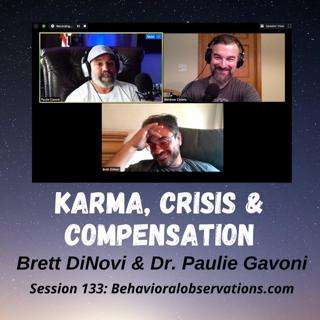
Karma, Crisis, and Compensation: Session 133 with Brett DiNovi and Paul Gavoni
Behavioral Karma: The 5 Scientific Laws of Life and Leadership* is the book that was just recently published by Brett DiNovi and Dr. Pauli Gavoni. In this episode, we talked about what these five laws are, and how one can apply them to just about anything in life, and see positive outcomes as a result. Because both of these gentlemen are previous guests on the show, we started off by catching up a bit. Paulie talked about joining up with Brett's company, Brett DiNovi and Associates, and Brett talked about how he and the rest of the folks at BDA responded to the challenges brought on by the coronavirus pandemic. I also had a chance to pick their brains on a topic that I'm fascinated with: Compensating employees in a Pay-for-Performance model, an idea pioneered by William Abernathy (you can find all the books he wrote on this topic here*). All and all, this was a fun and wide ranging discussion, and I think listeners will be able to get some neat takeaways from it. Here are some links to some of the things that came up in conversation: Brett's first appearance on the show. Pauli's first appearance on the show. Hoosier Association for Behavior Analysis. BDA's YouTube Channel, Behavioral Karma. The Behavioral Karma Podcast, hosted by Billy Brown and Paulie Gavoni. Fighting Words in ABA (Pauli's article on BSci21.org). Pauli's LinkedIn page. Brett's LinkedIn page. The Performance Diagnostic Checklist (Carr et al., 2013). Brett's interview of me at HABA 2018. Today's episode is brought to you by the following: If you want to study ABA and Positive Behavior Supports at a top-notch setting in Europe, then look no further than the Tizard Center at the University of Kent. Since 1986, they've been training professionals to support individuals with disabilities. Their primary focus has always been promoting values-based and ethical approaches to supporting people with intellectual and developmental disabilities. If you would like to learn more about ABA and PBS training on an international stage, check out www.tizard.org. HRIC Recruiting. Barb Voss has been placing BCBAs in permanent positions throughout the US for just about a decade, and has been in the business more generally for 30 years. When you work with HRIC, you work directly with Barb, thereby accessing highly personalized service. So if you're about to graduate, you're looking for a change of pace, or you just want to know if the grass really is greener on the other side, head over to HRIColorado.com to schedule a confidential chat right away. And while I'm promoting the stuff on my website, I'd be remiss if I didn't mention the membership program. Think of it as a DIY Patreon… Members get access to a private FB group in which they are able to get nearly instantaneous access to the videos of these podcast interviews. For example, this interview has been available to members for two months. Members get the raw feed. That means no ads, and none of these introductory comments. You just get right to the interview. Another cool thing we do is hold Zoom Hangouts with former guests so where you can interact with them directly. For more information, check out behavioralobservations.com/membership.
7 Loka 20201h 8min
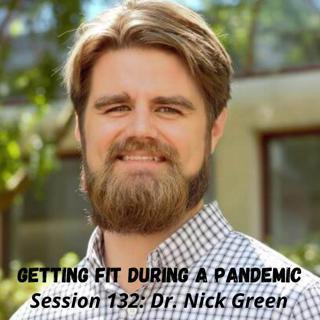
Getting Fit During a Pandemic: Session 132 with Nick Green
Dr. Nick Green joins me in Session 132 for his third appearance on the show. In this episode, we discuss: How he responded to being furloughed for a few months. His contributions to Covid-19 research at the University of Florida. Nick's general principles on how he helps clients develop and accomplish fitness goals. How to overcome barriers to fitness, especially when gyms are closed. What are some basic movement patterns that people should train. Some of the great results his fitness clients are seeing. His advice on wearable tech and other methods for collecting fitness analytics. How to think about time allocation so busy people can still meet their fitness goals. How to incorporate health and fitness into a comprehensive ABA program. What steps Behavior Analysts can take to begin work in the health and fitness industry. We also took questions submitted by members of The Behavioral Observations Membership Program. Here are the links to the stuff we talked about: The BehaviorFit homepage. Hell in a Bucket reference (tunes from a simpler time). Dr. John Lednicky from the U. of Florida (Covid-19 researcher Nick worked with). Nick's infographic on the 7 Functional Movements. Silver Sneakers (online fitness program for 65+ people). Onnit Academy (online instructional videos). The Daily Burn (another online instruction site). BehaviorFit on Instagram. Nick's earlier appearances on the BOP. The Whoop Strap (still not a sponsor, but I'm open to it ;-). Nick's podcast, BehaviorFit Radio. Used sporting goods store, Play it Again Sports. My favorite music education YouTube channel. Bannerman, et al (1990). Balancing the right to habilitation with the right to personal liberties: the rights of people with developmental disabilities to eat too many doughnuts and take a nap. Session 132 is brought to you with the support of the following sponsors: Behavior University. Their mission is to provide university quality professional development for the busy Behavior Analyst. Learn about their CEU offerings and podcast-specific discounts over at behavioruniversity.com/observations. The ABA Marketing Minute with Rich Brooks. Digital marketing guru and two-time guest Rich Brooks and I have teamed up to provide listeners with 60-second micro-lessons in digital marketing. You'll hear the first installment later in this broadcast, so I won't spoil it here, but let's just say the message should parallel a lot of what we should strive for in our clinical practice. If you're interested in marketing your practice on social media or Google, or if you want to give your website a makeover, I highly recommend working with Rich and his awesome team over at Flyte New Media. And while I'm promoting the stuff on my website, I'd be remiss if I didn't mention the membership program. Think of it as a DIY Patreon… Members get access to a private FB group in which they are able to get nearly instantaneous access to the videos of these podcast interviews. For example, this interview has been available to members for two months. Members get the raw feed. That means no ads, and none of these introductory comments. You just get right to the interview. Another cool thing we do is hold Zoom Hangouts with former guests so where you can interact with them directly. For more information, check out behavioralobservations.com/membership.
29 Syys 20201h 10min
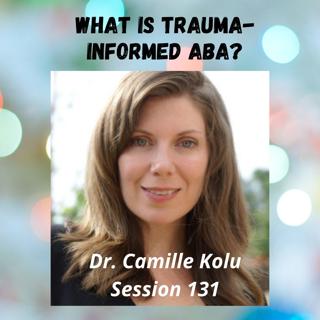
What is Trauma-Informed ABA? Session 131 with Camille Kolu
Dr. Camille Kolu joins me in Session 131 to provide a primer on all things Trauma, and how this broad area applies to the practice of Behavior Analysis In this interview, Camille talked about how she began working in the area of trauma, what is trauma actually, how she screens for trauma histories, what ABA practices are contra-indicated for individuals with traumatic backgrounds, and so much more. This was an interview that could've gone for at least another hour if time permitted. If you're interested in hearing Camille expand on this topic, I highly suggest checking out the New Hampshire ABA 2020 Conference (disclosure: NHABA is sponsoring this episode). Camille has been a leader in disseminating her work in this area. You can check out her website, cuspemergence.com and browse the dozens of blog posts she's written in the area of Trauma-Informed ABA. If you're like me, and you're interested in taking your knowledge in this area to the next level, she has a series of courses available, and you can find those at cuspemergenceuniversity.com. During our chat, Camille fielded questions from the Behavioral Observations Membership group. The BOP Membership is my DIY Patreon. And lucky for us, Camille has agreed to join the membership for a Zoom hangout, either in late September or early October. Once we get a date nailed down, I'll be sure to share the details via the email list, social media, and so on. Here are the links from Session 131: Cusp Emergence (Camille's main dissemination website). Cusp Emergence University (site for specific courses in T-ABA). Felitti et al, (1998). Relationship of Childhood Abuse and Household Dysfunction to Many of the Leading Causes of Death in Adults: The Adverse Childhood Experiences (ACE) Study. Camille's blog post, Contraindicated Behavioral Procedures After Trauma. Greer, et al. (2008). The emergence of praise as conditioned reinforcement as a function of observation in preschool and school age children. Research in Social Work Practice (journal recommended by Camille to check out). Extinction effects of Renewal, Resurgence, and Reinstatement (described here in Session 125). My interview with Chuck Merbitz. Camille's ABAC/Cambridge Center presentation. This podcast is brought to you with the support of the following sponsors: The 2020 New Hampshire Association for Behavior Analysis Virtual Conference! NH ABA is only a handful of years old, but for a smallish state, our conference has punched above its weight. The 2020 event will be no exception. This year's speaker list includes Drs. Solanday Forte, Deb Grossett, Bridget Taylor, Alyssa Wilson, Camille Kolu, and Emily Sandoz. NH ABA also acknowledges that the Covid-19 pandemic has resulted in financial burdens on many Behavior Analysts, so they've decided to use a values-based registration fee, which means that while there are suggested registration fees, you can participate in the event for a lot less if that's appropriate to your financial situation. For more information, check out nhaba.net, and I hope that you choose to join us virtually on September 26th! HRIC Recruiting. Barb Voss has been placing BCBAs in permanent positions throughout the US for just about a decade, and has been in the business more generally for 30 years. When you work with HRIC, you work directly with Barb, thereby accessing highly personalized service. So if you're about to graduate, you're looking for a change of pace, or you just want to know if the grass really is greener on the other side, head over to HRIColorado.com to schedule a confidential chat right away.
14 Syys 20201h 9min
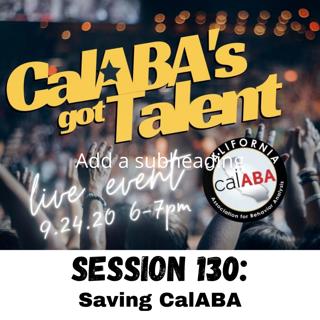
Saving CalABA: Session 130 with Jennifer Harris and Greg Elsky
I've never attended CalABA. In fact, I've never even set foot in the state. And while I live all the way across the country, I recognize the importance of Behavior Analysts banding together to advocate for our clients, our communities, and of course, our profession. When CalABA had to cancel their conference in response to the Covid-19 pandemic, the timing was such that they were not able to recoup the costs associated with hotel reservations, conference venues, and the like. The amount of money CalABA lost from this "black swan" type of event was staggering. In this podcast, Drs. Jennifer Harris and Greg Elsky take us behind the scenes of the events from the ill-fated CalABA 2020 conferecne. Specifically, we talk about what it was like leading up to the scheduled conference itself during the infancy of the Covid-19 pandemic, how they learned they had to cancel the event, what it was like to share this news with the attendees who were streaming into the venue, and we talk at length about the devastating financial consequences of cancelling the event. We also talk about how CalABA can overcome such a difficult situation with their current fundraising campaign. To be candid, without an influx of cash, CalABA's ability to advocate on behalf of the field in the nation's most populous state will be seriously jeopardized. Moreover, legislation that negatively affects the practice of Behavior Analysis in California has the potential to influence other states and provinces. Based on these factors, I will be supporting CalABA in their fundraising efforts. The Covid crisis has hit many of us in the wallet (myself included), however if you have the means to do so, please consider donating to what I believe is a worth cause.
10 Syys 202040min
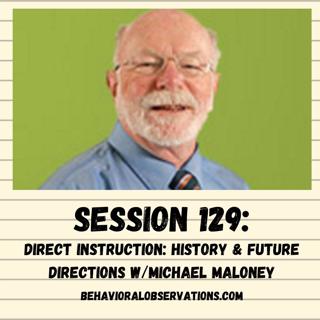
Direct Instruction for Teaching Reading and Math: Session 129 with Michael Maloney
It's back to school time for children, and in this day and age, school is looking a bit different than it has historically. In my neck of the woods, school districts are reopening with a few different models ranging from fully online/remote, hybrid in-person/remote, and full in-person instruction. It's hard to tell what impact this might have on our children's ability to learn the basics, and it is with this in mind that I'm grateful to have Michael Maloney on the show to talk about his 40+ years of experience using Direct Instruction and Precision Teaching. In this podcast, we discuss the history of Direct Instruction (DI; also, see Project Follow Through Outcome data below), including the simultaneously fascinating and tragic story of Project Follow Through, how Michael learned about DI and applied it not only to school settings but also in the context of remediating adult illiteracy, his initial forays into running his own educational centers, as well as the instructional software solutions he's developed. Michael was also kind enough to field some questions from the Behavioral Observations Members. Michael has also been generous enough to give away free instructional materials, so if this is something you're interested in, check out the site, maloneymethod.com. Here are some of the resources we discussed: Some background on Project Follow Through. Roger Bacon Academy (charter school implementing Direct Instruction). Michael's website, MaloneyMethod.com. Free educational resources. Michael's DailyBA appearance. Michael's appearance on The Controversial Exchange. Michael's book, Teach Your Children Well. Cyberslate (instructional software). The BOP Membership Program. PROJECT FOLLOW THROUGH OUTCOME DATA Huge thanks to the following sponsors for this episode!!! The 2020 New Hampshire Association for Behavior Analysis Virtual Conference! NH ABA is only a handful of years old, but for a smallish state, our conference has punched above its weight. The 2020 event will be no exception. This year's speaker list includes Drs. Solanday Forte, Deb Grossett, Bridget Taylor, Alyssa Wilson, Camille Kolu, and Emily Sandoz. NH ABA also acknowledges that the Covid-19 pandemic has resulted in financial burdens on many Behavior Analysts, so they've decided to use a values-based registration fee, which means that while there are suggested registration fees, you can participate in the event for a lot less if that's appropriate to your financial situation. For more information, check out nhaba.net, and I hope that you choose to join us virtually on September 26th! My friends at Praxis CET have two great ACT and RFT classes coming up that seem really cool (Understanding and Using Relational Frame Theory for Behavior Analysts with Drs. Siri Ming and Tom Szabo and Acceptance and Commitment Therapy with Parents with Drs. Lisa Coyne and Evelyn Gould). These are live, online courses, where participants can ask questions, get feedback, etc... on the spot. For more information, go to www.praxiscet.com/bopod. If you check it out and decide to enroll, use the code OBSERVATIONS to save some $$$ at registration. Two-time guest and digital marketing guru Rich Brooks dropped another 60-second lesson for ABA Business Owners. In this installment of the ABA Marketing Minute, Rich Brooks talks about how to get your business to rank highly for local search results in Google. If you are interested in a free 30-minute webinar on building an effective website for your practice, check out takeflyte.com/abaminute!
4 Syys 20201h 16min
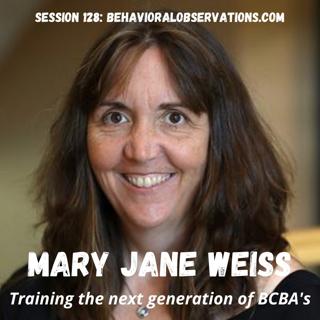
Training the Next Generation of BCBA's: Session 128 with Mary Jane Weiss
Dr. Mary Jane Weiss joins me in Session 128 to talk about the evolution of the practice of Applied Behavior Analysis. This is the second interview that was recorded live during the virtual Behavior Analyst Leadership Council Conference that was held in April 2020. Mary Jane's accomplishments in the field are too great to list here in their entirety, but this bio-sketch should give you a bit of background: Dr. Mary Jane Weiss is a Professor at Endicott College, where she serves as the executive director of programs in ABA and autism, and as director of the Ph.D. program in ABA. Dr. Weiss has worked in the field of ABA and Autism for over 30 years. She received her Ph.D. in Clinical Psychology from Rutgers University in 1990. She previously worked for 16 years at the Douglass Developmental Disabilities Center at Rutgers University, where she served as Director of Research and Training and as Clinical Director. She serves on the Scientific Council of the Organization for Autism Research, is on the Board of Advisors for the Cambridge Center for Behavioral Studies, and is a regular reviewer for a variety of professional journals. She is a frequent member of service committees for the Behavior Analyst Certification Board, including many years of service on Disciplinary Review Committees and serving as the inaugural chair of the Code Compliance Committee for the Professional and Ethical Compliance Code. Dr. Weiss authored the Ethics Corner column for APBA for over two years. She is a Past President of the Autism Special Interest Group of ABAI, a former member of the Board of the APBA, and a former Board Vice President for Autism New Jersey. In this podcast, we discuss what ABA practice was like as she came up in her training and early career, and trace that arc up to what she's doing these days as the Executive Director of Programs in ABA and Autism at Endicott College. We also discuss what Mary Jane would do to change the training of new BCBA's if she had that proverbial magic wand, why she really likes teaching online, what makes for good instructional design, how to improve the quality of ABA training, why it's important to have a broad philosophical and conceptual background in Behavior Analysis, how to work well with other professions, and her thoughts on the Autism-centric perception of our profession. And if you listen to any part of the podcast at all, be sure to listen to her closing advice for BCBA's of all experience levels. In short, if you're interested in where our field is going, this is the podcast for you. During our conversation, we discussed the following resources: Let Me Hear Your Voice, by Catherine Maurice. Oliver, Pratt, and Normand (2015). A survey of functional behavior assessment methods used by behavior analysts in practice. LaFrance, et al., (2019). Multidisciplinary Teaming: Enhancing collaboration and increased understanding. ASHA position statement on Rapid Prompting Methods. ASHA position statement on Facilitated Communication. I'd like to thank long-time listener Jim from Colorado, for helping me prepare for this interview, the BALC for making this opportunity happen, and the following sponsors: The 2020 New Hampshire Association for Behavior Analysis Virtual Conference! NH ABA is only a handful of years old, but for a smallish state, our conference has punched above its weight. The 2020 event will be no exception. This year's speaker list includes Drs. Solanday Forte, Deb Grossett, Bridget Taylor, Alyssa Wilson, Camille Kolu, and Emily Sandoz. NH ABA also acknowledges that the Covid-19 pandemic has resulted in financial burdens on many Behavior Analysts, so they've decided to use a values-based registration fee, which means that while there are suggested registration fees, you can participate in the event for a lot less if that's appropriate to your financial situation. For more information, check out nhaba.net, and I hope that you choose to join us virtually on September 26th! My friends at Praxis CET have two great ACT and RFT classes coming up that seem really cool (Understanding and Using Relational Frame Theory for Behavior Analysts with Drs. Siri Ming and Tom Szabo and Acceptance and Commitment Therapy with Parents with Drs. Lisa Coyne and Evelyn Gould). These are live, online courses, where participants can ask questions, get feedback, etc... on the spot. For more information, go to www.praxiscet.com/bopod. If you check it out and decide to enroll, use the code OBSERVATIONS to save some $$$ at registration. Behavior University. Their mission is to provide university quality professional development for the busy Behavior Analyst. Learn about their CEU offerings and podcast-specific discounts over at behavioruniversity.com/observations.
28 Elo 202050min