256. Maggie losing it

256. Maggie losing it

Having looked last week at how Maggie Thatcher was running out of options for how to carve out a new role for Britain on the world stage, this week we look at how things were going at home. After all, she’d won a second landslide Commons majority in 1987, and that ought to be enough for anyone to shape politics to their wishes.

Well, it turned out not be that easy. Though it didn’t go far at this time, this was when the first stirrings for devolution, and eventually perhaps even independence, began to emerge in Scotland and Wales. After all, they’d been held together with England in Britain when there was a British Empire, and with that Empire gone, what held them together now?

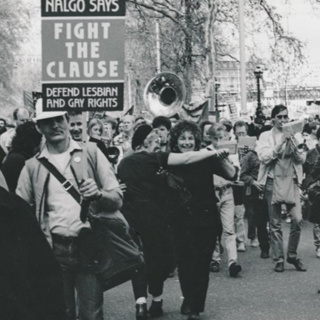
And then there was the crisis over the HIV/AIDS worldwide pandemic. It had led to a surge in homophobia, as many mistakenly labelled the condition ‘the gay disease’. Some Labour-contraolled local councils had reacted by working with organisations from the gay community and even funding some of them. This was repugnant to Thatcher, who shared a widespread view that the family was the bedrock of society, and acceptance of gay lifestyles was a major threat to it. The result was the adoption of what came to be known as ‘Section 28’ banning the ‘promotion’ of homosexuality by local councils or in schools. No prosecution of a local authority under Section 28, but its mere existence and the uncertainty of just what constituted ‘promotion’ put a chill on work to support people suffering discrimination and to encourage safe sexual practices.

Then there was Northern Ireland, and one of the weirder Thatcher initiatives. This was to try to deny terrorist or terrorist-associated organisations what she thought of as ‘the oxygen of publicity’. She banned the broadcasting of the voices of the leaders of these organisations which led to the ludicrous state of affairs where actors were used to repeat the words of those leaders, as though somehow banning the voice mattered more than banning the words.

And then there was the economy. Things were beginning to turn a little nasty with unemployment and inflation both climbing worryingly. One approach favoured by some of Thatcher’s collaborators, notably her Chancellor of the Exchequer, was to ‘shadow’ the German currency, the Deutschemark. Since the Mark had joined the EEC’s Exchange Rate Mechanism, setting exchange rates between European currencies which were only allowed to vary by 6% above or below that rate, Britain was in effect accepting the constraints of the ERM without being a member.

When Lawson realised that advisers to Thatcher inside Downing Street were mocking his approach, he decided that he was being undermined in his work and resigned from the government.

After Michael Heseltine in 1986, this was the second Tory big beast to leave her Cabinet. One loss of a minister might be regarded as a misfortune, two looked like carelessness. A third one would start to look very bad, as we’ll discover next week.

Oddly, after Lawson had gone, to be replaced by his deputy, a man who’d made a remarkably rapid rise through the ranks of the government, John Major, Thatcher allowed herself to be persuaded to take Britain into the ERM. Sadly, because sterling went in at far too high a value, this only limited options for dealing with the worsening economic position.

So, as with foreign affairs, Thatcher was facing shrinking options on the domestic front too.


Illustration: 9 February 1988 Protest against Section 28. Photo by Maggie Honey

Music: Bach Partita #2c by J Bu licensed under an Attribution-NonCommercial-No Derivatives (aka Music Sharing) 3.0 International License


Tämä jakso on lisätty Podme-palveluun avoimen RSS-syötteen kautta eikä se ole Podmen omaa tuotantoa. Siksi jakso saattaa sisältää mainontaa.

Jaksot(275)

266. A time of dodgy dossiers

266. A time of dodgy dossiers

When Tony Blair took Britain to war in Iraq in 2003, as part of a US-led and rather limited coalition of nations, it was against the will of large numbers of Brits expressed in possibly the biggest de...

2 Marras 202514min
265. War in a unipolar world

265. War in a unipolar world

By the latter part of the twentieth century, the world had become unipolar. The Soviet Empire collapsed even more rapidly than the British one had after the Berlin Wall fell in 1989. China was not yet...

26 Loka 202514min
264. Ethics, votes and wars

264. Ethics, votes and wars

We saw in the last episode, that Britain’s involvement in the NATO intervention in Kosovo could be regarded as part of an ‘ethical foreign policy’, since its objective, many felt, was humanitarian, th...

12 Loka 202514min
263. Tragedy at home, ethics abroad

263. Tragedy at home, ethics abroad

Divorce, contrary to what many believe, was not permitted by the Church of England. Henry VIII didn’t divorce two wives, he had the marriages annulled, declaring in effect that they’d never happened. ...

5 Loka 202514min
262. Uncool

262. Uncool

In the early years of Blair’s premiership, his supporters liked to refer to Britain as ‘Cool Britannia’, in a play on the title of the song ‘Rule Britannia’. Last week, we talked about some of the coo...

28 Syys 202514min
261. Cool Britannia

261. Cool Britannia

The Blair government threw itself into action as soon as it was formed.Rather confirming the existence of a deal between them, something they’ve never confirmed, Blair quickly appointed Gordon Brown C...

21 Syys 202514min

260. New Dawn

260. New Dawn

It was a new dawn. Or at least so Tony Blair said, as he emerged from his landslide victory in the 1997 General Election. It’s what he would say, isn’t it?Still, there was some truth to the claim. It ...

14 Syys 202514min

259. Major error, major success, Major’s out

259. Major error, major success, Major’s out

We’re just about ready to move on from John Major but, before we do, we need to spend a few moments on two major events of his second premiership. One was a significant breakthrough, in Ireland, even ...

7 Syys 202514min

Suosittua kategoriassa Historia

olipa-kerran-otsikko
gogin-ja-janin-maailmanhistoria
mayday-fi
huijarit
mystista
rss-ikiuni
totuus-vai-salaliitto
konginkangas
tsunami
rss-i-dont-like-mondays-2
sotaa-ja-historiaa-podi
rss-subjektiivinen-todistaja
rouva-diktaattori
rss-historian-pitka-oppimaara
rss-sattuu-sita-suomessakin
rss-peter-peter
historiaa-suomeksi
maailmanpuu
rss-kirkon-ihmeellisimmat-tarinat
rss-kalmakabinetti