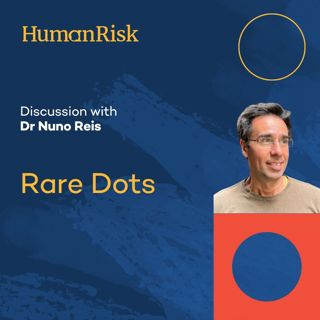
Dr Nuno Reis on Rare Dots

Dr Nuno Reis on Rare Dots

What if the ideas that linger in the back of your mind — the ones you can’t quite explain — are the ones you most need to pay attention to?

Episode Summary
In this episode, I explore that question with Dr Nuno Reis, a former physicist and investment banker turned thinker and guide in uncovering what he calls rare dots — those unique, pre-verbal insights that feel deeply resonant but don’t yet fit into our existing models of the world.

Our conversation begins with Nuno’s unusual career path, from string theory and theoretical physics into financial modelling and risk management, before moving into transparency roles in finance. From there, we trace the thread of his enduring curiosity: how crises drive paradigm shifts, why models are useful but limited, and what happens when we acknowledge that not everything fits into neat rational frameworks.Nuno then introduces the concept of rare dots and explains how he’s harnessing AI in a novel, deeply human way: not to replace thought, but to help us surface the preverbal ideas that shape our uniqueness. Together, we explore how rare dots can guide creativity, meaning, and innovation in our work and lives — and why paying attention to the things that don’t quite make sense may be the most sensible thing we can do.

Guest Biography
Dr Nuno Reis describes himself as a physicist turned banker turned explorer of human thinking. After completing a PhD in theoretical physics with a focus on string theory, he transitioned into investment banking at UBS and later into financial engineering and transparency initiatives at Bloomberg.

Over 18 years in finance, he applied scientific methods to risk modelling, hedging, and complex derivatives, all while maintaining a deep curiosity about the limits of logic and models.

Today, Nuno is the creator of the Rare Dots framework, which helps individuals and organisations uncover the pre-verbal insights that drive creativity and meaning. He combines philosophy, history of thought, and cutting-edge uses of AI to build environments where people can explore their deepest intuitions.

Through workshops, cohorts, and his own practice, he guides others in turning those rare dots into pathways for innovation, purpose, and contribution.

AI-Generated Timestamped Summary
[00:00:00] Introduction and framing of rare dots as preverbal insights
[00:01:00] Nuno’s background: from physics to banking and financial modelling
[00:06:00] Applying scientific methods to markets and the 2008 crisis
[00:12:00] Replication crisis and paradigm shifts in science
[00:18:00] Early story of curiosity and existential questions
[00:21:00] Introduction of rare dots as deeply resonant insights
[00:26:00] How resonance and intuition shape meaning
[00:30:00] Creating environments to surface rare dots
[00:35:00] History of thinking vs history of ideas
[00:40:00] Using AI as a tool for rare dots and Wittgenstein’s ladder
[00:46:00] How AI can surface pre-verbal thinking
[00:52:00] AI as a prompt for deeper human thinking
[00:56:00] Rare dots exploration as an infinite game
[01:02:00] Rare dots as a guide for careers and human value

Links
Nuno on LinkedIn - https://www.linkedin.com/in/nuno-reis/
Nuno's Substack - https://nunobreis.substack.com/

Tämä jakso on lisätty Podme-palveluun avoimen RSS-syötteen kautta eikä se ole Podmen omaa tuotantoa. Siksi jakso saattaa sisältää mainontaa.

Jaksot(368)

Stefan Gaillard on the importance of Trial & Error

Stefan Gaillard on the importance of Trial & Error

Why is it so hard for us to admit mistakes? That's what my guest Stefan Gaillard & I explore in this episode. Stefan is the Editor of The Journal of Trial & Error, a project that seeks to promote the...

18 Marras 20201h 1min

Stuart Tootal & Greg Davies on the lessons for business from military decision-making

Stuart Tootal & Greg Davies on the lessons for business from military decision-making

What can the military teach business? Much as companies often talk about 'wars' (most obviously when it comes to talent) and 'battles' (usually for market share), it's not obvious that the two have mu...

14 Marras 202055min

John Sutherland on mitigating Board Level Human Risk

John Sutherland on mitigating Board Level Human Risk

If you were looking for a sector that had lots of examples of Human Risk, then you'd probably pick banking? And if you were trying to understand why some of the senior people within banking hadn't be...

7 Marras 202058min

Luca Dellanna on Ergodicity: why the way we often view the world, can lead to bad decisions

Luca Dellanna on Ergodicity: why the way we often view the world, can lead to bad decisions

What is ergodicity? If it's a new term to you, then listen to my guest Luca Dellanna explain why ergodic thinking is often at the heart of much of our flawed decision-making. This is Luca's second ap...

29 Loka 20201h 1min

Leanne Spencer on Wellbeing: why it matters & how we can improve it.

Leanne Spencer on Wellbeing: why it matters & how we can improve it.

We often think of our body and our mind as being somehow distinct, yet there is a strong linkage between mental health and physical wellbeing. That's what I explore with my guest Leanne Spencer on th...

27 Loka 202045min

Multi-million selling Singer Songwriter Dr Glenn Medeiros on Human Risk in the Music Industry

Multi-million selling Singer Songwriter Dr Glenn Medeiros on Human Risk in the Music Industry

On this episode, I'm exploring an industry whose product we all sample daily, but probably don't fully understand: music. In the late 1980s and early 1990s, my guest, Dr Glenn Medeiros, was a global ...

22 Loka 20201h

Professor Don Moore on Confidence and how it impacts our decision-making

Professor Don Moore on Confidence and how it impacts our decision-making

We all understand the idea of Confidence and that having it can help us succeed. Equally, not having it can also paralyse us into inaction. So what is the optimal level of confidence?That's what my ...

15 Loka 202051min

Dr Thomas Roulet on Negative Social Evaluations: the science behind the ways we judge each other

Dr Thomas Roulet on Negative Social Evaluations: the science behind the ways we judge each other

We all instinctively know the impact negative reviews have on individuals and organizations; whether TripAdvisor ratings or publicly administered regulatory sanctions. It's not good. Yet there are ma...

8 Loka 202057min

Suosittua kategoriassa Tiede

rss-poliisin-mieli
tiedekulma-podcast
rss-mita-tulisi-tietaa
docemilia
filocast-filosofian-perusteet
menologeja-tutkimusmatka-vaihdevuosiin
rss-duodecim-lehti
rss-tiedetta-vai-tarinaa
sotataidon-ytimessa
rss-lapsuuden-rakentajat-podcast
rss-lihavuudesta-podcast
utelias-mieli
radio-antro
rss-bios-podcast
rss-metsantuntijat-podcast
rss-luontopodi-samuel-glassar-tutkii-luonnon-ihmeita
rss-sosiopodi