Solar Flares and Deep Space Nine with Dr. Jimmy Negus

Solar Flares and Deep Space Nine with Dr. Jimmy Negus

Welcome to the Season 3 premiere of The LIUniverse, your happy half-hour dose of cosmic conversation and geeky banter with host Dr. Charles Liu! In this episode, Chuck and co-host Allen Liu welcome back Dr. Jimmy Negus, who was our guest on our very first episode, to talk about Solar Flares, “Deep Space Nine,” and more.

As some of you may remember, Jimmy was only a PhD candidate back then, with his research focused on active galactic nuclei, including black holes, quasars and more. Now that he’s got his doctorate, Jimmy has pivoted to studying solar physics, which is the perfect lead in to discuss the upcoming Great American Eclipse, the total solar eclipse on April 8, 2024 that has them – and the rest of America – buzzing with excitement.

As always, though, we start off with the day’s “Joyfully Cool Cosmic Thing” – the discovery of a pulsar in a binary system with an unknown and mysterious object that seems to be somewhere between the mass of a neutron star and a black hole by astronomers using the radio telescopes in the MeerKAT array in the South African Radio Astronomy Observatory (SARAO). Jimmy explains that the leading theory may be that it is a smaller mass black hole than we’ve yet observed that was created by the collision of two neutron stars. Special thanks to our friends at the All Things Unexplained podcast (@allthingsunexplained) for bringing today’s JCCT to our attention!

Our first question of the day – and the season! – comes from audience member Makalya, who asks, “What are the chances of having black holes consume each other, becoming giant black holes, and slowly start growing from there?”

Pretty high, it turns out. Dr. Negus explains how we use gravitational waves to deduce the frequency of black hole mergers in the universe. If we look across the entire observable universe, there are between 200,000-400,000 mergers EVERY YEAR! Of course, that includes all types of black holes. If we’re only looking Jimmy estimates only about 10% of that number are collisions of supermassive black holes. And we’ve got a little while before that happens to our supermassive black hole, which will someday collide with Andromeda’s – something on the order of 4 billion years or so.

Moving on, Jimmy tells us about his new gig at The University of Colorado, Boulder, where he stayed on as a research faculty member after getting his PhD. He’s now analyzing, calibrating and validating data from NOAA’s GOES-18 satellite (GOES is a suite of Geostationary, Environmental Operational Satellites, the longest running continuous stream of satellites, first launched in 1974.) In addition to its weather-sensing technology that points down at the Earth, the satellite carries X-ray and UV sensors that point towards the sun to track space weather.

Next up, we turn to the impending Solar Max period of our solar cycle, where the magnetic field of the sun completely flips every 11 years. Jimmy discusses the 2025 peak of the solar cycle, how solar emissions like X-Class Solar Flares can impact us. Charles points out that previous solar maxes have even taken down satellites, and Jimmy describes various ways we work to mitigate the damage from the next flare.

Speaking of which, for our next question Shana asks whether a solar flare can set her phone on fire. Jimmy explains why we’re not in danger here on Earth, thanks to technological advancements, but that a satellite disruption could disrupt service temporarily. He describes the Carrington Event of September 1859 during solar cycle 10, which was the most intense geomagnetic storm ever recorded, and actually caused some telegraph wires to burst into flame.

Finally, Chuck turns our focus to our obsession with science fiction. We revisit “The Expanse,” which Jimmy just finished watching, and while good, “certainly wasn’t a perfect show. It wasn’t “Deep Space Nine,” my favorite.” Chuck posits that Voyager was better, but the two wisely reserve judgment on the new Star Trek shows and sticking with the classics.

If you’d like to keep up with Dr. Jimmy Negus, you can visit his website at www.jimmynegus.com and @spacebound_negus on Instagram.

We hope you enjoy this episode of The LIUniverse, and, if you do, please support us on Patreon.

Credits for Images Used in this Episode:

– Path of the April 8 2024 eclipse through the USA – NASA SVS/ Michala Garrison, Public domain

– Radio telescopes in the MeerKAT array – Square Kilometre Array Organisation (SKAO) / South African Radio Astronomy Observatory (SARAO) CC BY 3.0

– Animation of a Pulsar – NASA SVS, Public domain

– GOES-18 before launch – NOAA Satellites, Public domain

– An X-class flare in 2012 – NASA Goddard Space Flight Center, Public domain

– The Solar Dynamics Observatory before launch – NASA/Jim Grossmann

#theliuniverse #charlesliu #allenliu #sciencepodcast #astronomypodcast #jamesnegus #jimmynegus #universityofcolorado #astronomy #astrophysics #totalsolareclipse #greatamericaneclipse #quasar #blackhole #activegalacticnucleus #agn #theexpanse #deepspacenine #supermassiveblackholes #solarmax #xclasssolarflares #solarcycle #neutronstar #carringtonevent #NOAA #GOES18 #satellite #MeerKAT #southafricanradioastronomyobservatory #SARAO

Tämä jakso on lisätty Podme-palveluun avoimen RSS-syötteen kautta eikä se ole Podmen omaa tuotantoa. Siksi jakso saattaa sisältää mainontaa.

Jaksot(78)

ChuckGPT - Patreon Question Edition

ChuckGPT - Patreon Question Edition

It’s time for the Season 5 finale of The LIUniverse, which means another episode of ChuckGPT where we answer our audience’s most vexing questions – this time via video from our Patreon Patrons. And to...

13 Kesä 38min
Our Weird, Wondrous Universe with Erika Hamden

Our Weird, Wondrous Universe with Erika Hamden

How do distant galaxies form? If you have two distant clouds of hydrogen, why does one turn into a star and another doesn’t? To find out, Dr. Charles Liu and co-host Allen Liu welcome Dr. Erika Hamden...

30 Touko 43min
Ruby Raindrops and Painted Peacocks with Munazza Alam

Ruby Raindrops and Painted Peacocks with Munazza Alam

Are there really exoplanets with where it rains ruby and emerald raindrops? How do we measure the atmospheres of exoplanets light years away? To find out, Dr. Charles Liu and co-host Allen Liu welcome...

16 Touko 45min
Astrophotography with Astronaut Don Pettit

Astrophotography with Astronaut Don Pettit

Can the physics you learned in High School take you to the stars? Who is behind many of your favorite pictures of space? What is it actually like to live and work in space? You might be surprised to k...

2 Touko 47min
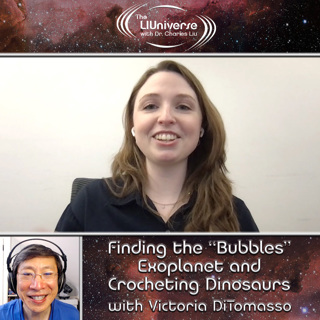
Finding the “Bubbles” Exoplanet and Crocheting Dinosaurs with Victoria DiTomasso

Finding the “Bubbles” Exoplanet and Crocheting Dinosaurs with Victoria DiTomasso

How do we find exoplanets? What is the Milky Way’s “Thick Disk” and what makes it so special? To find out, Dr. Charles Liu and co-host Allen Liu welcome Harvard astronomer Dr. Victoria DiTomasso, who ...

11 Huhti 47min
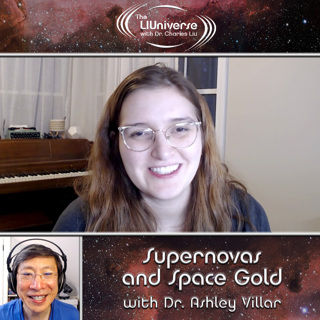
Supernovas and Space Gold with Dr. Ashley Villar

Supernovas and Space Gold with Dr. Ashley Villar

How do stars die? And what happens when they do? To find out, Dr. Charles Liu and co-host Allen Liu welcome Dr. Ashley Villar, who teaches astronomy at Harvard and whose team studies supernovas as the...

21 Maalis 40min
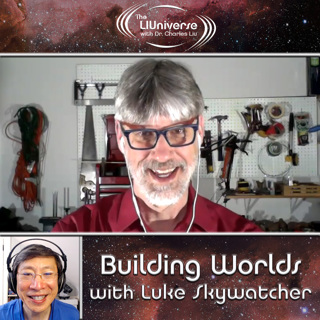
Building Worlds with Luke Skywatcher

Building Worlds with Luke Skywatcher

How do planetary systems form? If you wanted to observe them, where would you look and what would you look for? To find out, Dr. Charles Liu and co-host Allen Liu welcome Luke Keller, professor of Ast...

8 Maalis 43min
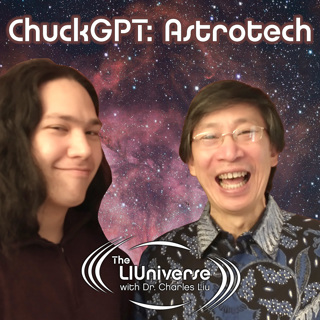
Chuck GPT: Astrotech

Chuck GPT: Astrotech

How can a helicopter fly in space? How does LIGO detect gravitational waves? How do quantum electronic devices like Josephson junctions work? Could AI turn evil and destroy humanity? What about those ...

8 Helmi 55min

Suosittua kategoriassa Tiede

rss-poliisin-mieli
rss-mita-tulisi-tietaa
tiedekulma-podcast
rss-tiedetta-vai-tarinaa
docemilia
rss-duodecim-lehti
rss-lapsuuden-rakentajat-podcast
hippokrateen-vastaanotolla
rss-hereilla
rss-ranskaa-raakana
rss-bios-podcast
utelias-mieli
filocast-filosofian-perusteet
radio-antro