Making Space Accessible with Celene Shimmen

Making Space Accessible with Celene Shimmen

How do you go from a small town in Colorado to being a scientist-astronaut candidate in Australia? And how can you make space accessible for disabled astronauts? To find out, Dr. Charles Liu and co-host Allen Liu welcome scientist-astronaut candidate Celene Shimmen.

As always, though, we start off with the day’s joyfully cool cosmic thing, the new study using the James Webb Space Telescope that disproves the detection of tryptophan, a complex amino acid, in the interstellar cloud IC 348. Or, as Chuck jokes, no sleepy turkeys in space.

Then we get to meet Celene Shimmen, who is a scientist-astronaut candidate in Australia. She’s a physical therapy student who is already putting her research to work in the space industry.

Celene describes how she recently designed and implemented the Lower Extremity Motor Coordination Test in Microgravity for AstroAccess, a project she works with dedicated to promoting disability inclusion in human space exploration by paving the way for disabled astronauts. (You may remember Cady Coleman talking about working with AstroAccess in our recent episode, Sharing Space with Astronaut Cady Coleman, Part 1.

You’ll hear about Celene’s acceptance into the scientist-astronaut training program for suborbital missions with the International Institute of Astronautical Sciences, beginning in 2023. She tells us about her upcoming parabolic flight where she’ll be the principal investigator testing balance differences after acute exposure to weightlessness. Chuck asks whether the “Vomit Comet” is aptly named – Celene explains that she’ll have to let us know, since her upcoming flight will have 16 periods of microgravity.

Our first question comes from Anne, who asks, “What are some psychological or physical traits that make for a good astronaut?” Celene highlights the importance of training for strength, endurance, balance, and cardiovascular fitness, especially for upcoming, long-term missions on the moon. It turns out that while the moon has lower gravity, the encumbrance of spacesuits requires greater strength and endurance. Allen explains that lesser gravity doesn’t mitigate some aspects of force and inertia that also require physical strength.

Celene describes the psychological aspects of being an astronaut, and the need for mental resilience to cope with isolation and stressful situations, as well as problem solving skills and the ability to work as part of a team.

You’ll also find out about Celene’s journey from growing up in a single-wide trailer in a town of 1000 residents in Colorado to studying hospitality in the Disney College Program in Florida, where she met her Australian husband. After watching “First Man”, the movie about Neil Armstrong, Celene decided she wanted to get into the space program. She applied to and was accepted by the Melbourne Space Program, working on a nano-satellite program. She also helped a humanoid robot take its first step, which inspired her to get involved with physiotherapy and the human body in space.

Our next question is from “anonymous”: What part of the human body is most vulnerable in space? Celene explains that extended exposure to microgravity leads to muscle atrophy and bone density loss, which is still a big issue even with ongoing exercise. Even just a 14-day stay in space leaves returning astronauts with muscle weakness.

Finally, we hear about Celene’s desire to be deployed to the moon, should the opportunity arise. Upcoming lunar missions to the moon will likely last about 30 days each, including 7 days of activity on the lunar surface.

If you’d like to reach out to Celene and chat, you can follow her on Instagram @spaceptcelene and on LinkedIn and Facebook as Celene Shimmen.

You can also find out more about AstroAccess here.

We hope you enjoy this episode of The LIUniverse, and, if you do, please support us on Patreon.

Credits for Images Used in this Episode:

– JWST image of IC 348, a star cluster wreathed in dusty gas. – NASA, ESA, CSA, STScI, Kevin Luhman (PSU), Catarina Alves de Oliveira (ESA)

– The different gravity phases during a parabolic flight. – ESA

– 2013 parabolic flight for astronaut trainees on a NASA C-9 aircraft – NASA

– Astronaut Jim Irwin at the Apollo 15 mission’s Hadley-Apennine lunar landing site. – NASA

– Humanoid Robot developed by students in the Melbourne Space Program – University of Melbourne, Australia

– Participants in NASA’s 30-day bed rest study must maintain a six-degree head-down tilt at all times. – NASA

– Concept animation of NASA Artemis astronauts exploring the lunar South Pole. – NASA

#TheLIUniverse #CharlesLiu #AllenLiu #SciencePodcast #AstronomyPodcast #CeleneShimmen #CeleneMerazBenavente #microgravity #weightlessness #AstroAccess #JamesWebbSpaceTelescope #tryptophan #IC348 #spaceexploration #VomitComet #gravity #astronaut #astronauttraining #MelbourneSpaceProgram #physiotherapy #physicaltherapy #muscleatrophy #bonedensityloss #lunarmission #InternationalInstituteofAstronauticalSciences

Tämä jakso on lisätty Podme-palveluun avoimen RSS-syötteen kautta eikä se ole Podmen omaa tuotantoa. Siksi jakso saattaa sisältää mainontaa.

Jaksot(79)

Bonus Episode: The Secret Fortress of Ag-Karrah, Part 1 (Actual Play)

Bonus Episode: The Secret Fortress of Ag-Karrah, Part 1 (Actual Play)

What happens when an astronomer, a mathematician, an educator, a physics student and a biomedical engineer set off to explore the Secret Fortress of Ag-Karrah? You get Part One of this summer’s bonus ...

16 Elo 48min
ChuckGPT - Patreon Question Edition

ChuckGPT - Patreon Question Edition

It’s time for the Season 5 finale of The LIUniverse, which means another episode of ChuckGPT where we answer our audience’s most vexing questions – this time via video from our Patreon Patrons. And to...

13 Kesä 38min
Our Weird, Wondrous Universe with Erika Hamden

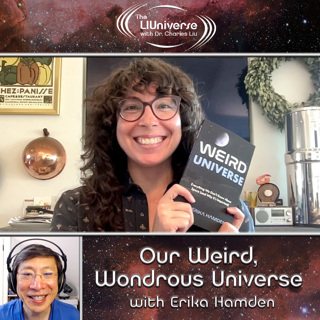
Our Weird, Wondrous Universe with Erika Hamden

How do distant galaxies form? If you have two distant clouds of hydrogen, why does one turn into a star and another doesn’t? To find out, Dr. Charles Liu and co-host Allen Liu welcome Dr. Erika Hamden...

30 Touko 43min
Ruby Raindrops and Painted Peacocks with Munazza Alam

Ruby Raindrops and Painted Peacocks with Munazza Alam

Are there really exoplanets with where it rains ruby and emerald raindrops? How do we measure the atmospheres of exoplanets light years away? To find out, Dr. Charles Liu and co-host Allen Liu welcome...

16 Touko 45min
Astrophotography with Astronaut Don Pettit

Astrophotography with Astronaut Don Pettit

Can the physics you learned in High School take you to the stars? Who is behind many of your favorite pictures of space? What is it actually like to live and work in space? You might be surprised to k...

2 Touko 47min
Finding the “Bubbles” Exoplanet and Crocheting Dinosaurs with Victoria DiTomasso

Finding the “Bubbles” Exoplanet and Crocheting Dinosaurs with Victoria DiTomasso

How do we find exoplanets? What is the Milky Way’s “Thick Disk” and what makes it so special? To find out, Dr. Charles Liu and co-host Allen Liu welcome Harvard astronomer Dr. Victoria DiTomasso, who ...

11 Huhti 47min
Supernovas and Space Gold with Dr. Ashley Villar

Supernovas and Space Gold with Dr. Ashley Villar

How do stars die? And what happens when they do? To find out, Dr. Charles Liu and co-host Allen Liu welcome Dr. Ashley Villar, who teaches astronomy at Harvard and whose team studies supernovas as the...

21 Maalis 40min
Building Worlds with Luke Skywatcher

Building Worlds with Luke Skywatcher

How do planetary systems form? If you wanted to observe them, where would you look and what would you look for? To find out, Dr. Charles Liu and co-host Allen Liu welcome Luke Keller, professor of Ast...

8 Maalis 43min

Suosittua kategoriassa Tiede

rss-poliisin-mieli
tiedekulma-podcast
rss-mita-tulisi-tietaa
rss-tiedetta-vai-tarinaa
docemilia
rss-duodecim-lehti
utelias-mieli
rss-kasvikutsut
rss-astetta-parempi-elama-podcast
radio-antro
rss-hereilla
rss-ammamafia
rss-tervetta-skeptisyytta
hippokrateen-vastaanotolla
rss-ranskaa-raakana
rss-radplus
filocast-filosofian-perusteet
mielipaivakirja
rss-bios-podcast
rss-ylistys-elaimille