The MCC, DFC Deception and Electricity Corruption in Sierra Leone

The MCC, DFC Deception and Electricity Corruption in Sierra Leone

The privatization program in postwar Sierra Leone was supposedly advanced by international financial institutions – the World Bank, IMF, African Development Bank – as a multi-sectoral development strategy aimed at reducing poverty and corruption, and improving economic growth and quality of governance and service delivery in the small West African country.

Since 2005, this World Bank and IMF supported privatization agenda has been called different names by successive regimes in Sierra Leone. Inaugurated by Tejan Kabbah as a "poverty reduction strategy", it was renamed “agenda for change and prosperity” by Ernest Koroma, and now rebranded as a “new direction and medium-term development plan” by Julius Maada Bio. However, its unfulfilled promise remained the same and included the supply of reliable electricity, the creation of value-added agricultural productivity, developing a national transportation network, and sustainable human development through efficient social service delivery.

Twenty years later, this IMF/World Bank privatization agenda in Sierra Leone has produced, and still produces, the reverse of its pronounced objectives. Today in Sierra Leone, more than 90% of the population live in absolute poverty, with expenditures below US$1 a day, according to the IMF. With rising youth unemployment, high infant and maternal mortality rates, poor growth performance, lack of income and access to basic social services, and excessive debt overhangs, the country’s development prospects still remain grim.

Consequently, instead of advancing economic growth and reducing poverty, Sierra Leone’s privatization program has heightened political corruption and led to intensified multinational exploitation. At the heart of this development nightmare is the hidden competition between British financed corporations and United States-backed companies for control of non-transparent service-related contracts and corruptly awarded critical infrastructure projects.

In this episode, we discuss how the British Commonwealth Development Corporation (CDC) and the United States Development Finance Corporation (DFC) used shell companies registered and operating out of British Virgin Islands, Mauritius, Zambia, Lebanon, Turkey, United Arab Emirates, South Africa, Kenya, and elsewhere to impose manufactured debts on Sierra Leone between 2013 and 2023 with the promise of providing reliable electricity that is still unavailable to Sierra Leonean citizens. We highlight how Ernest Bai Koroma and Julius Maada Bio enabled these corrupt energy agreements in the last 15 years, and how various energy and finance ministers of both the All Peoples Congress (APC) and Sierra Leone Peoples Party (SLPP) served as agents for British financed companies and United States-backed corporations in the corrupt use of the privatization program to facilitate state corruption and multinational exploitation.

Thus, we use the ruthless competition between the Commonwealth Development Corporation (CDC) and United States Development Finance Corporation (DFC) over the multimillion dollars non-transparent Western Area Power Generation Project loan agreements involving Blue Flare (BVI), TCQ Power Ltd, CEC Africa Investments Ltd (CECA), Milele Energy, the World Bank, African Development Bank, and other financial institutions to further illustrate how the privatization of social service delivery in Sierra Leone is corruptly enriching multinational companies and the local political elites, while increasing the sovereign debt crisis and worsening living standards for regular citizens.

Hence, the current political and economic crisis in Sierra Leone, including the rigged June 2023 elections, skyrocketing taxes, and ongoing human rights violations, are directly linked to the unscrupulous competition between British companies and American financed corporations to exploit Sierra Leone’s privatization of social service delivery.

This episode is part of the VOICE FROM EXILE commentary series of the Africanist Press.

Tämä jakso on lisätty Podme-palveluun avoimen RSS-syötteen kautta eikä se ole Podmen omaa tuotantoa. Siksi jakso saattaa sisältää mainontaa.

Jaksot(77)

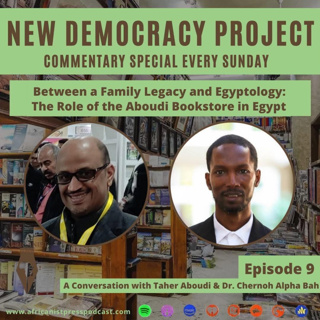
Between a Family Legacy and Egyptology: The Role of the Aboudi Bookstore in Egypt

Between a Family Legacy and Egyptology: The Role of the Aboudi Bookstore in Egypt

This episode examines the Aboudi Bookstore and its role in Egyptology, the scientific and academic study of ancient Egypt. Established in 1909 in Luxor by Egyptologist and tour guide Professor Mohamed...

8 Kesä 20min
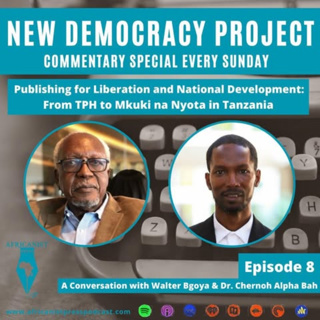
Publishing for Liberation and National Development: From TPH to Mkuki na Nyota in Tanzania

Publishing for Liberation and National Development: From TPH to Mkuki na Nyota in Tanzania

When Tanzania gained independence in 1961, Julius Nyerere saw publishing as a key part of decolonization and nation-building. In 1966, he founded the Tanzania Publishing House (TPH), putting state pub...

1 Kesä 1h 19min

Building a Literary Community: The Work of the Writers Association of the Gambia

Building a Literary Community: The Work of the Writers Association of the Gambia

In this episode, we spotlight the Writers Association of the Gambia and its efforts to build a vibrant literary community, featuring Dr. Cherno Omar Barry, the Association's President, who shares insp...

25 Touko 42min

The Role of Libraries in African Development: A Look at the Gambia National Library Service Authority

The Role of Libraries in African Development: A Look at the Gambia National Library Service Authority

In this episode, we explore how national libraries drive African development. Drawing on insights from Bakary Sanyang, Director General of the Gambia National Library Service Authority, we examine the...

18 Touko 38min

Bookstores in Africa's Nation-Building: The Story of Timbooktoo in The Gambia

Bookstores in Africa's Nation-Building: The Story of Timbooktoo in The Gambia

In this podcast episode, we talk with Ousainou and Kathy Jagne, founders of Timbooktoo Bookstore in Banjul, Gambia. With 28 years of experience running an independent bookstore, they explain how books...

10 Touko 38min

Reimagining New Technology in African Classrooms: A Conversation with Laetitia Musheche

Reimagining New Technology in African Classrooms: A Conversation with Laetitia Musheche

In this episode,  we feature a conversation with Laetitia Musheche, founder of BauHouse Arts Academy, on reimagining new technology in African classrooms and the need to build an all-African-centered ...

5 Touko 48min

Sierra Leone's Tripartite Agreement: A Triangle of Illegality

Sierra Leone's Tripartite Agreement: A Triangle of Illegality

In this episode, we focus on the Tripartite Agreement’s creation of a triangle of illegality, examining how it violated Sierra Leone’s Constitution and public election laws, and its ongoing threat to ...

27 Huhti 41min

Democracy is not a Tripartite Agreement: The APC and SLPP's Undemocratic Politics of Rotating Power

Democracy is not a Tripartite Agreement: The APC and SLPP's Undemocratic Politics of Rotating Power

In this episode, we focus on why the Tripartite Agreement is regarded as illegal, specifically highlighting its legal and political implications. We also analyze how foreign organizations are actively...

20 Huhti 48min

Suosittua kategoriassa Politiikka ja uutiset

uutiscast
aikalisa
ootsa-kuullut-tasta-2
rss-ootsa-kuullut-tasta
rss-podme-livebox
tervo-halme
otetaan-yhdet
aihe
politiikan-puskaradio
rss-vaalirankkurit-podcast
rss-girls-finish-f1rst
rss-seksicast
the-ulkopolitist
rss-mina-ukkola
rss-aijat-hopottaa-podcast
rss-mita-tapahtuu
rss-kaikki-uusiksi
rss-asiastudio
rss-ulkopoditiikkaa
rss-pinnalla