#223 – Neel Nanda on leading a Google DeepMind team at 26 – and advice if you want to work at an AI company (part 2)

#223 – Neel Nanda on leading a Google DeepMind team at 26 – and advice if you want to work at an AI company (part 2)

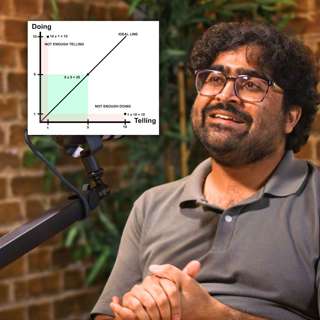
At 26, Neel Nanda leads an AI safety team at Google DeepMind, has published dozens of influential papers, and mentored 50 junior researchers — seven of whom now work at major AI companies. His secret? “It’s mostly luck,” he says, but “another part is what I think of as maximising my luck surface area.”

Video, full transcript, and links to learn more: https://80k.info/nn2

This means creating as many opportunities as possible for surprisingly good things to happen:

  • Write publicly.
  • Reach out to researchers whose work you admire.
  • Say yes to unusual projects that seem a little scary.

Nanda’s own path illustrates this perfectly. He started a challenge to write one blog post per day for a month to overcome perfectionist paralysis. Those posts helped seed the field of mechanistic interpretability and, incidentally, led to meeting his partner of four years.

His YouTube channel features unedited three-hour videos of him reading through famous papers and sharing thoughts. One has 30,000 views. “People were into it,” he shrugs.

Most remarkably, he ended up running DeepMind’s mechanistic interpretability team. He’d joined expecting to be an individual contributor, but when the team lead stepped down, he stepped up despite having no management experience. “I did not know if I was going to be good at this. I think it’s gone reasonably well.”

His core lesson: “You can just do things.” This sounds trite but is a useful reminder all the same. Doing things is a skill that improves with practice. Most people overestimate the risks and underestimate their ability to recover from failures. And as Neel explains, junior researchers today have a superpower previous generations lacked: large language models that can dramatically accelerate learning and research.

In this extended conversation, Neel and host Rob Wiblin discuss all that and some other hot takes from Neel's four years at Google DeepMind. (And be sure to check out part one of Rob and Neel’s conversation!)


What did you think of the episode? https://forms.gle/6binZivKmjjiHU6dA

Chapters:

  • Cold open (00:00:00)
  • Who’s Neel Nanda? (00:01:12)
  • Luck surface area and making the right opportunities (00:01:46)
  • Writing cold emails that aren't insta-deleted (00:03:50)
  • How Neel uses LLMs to get much more done (00:09:08)
  • “If your safety work doesn't advance capabilities, it's probably bad safety work” (00:23:22)
  • Why Neel refuses to share his p(doom) (00:27:22)
  • How Neel went from the couch to an alignment rocketship (00:31:24)
  • Navigating towards impact at a frontier AI company (00:39:24)
  • How does impact differ inside and outside frontier companies? (00:49:56)
  • Is a special skill set needed to guide large companies? (00:56:06)
  • The benefit of risk frameworks: early preparation (01:00:05)
  • Should people work at the safest or most reckless company? (01:05:21)
  • Advice for getting hired by a frontier AI company (01:08:40)
  • What makes for a good ML researcher? (01:12:57)
  • Three stages of the research process (01:19:40)
  • How do supervisors actually add value? (01:31:53)
  • An AI PhD – with these timelines?! (01:34:11)
  • Is career advice generalisable, or does everyone get the advice they don't need? (01:40:52)
  • Remember: You can just do things (01:43:51)

This episode was recorded on July 21.

Video editing: Simon Monsour and Luke Monsour
Audio engineering: Ben Cordell, Milo McGuire, Simon Monsour, and Dominic Armstrong
Music: Ben Cordell
Camera operator: Jeremy Chevillotte
Coordination, transcriptions, and web: Katy Moore

Jaksot(318)

#64 – Bruce Schneier on how insecure electronic voting could break the United States — and surveillance without tyranny

#64 – Bruce Schneier on how insecure electronic voting could break the United States — and surveillance without tyranny

November 3 2020, 10:32PM: CNN, NBC, and FOX report that Donald Trump has narrowly won Florida, and with it, re-election.  November 3 2020, 11:46PM: The NY Times and Wall Street Journal report that so...

25 Loka 20192h 11min
Rob Wiblin on plastic straws, nicotine, doping, & whether changing the long-term is really possible

Rob Wiblin on plastic straws, nicotine, doping, & whether changing the long-term is really possible

Today's episode is a compilation of interviews I recently recorded for two other shows, Love Your Work and The Neoliberal Podcast.  If you've listened to absolutely everything on this podcast feed, y...

25 Syys 20193h 14min

Have we helped you have a bigger social impact? Our annual survey, plus other ways we can help you.

Have we helped you have a bigger social impact? Our annual survey, plus other ways we can help you.

1. Fill out our annual impact survey here. 2. Find a great vacancy on our job board. 3. Learn about our key ideas, and get links to our top articles. 4. Join our newsletter for an email about what's n...

16 Syys 20193min
#63 – Vitalik Buterin on better ways to fund public goods, blockchain's failures, & effective giving

#63 – Vitalik Buterin on better ways to fund public goods, blockchain's failures, & effective giving

Historically, progress in the field of cryptography has had major consequences. It has changed the course of major wars, made it possible to do business on the internet, and enabled private communicat...

3 Syys 20193h 18min
#62 – Paul Christiano on messaging the future, increasing compute, & how CO2 impacts your brain

#62 – Paul Christiano on messaging the future, increasing compute, & how CO2 impacts your brain

Imagine that – one day – humanity dies out. At some point, many millions of years later, intelligent life might well evolve again. Is there any message we could leave that would reliably help them out...

5 Elo 20192h 11min
#61 - Helen Toner on emerging technology, national security, and China

#61 - Helen Toner on emerging technology, national security, and China

From 1870 to 1950, the introduction of electricity transformed life in the US and UK, as people gained access to lighting, radio and a wide range of household appliances for the first time. Electricit...

17 Heinä 20191h 54min
#60 - Phil Tetlock on why accurate forecasting matters for everything, and how you can do it better

#60 - Phil Tetlock on why accurate forecasting matters for everything, and how you can do it better

Have you ever been infuriated by a doctor's unwillingness to give you an honest, probabilistic estimate about what to expect? Or a lawyer who won't tell you the chances you'll win your case? Their beh...

28 Kesä 20192h 11min
#59 – Cass Sunstein on how change happens, and why it's so often abrupt & unpredictable

#59 – Cass Sunstein on how change happens, and why it's so often abrupt & unpredictable

It can often feel hopeless to be an activist seeking social change on an obscure issue where most people seem opposed or at best indifferent to you. But according to a new book by Professor Cass Sunst...

17 Kesä 20191h 43min

Suosittua kategoriassa Koulutus

rss-murhan-anatomia
psykopodiaa-podcast
voi-hyvin-meditaatiot-2
rss-narsisti
adhd-podi
psykologia
rss-liian-kuuma-peruna
kesken
rss-niinku-asia-on
rss-duodecim-lehti
ihminen-tavattavissa-tommy-hellsten-instituutti
rahapuhetta
aamukahvilla
rss-honest-talk-with-laurrenna
rss-luonnollinen-synnytys-podcast
rss-tietoinen-yhteys-podcast-2
rss-opeklubi
rss-vapaudu-voimaasi
nakokulmia-rikollisuudesta-irrottautumiseen
rss-arkea-ja-aurinkoa-podcast-espanjasta