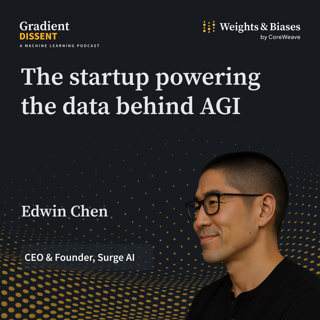
The Startup Powering The Data Behind AGI

The Startup Powering The Data Behind AGI

In this episode of Gradient Dissent, Lukas Biewald talks with the CEO & founder of Surge AI, the billion-dollar company quietly powering the next generation of frontier LLMs. They discuss Surge's origin story, why traditional data labeling is broken, and how their research-focused approach is reshaping how models are trained.

You’ll hear why inter-annotator agreement fails in high-complexity tasks like poetry and math, why synthetic data is often overrated, and how Surge builds rich RL environments to stress-test agentic reasoning. They also go deep on what kinds of data will be critical to future progress in AI—from scientific discovery to multimodal reasoning and personalized alignment.


It’s a rare, behind-the-scenes look into the world of high-quality data generation at scale—straight from the team most frontier labs trust to get it right.


Timestamps:

00:00 – Intro: Who is Edwin Chen?

03:40 – The problem with early data labeling systems

06:20 – Search ranking, clickbait, and product principles

10:05 – Why Surge focused on high-skill, high-quality labeling

13:50 – From Craigslist workers to a billion-dollar business

16:40 – Scaling without funding and avoiding Silicon Valley status games

21:15 – Why most human data platforms lack real tech

25:05 – Detecting cheaters, liars, and low-quality labelers

28:30 – Why inter-annotator agreement is a flawed metric

32:15 – What makes a great poem? Not checkboxes

36:40 – Measuring subjective quality rigorously

40:00 – What types of data are becoming more important

44:15 – Scientific collaboration and frontier research data

47:00 – Multimodal data, Argentinian coding, and hyper-specificity

50:10 – What's wrong with LMSYS and benchmark hacking

53:20 – Personalization and taste in model behavior

56:00 – Synthetic data vs. high-quality human data


Follow Weights & Biases:

https://twitter.com/weights_biases

https://www.linkedin.com/company/wandb

Jaksot(131)

Johannes Otterbach — Unlocking ML for Traditional Companies

Johannes Otterbach — Unlocking ML for Traditional Companies

Johannes Otterbach is VP of Machine Learning Research at Merantix Momentum, an ML consulting studio that helps their clients build AI solutions.Johannes and Lukas talk about Johannes' background in physics and applications of ML to quantum computing, why Merantix is investing in creating a cloud-agnostic tech stack, and the unique challenges of developing and deploying models for different customers. They also discuss some of Johannes' articles on the impact of NLP models and the future of AI regulations.Show notes (transcript and links): http://wandb.me/gd-johannes-otterbach---⏳ Timestamps: 0:00 Intro1:04 Quantum computing and ML applications9:21 Merantix, Ventures, and ML consulting19:09 Building a cloud-agnostic tech stack24:40 The open source tooling ecosystem 30:28 Handing off models to customers31:42 The impact of NLP models on the real world35:40 Thoughts on AI and regulation40:10 Statistical physics and optimization problems42:50 The challenges of getting high-quality data44:30 Outro---Connect with Johannes:📍 LinkedIn: https://twitter.com/jsotterbach📍 Personal website: http://jotterbach.github.io/📍 Careers at Merantix Momentum: https://merantix-momentum.com/about#jobs---💬 Host: Lukas Biewald📹 Producers: Cayla Sharp, Angelica Pan, Sanyam Bhutani, Lavanya Shukla---Subscribe and listen to our podcast today!👉 Apple Podcasts: http://wandb.me/apple-podcasts​​👉 Google Podcasts: http://wandb.me/google-podcasts​👉 Spotify: http://wandb.me/spotify​

12 Touko 202244min

Mircea Neagovici — Robotic Process Automation (RPA) and ML

Mircea Neagovici — Robotic Process Automation (RPA) and ML

Mircea Neagovici is VP, AI and Research at UiPath, where his team works on task mining and other ways of combining robotic process automation (RPA) with machine learning for their B2B products.Mircea and Lukas talk about the challenges of allowing customers to fine-tune their models, the trade-offs between traditional ML and more complex deep learning models, and how Mircea transitioned from a more traditional software engineering role to running a machine learning organization.Show notes (transcript and links): http://wandb.me/gd-mircea-neagovici---⏳ Timestamps: 0:00 Intro1:05 Robotic Process Automation (RPA)4:20 RPA and machine learning at UiPath8:20 Fine-tuning & PyTorch vs TensorFlow14:50 Monitoring models in production16:33 Task mining22:37 Trade-offs in ML models29:45 Transitioning from software engineering to ML34:02 ML teams vs engineering teams40:41 Spending more time on data43:55 The organizational machinery behind ML models45:57 Outro---Connect with Mircea:📍 LinkedIn: https://www.linkedin.com/in/mirceaneagovici/📍 Careers at UiPath: https://www.uipath.com/company/careers---💬 Host: Lukas Biewald📹 Producers: Cayla Sharp, Angelica Pan, Sanyam Bhutani, Lavanya Shukla

21 Huhti 202246min

Jensen Huang — NVIDIA’s CEO on the Next Generation of AI and MLOps

Jensen Huang — NVIDIA’s CEO on the Next Generation of AI and MLOps

Jensen Huang is founder and CEO of NVIDIA, whose GPUs sit at the heart of the majority of machine learning models today.Jensen shares the story behind NVIDIA's expansion from gaming to deep learning acceleration, leadership lessons that he's learned over the last few decades, and why we need a virtual world that obeys the laws of physics (aka the Omniverse) in order to take AI to the next era. Jensen and Lukas also talk about the singularity, the slow-but-steady approach to building a new market, and the importance of MLOps.The complete show notes (transcript and links) can be found here: http://wandb.me/gd-jensen-huang---⏳ Timestamps:0:00 Intro0:50 Why NVIDIA moved into the deep learning space7:33 Balancing the compute needs of different audiences10:40 Quantum computing, Huang's Law, and the singularity15:53 Democratizing scientific computing20:59 How Jensen stays current with technology trends25:10 The global chip shortage27:00 Leadership lessons that Jensen has learned32:32 Keeping a steady vision for NVIDIA35:48 Omniverse and the next era of AI42:00 ML topics that Jensen's excited about45:05 Why MLOps is vital48:38 Outro---Subscribe and listen to our podcast today!👉 Apple Podcasts: http://wandb.me/apple-podcasts​​👉 Google Podcasts: http://wandb.me/google-podcasts​👉 Spotify: http://wandb.me/spotify​

3 Maalis 202248min

Peter & Boris — Fine-tuning OpenAI's GPT-3

Peter & Boris — Fine-tuning OpenAI's GPT-3

Peter Welinder is VP of Product & Partnerships at OpenAI, where he runs product and commercialization efforts of GPT-3, Codex, GitHub Copilot, and more. Boris Dayma is Machine Learning Engineer at Weights & Biases, and works on integrations and large model training.Peter, Boris, and Lukas dive into the world of GPT-3:- How people are applying GPT-3 to translation, copywriting, and other commercial tasks- The performance benefits of fine-tuning GPT-3- - Developing an API on top of GPT-3 that works out of the box, but is also flexible and customizableThey also discuss the new OpenAI and Weights & Biases collaboration, which enables a user to log their GPT-3 fine-tuning projects to W&B with a single line of code.The complete show notes (transcript and links) can be found here: http://wandb.me/gd-peter-and-boris---Connect with Peter & Boris:📍 Peter's Twitter: https://twitter.com/npew📍 Boris' Twitter: https://twitter.com/borisdayma---⏳ Timestamps: 0:00 Intro1:01 Solving real-world problems with GPT-36:57 Applying GPT-3 to translation tasks14:58 Copywriting and other commercial GPT-3 applications20:22 The OpenAI API and fine-tuning GPT-328:22 Logging GPT-3 fine-tuning projects to W&B38:25 Engineering challenges behind OpenAI's API43:15 Outro---Subscribe and listen to our podcast today!👉 Apple Podcasts: http://wandb.me/apple-podcasts​​👉 Google Podcasts: http://wandb.me/google-podcasts​👉 Spotify: http://wandb.me/spotify​

10 Helmi 202243min

Ion Stoica — Spark, Ray, and Enterprise Open Source

Ion Stoica — Spark, Ray, and Enterprise Open Source

Ion Stoica is co-creator of the distributed computing frameworks Spark and Ray, and co-founder and Executive Chairman of Databricks and Anyscale. He is also a Professor of computer science at UC Berkeley and Principal Investigator of RISELab, a five-year research lab that develops technology for low-latency, intelligent decisions.Ion and Lukas chat about the challenges of making a simple (but good!) distributed framework, the similarities and differences between developing Spark and Ray, and how Spark and Ray led to the formation of Databricks and Anyscale. Ion also reflects on the early startup days, from deciding to commercialize to picking co-founders, and shares advice on building a successful company.The complete show notes (transcript and links) can be found here: http://wandb.me/gd-ion-stoica---Timestamps: 0:00 Intro0:56 Ray, Anyscale, and making a distributed framework11:39 How Spark informed the development of Ray18:53 The story behind Spark and Databricks33:00 Why TensorFlow and PyTorch haven't monetized35:35 Picking co-founders and other startup advice46:04 The early signs of sky computing49:24 Breaking problems down and prioritizing53:17 Outro---Subscribe and listen to our podcast today!👉 Apple Podcasts: http://wandb.me/apple-podcasts​​👉 Google Podcasts: http://wandb.me/google-podcasts​👉 Spotify: http://wandb.me/spotify​

20 Tammi 202253min

Stephan Fabel — Efficient Supercomputing with NVIDIA's Base Command Platform

Stephan Fabel — Efficient Supercomputing with NVIDIA's Base Command Platform

Stephan Fabel is Senior Director of Infrastructure Systems & Software at NVIDIA, where he works on Base Command, a software platform to coordinate access to NVIDIA's DGX SuperPOD infrastructure.Lukas and Stephan talk about why having a supercomputer is one thing but using it effectively is another, why a deeper understanding of hardware on the practitioner level is becoming more advantageous, and which areas of the ML tech stack NVIDIA is looking to expand into.The complete show notes (transcript and links) can be found here: http://wandb.me/gd-stephan-fabel---Timestamps: 0:00 Intro1:09 NVIDIA Base Command and DGX SuperPOD10:33 The challenges of multi-node processing at scale18:35 Why it's hard to use a supercomputer effectively25:14 The advantages of de-abstracting hardware29:09 Understanding Base Command's product-market fit36:59 Data center infrastructure as a value center42:13 Base Command's role in tech stacks47:16 Why crowdsourcing is underrated49:24 The challenges of scaling beyond a POC51:39 Outro---Subscribe and listen to our podcast today!👉 Apple Podcasts: http://wandb.me/apple-podcasts​​👉 Google Podcasts: http://wandb.me/google-podcasts​👉 Spotify: http://wandb.me/spotify​

6 Tammi 202252min

Chris Padwick — Smart Machines for More Sustainable Farming

Chris Padwick — Smart Machines for More Sustainable Farming

Chris Padwick is Director of Computer Vision Machine Learning at Blue River Technology, a subsidiary of John Deere. Their core product, See & Spray, is a weeding robot that identifies crops and weeds in order to spray only the weeds with herbicide.Chris and Lukas dive into the challenges of bringing See & Spray to life, from the hard computer vision problem of classifying weeds from crops, to the engineering feat of building and updating embedded systems that can survive on a farming machine in the field. Chris also explains why user feedback is crucial, and shares some of the surprising product insights he's gained from working with farmers.The complete show notes (transcript and links) can be found here: http://wandb.me/gd-chris-padwick---Connect with Chris:📍 LinkedIn: https://www.linkedin.com/in/chris-padwick-75b5761/📍 Blue River on Twitter: https://twitter.com/BlueRiverTech---Timestamps: 0:00 Intro1:09 How does See & Spray reduce herbicide usage?9:15 Classifying weeds and crops in real time17:45 Insights from deployment and user feedback29:08 Why weed and crop classification is surprisingly hard37:33 Improving and updating models in the field40:55 Blue River's ML stack44:55 Autonomous tractors and upcoming directions48:05 Why data pipelines are underrated52:10 The challenges of scaling software & hardware54:44 Outro55:55 Bonus: Transporters and the singularity---Subscribe and listen to our podcast today!👉 Apple Podcasts: http://wandb.me/apple-podcasts​​👉 Google Podcasts: http://wandb.me/google-podcasts​👉 Spotify: http://wandb.me/spotify​

23 Joulu 20211h

Kathryn Hume — Financial Models, ML, and 17th-Century Philosophy

Kathryn Hume — Financial Models, ML, and 17th-Century Philosophy

Kathryn Hume is Vice President Digital Investments Technology at the Royal Bank of Canada (RBC). At the time of recording, she was Interim Head of Borealis AI, RBC's research institute for machine learning.Kathryn and Lukas talk about ML applications in finance, from building a personal finance forecasting model to applying reinforcement learning to trade execution, and take a philosophical detour into the 17th century as they speculate on what Newton and Descartes would have thought about machine learning.The complete show notes (transcript and links) can be found here: http://wandb.me/gd-kathryn-hume---Connect with Kathryn:📍 Twitter: https://twitter.com/humekathryn📍 Website: https://quamproxime.com/---Timestamps: 0:00 Intro0:54 Building a personal finance forecasting model10:54 Applying RL to trade execution18:55 Transparent financial models and fairness26:20 Semantic parsing and building a text-to-SQL interface29:20 From comparative literature and math to product37:33 What would Newton and Descartes think about ML?44:15 On sentient AI and transporters47:33 Why casual inference is under-appreciated49:25 The challenges of integrating models into the business51:45 Outro---Subscribe and listen to our podcast today!👉 Apple Podcasts: http://wandb.me/apple-podcasts​​👉 Google Podcasts: http://wandb.me/google-podcasts​👉 Spotify: http://wandb.me/spotify​

16 Joulu 202152min

Suosittua kategoriassa Liike-elämä ja talous

sijotuskasti
psykopodiaa-podcast
rss-rahapodi
ostan-asuntoja-podcast
mimmit-sijoittaa
pomojen-suusta
rss-bisnesta-bebeja
rss-sisalto-kuntoon
rss-seuraava-potilas
taloudellinen-mielenrauha
rss-porssipuhetta
rss-lahtijat
rss-startup-ministerio
rss-paasipodi
pari-sanaa-lastensuojelusta
bakkari-tarinoita-tapahtumien-takahuoneista
rss-markkinointiradio
rss-karon-grilli
rss-podcast-podcasteista
rss-yritys-ja-erehdys