
Animal, heal thyself
Many Minds14 Marras 2024

Animal, heal thyself

What happens to animals when they get sick? If they're pets or livestock, we probably call the vet. And the vet may give them drugs or perform a procedure. But what about wild animals? Do they just languish in misery? Well, not so much. It turns out that animals—from bees to butterflies, porcupines to primates—medicate themselves. They seek out bitter plants, they treat wounds, they amputate limbs, they eat clay—the list goes on. This all raises an obvious question: How do they know to do this? How do they know what they know about healing and medicine? It also invites a related question: How do we humans know what we know?

My guests today are Dr. Jaap De Roode and Dr. Michael Huffman. Jaap is a biologist at Emory University, and has studied animal medication in insects; he's also the author of a forthcoming book about animal medication across the tree of life. Mike is a primatologist at the University of Nagasaki, and made some of the very first observations about animal self-medication in chimpanzees in the 1980s.

Here, Jaap, Mike, and I talk about how they found their way into this field, in both cases kind of by accident. We discuss what defines animal medication generally as well as what defines its more specific subtypes—social medication, allomedication, prophylactic medication, and others. We consider how animals know what they know about healing—whether these medicinal behaviors are mostly driven by innate tendencies, by individual experimentation, by social learning, or by some combination. We talk about the evidence that many of the medical insights that humans have had over the years actually began with observations of animals. Along the way, we touch on medicinal amputation and medicinal cannibalism, geophagy, leaf-folding in primates, animal quackery, bear medicine, why lemurs rub themselves with millipedes, and the anti-parasitic power of cigarette butts.

Alright, friends, this is a fun one. Enjoy!

A transcript of this episode is available here.

Notes and links

3:00 – A paper describing how birds in Mexico City line their nests with cigarette butts. A follow-up experiment showing that they do so in response to increased presence of parasites.

7:30 – Dr. Huffman's original study of self-medication by a chimpanzee, using Vernonia amygdalina in Tanzania.

15:00 – Dr. de Roode's study on "transgenerational medicine" in monarch butterflies.

20:00 – For an overview of animal medication, including definitions and examples of its subtypes, see this recent primer by Dr. de Roode and Dr. Huffman.

25:00 – The recent study on "medicinal amputation" in ants. The recent study on "medicinal cannibalism" in ants.

30:00 – For an overview of medication in insects, see this recent paper by Dr. de Roode and colleagues.

34:00 – The paper by Mascaro and colleagues showing that chimpanzees treat wounds (to the self and others) by applying insects.

38:00 – A recent review of geophagy—soil eating—in primates by Paula Pebsworth, Dr. Huffman, and colleagues.

43:00 – A paper by Dr. Huffman and colleagues on chimpanzee leaf-swallowing in the wild. Dr. Huffman later did a series of experimental studies on this behavior, investigating the role of social learning—see here and here.

46:00 – An article on how goats learn to eat what they eat.

52:00 – An article describing the medicinal properties of Vernonia amygdalina.

54:00 ­– A study showing that lemurs rub each other with millipedes in a possible case of animal medication.

57:00 – A paper by Dr. Huffman in which he describes the use of mulengelele by a sick porcupine. A recent review by Dr. Huffman of what traditional healers have learned from observations of animal medication.

1:01:00 – An article about propolis and its medicinal use in bees; an article about its medicinal potential in humans.

Recommendations

Doctors by Nature, Jaap de Roode (forthcoming)

Wild Health, Cindy Engel

Nourishment, Fred Provenza

'Five clever animals that treat and prevent their own illnesses,' National Geographic

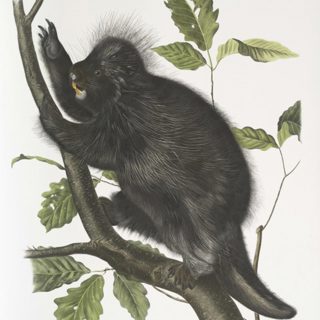
Tile image credit: Image from the New York Public Library via Unsplash

Many Minds is a project of the Diverse Intelligences Summer Institute, which is made possible by a generous grant from the John Templeton Foundation to Indiana University. The show is hosted and produced by Kensy Cooperrider, with help from Assistant Producer Urte Laukaityte and with creative support from DISI Directors Erica Cartmill and Jacob Foster. Our artwork is by Ben Oldroyd. Our transcripts are created by Sarah Dopierala.

Subscribe to Many Minds on Apple, Stitcher, Spotify, Pocket Casts, Google Play, or wherever you listen to podcasts. You can also now subscribe to the Many Minds newsletter here!

We welcome your comments, questions, and suggestions. Feel free to email us at: manymindspodcast@gmail.com.

For updates about the show, visit our website or follow us on Twitter (@ManyMindsPod) or Bluesky (@manymindspod.bsky.social).

Tämä jakso on lisätty Podme-palveluun avoimen RSS-syötteen kautta eikä se ole Podmen omaa tuotantoa. Siksi jakso saattaa sisältää mainontaa.

Jaksot(172)

Island of the tool users

Island of the tool users

Tool use is rare in the animal kingdom—but maybe not as rare as we once thought. Since Jane Goodall famously observed a chimpanzee fishing for termites, many new examples of animals using tools have c...

9 Loka 1h 26min

Cognitive offloading and its consequences

Cognitive offloading and its consequences

For thousands of years—maybe for as long as we've been human—we've offloaded our thinking. We've counted on our fingers. We've carved tallies into bone. We've invented a long series of tools to help u...

25 Syys 1h 15min

Coming of age in Ngogo

Coming of age in Ngogo

It's a familiar story in many ways. A child is born, and for years afterward is adored and indulged and anchored to home and family. But then the child grows up and starts crossing that long threshold...

11 Syys 1h 34min

The natural history of linguistic diversity

The natural history of linguistic diversity

Thousands of languages are used around the world today, and this linguistic diversity is a precious part of our human heritage. But it's also more than that. Linguistic diversity provides clues—a vast...

28 Elo 1h 32min

From the archive: Electric ecology

From the archive: Electric ecology

Hi friends! We're still taking a bit of a summer pause. We'll be back at the end of August—in the meanwhile, enjoy this listener favorite from our archives! ----- [originally aired September 19, 2024]...

17 Elo 1h 33min

From the archive: Varieties of childhood

From the archive: Varieties of childhood

Hi friends! We're taking a bit of a summer pause. We'll be back soon—in the meanwhile, enjoy this listener favorite from our archives! ----- [originally aired July 10, 2025] Childhood is a special tim...

31 Heinä 1h 28min

From the archive: Philosophers on psychedelics

From the archive: Philosophers on psychedelics

Hi friends! We're taking a bit of a summer pause. We will be back soon—in the meanwhile, enjoy this listener favorite from our archives! ----- [originally aired May 14, 2025] Some call it the "psyched...

17 Heinä 1h 40min

The origins of Darwin's ideas

The origins of Darwin's ideas

No discipline, no sphere of intellectual life, has been untouched by the work of Charles Darwin. He died in 1882 but his ideas are very much alive; they're now central to how we understand the natural...

3 Heinä 1h 19min

Suosittua kategoriassa Koulutus

rss-murhan-anatomia
aamukahvilla
psykopodiaa-podcast
voi-hyvin-meditaatiot-2
rss-duodecim-lehti
psykologia
rss-liian-kuuma-peruna
rss-rahamania
kesken
aloita-meditaatio
rss-uskonto-on-tylsaa
ihminen-tavattavissa-tommy-hellsten-instituutti
rss-hereilla
rss-luonnollinen-synnytys-podcast
rss-arkea-ja-aurinkoa-podcast-espanjasta
rss-suomen-aa-podcast
rahapuhetta
adhd-podi
koulu-podcast-2
rss-niinku-asia-on


















