

20VC: The Daily Deal: Coreweave IPO | Scale Hits $25BN on $2BN EOY Revenue | Sequoia's 25x Return on Wiz | Tech Stocks Tank with Tariffs | Cursor: Defensible or Dangerous Example of Lost Moats in Tech
Welcome to The Daily Deal — the new show with Harry Stebbings and Jason Lemkin, where we break down the biggest stories in tech, venture, and B2B. From market meltdowns to billion-dollar raises, wild valuations, and the drama behind the deals. We're covering it all! Plus, we'll be joined by some incredible guests to go deeper on the moves shaping the future of our industry. Today we discuss: Tech stocks were hammered in late trading today in response to the Trump administration's plans to levy tariffs of between 10% and 49% on imported goods, with Apple shares falling more than 6%. Rippling Deal: Illegal or Hustle? Emergence Raises $1B for B2B Investments Cursor, Replit, Windsurf: Who Wins? Lots of gen AI startups are crossing into the $100M ARR club. The latest entrant is talent marketplace Mercor, last valued at $2B. Is triple triple double double dead? ScaleAI at $25B: Pricey or Potential? Discussion with Bhavin Shah @ Moveworks: ServiceNow Acquires Moveworks for $2.5B: AI Craze Continues Sequoia Makes 25x on Wiz: Is M&A Open Again? USD Stablecoin issuer Circle has filed to go public. The company, which has raised $1.2 billion in VC money, reported $1.7 billion in 2024 revenue, with $155.7 million in net income. Oracle Cloud Revenue Up 23%: Old Guard Wins in AI? Salesforce Customers Love AgentForce, But Will They Pay? Dustin Moskovitz Retires from Asana: Is SaaS Too Tough? Discussion with Andrew Feldman @ Cerebras: Coreweave's Redemption Provision: A Time Bomb for Coatue? Can OpenAI's $12B Deal Save Coreweave from $5B Loss? OpenAI Won't Profit Until $127B in Annual Revenue A lot of young founders raising big in chips; bullish or bullshit?
3 Huhti 1h 27min

20VC: Microsoft CTO on Where Value Accrues in an AI World | Why Scaling Laws are BS | An Evaluation of Deepseek and How We Underestimate the Chinese | The Future of Software Development and The Future of Agents with Kevin Scott
Kevin Scott is the CTO of Microsoft, where he leads the company's AI and technology strategy at global scale and played a pivotal role in Microsoft's partnership with OpenAI. Prior to Microsoft, Kevin spent six years at Linkedin as SVP of Engineering. Kevin has also enjoyed advisory positions with Pinterest, Box, Code.org and more. In Today's Episode We Discuss: 04:10 Where is Enduring Value in a World of AI 10:53 Why Scaling Laws are BS 12:26 What is the Bottleneck Today: Data, Compute or Algorithms 15:38: In 10 Years Time: What % of Data Usage will be Synthetic 20:04 How Will AI Agents Evolve Over the Next Five Years 23:34: Deepseek Evalution: Do We Underestimate China 28:34 The Future of Software Development 31:53 The Thing That Most Excites Me in AI is Tech Debt 35:01 Leadership Lessons from Satya Nadella 41:13 Quickfire Round
31 Maalis 45min

20VC: Will Revolut and Monzo List in the UK | How Does London Compete Against the US To Win The Best UK IPOs | Are UK Public Companies Punished on Price for Listing in London | The Myths and the Reality of The London Stock Exchange with CEO, Julia Hoggett
Dame Julia Hoggett is the CEO of the London Stock Exchange. Julia previously worked at the UK's Financial Conduct Authority as Director of Market Oversight and Head of Wholesale Banking Supervision. In Today's Episode We Discuss: 04:25 How to Become CEO of a National Stock Exchange 05:36 Why The Domestic Economy is F***** Despite the Boom in Financial Services 06:45 How Pension Fund Reform Dmaaged the UK Economy 09:31 Should the UK Copy the Canadian Pension Fund Structure 16:30 Will the Best Companies Like Revolut and Monzo List in London 24:17 Why Are Revolut Wrong to Want to List in the US 27:32 Are Companies Priced Lower in the UK vs US 32:05 Why is Stamp Duty a Perversity We Have to Change 35:46 Why is the Way the UK Thinks About Financial Services So Wrong 40:31 Quick Fire Round: Insights and Reflections
28 Maalis 50min
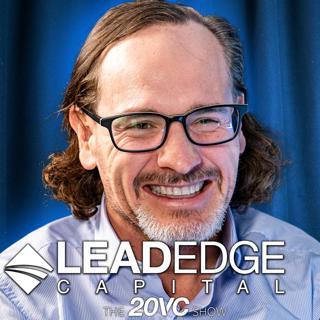
20VC: Why Traditional VC is Broken: How VCs Learned Nothing from 2021 | Why LPs are More Important than Founders & Advice to Emerging Managers | Bull Case for Bytedance & Why TikTok's Ban Doesn't Matter with Mitchell Green, Lead Edge Capital
Mitchell Green is the Founder and Managing Partner of Lead Edge Capital. Mitchell has led or co-led investments in companies including Alibaba, Asana, Benchling, ByteDance, Duo Security, Grafana, Mindbody, and Xamarin, among several others. In Today's Episode We Discuss: 04:31 How Bessemer Taught Me The One Golden Rule of Investing 06:48 Why AI Infrastrcture is the Worst Investment to Make 08:51 Why it is Comical to think there will be $BN one person companies? 09:26 WTF Happens To The Cohort of SaaS Companies With Slow Growth, Not Yet Profitable and $50M-$200M in Revenue 16:12 What is the Biggest Problem with the IPO Market 23:24 When is the Right Time to Sell in VC and How a Generation F******* it Up 27:37 Biggest Advice to Smaller Emerging Managers 40:13 The One Question That Tells You if a Business is Good 43:01 Why LPs are More Important than Founders 45:03 One Question Every LP Should Ask Their VCs 46:03 Why TikTok Does Not Matter to ByteDance and It Is a Screaming Buy 51:30 Why We Drastically Underestimate the Power of Chinese AI? 55:18 Why Social Media is the Most Dangerous Thing in Society 01:00:07 Quick Fire Questions
28 Maalis 1h 19min

20VC: The Insane Story of DeliveryHero: Losing $200M on a Gorillas Investment | Winning the Emerging Markets Delivery War with 35 Acquisitions | Competing with Uber and Doordash in a Capital Arms Race with Niklas Östberg
Niklas Östberg is the Founder and CEO of Delivery Hero, a global juggernaut now present in over 70 countries across four continents. In Q4 2024, the company announced GMV of $49BN with $12.8BN in revenue and $750M in EBITDA. They have made an astonishing 35+ acquisitions including $2BN for Glovo. Before launching Delivery Hero, Niklas co-founded Pizza.nu, leading its expansion across Sweden, Poland, Finland, and Austria. In Today's Episode We Discuss: 04:09 How Skiing Prepared Me For Life As An Entrepreneur 10:12 Losing $200M on Gorillas Investment 17:58 Quick Commerce: Does the Business Model Work? 25:09 How to Master M&A: Lessons from 35 Acquisitions 31:45 Evaluating Acquisitions: The Glovo Example 32:39 Cohort Analysis: Lessons from $49BN in GMV 34:35 Growth Strategies: What Worked? What Did Not Work? 38:27 Competing Against Uber and Doordash 41:40 Is Cash a Weapon in the War for Food Delivery 44:29 Why Are Emerging Markets a Good Investment? 48:21 Why Are European Markets Broken? Are Regulators Killing Europe? 51:57 Quickfire Round: Insights and Reflections
27 Maalis 1h 1min

20VC: AI Chip Wars: How Cerebras Plans to Topple NVIDIA's Dominance | Why We Have Not Reached Scaling Laws in AI | What Happens to the Cost of Inference | How We Underestimate China and Shouldn't Sell To Them with Andrew Feldman
Andrew Feldman is the Co-Founder and CEO @ Cerebras, the fastest AI inference + training platform in the world. In Sept 2024 the company filed to go public off the back of a rumoured $1BN deal with G42 in the UAE. Andrew is the leading expert for all things inference. In Today's Episode We Discuss: 04:23 Where Was AI Landscape in 2015 When Cerebras Founded 05:57 NVIDIA's Biggest Strength Has Become Their Biggest Weakness 07:09 What Happens to the Cost of Inference? 08:55 Why Are AI Algorithms So Inefficient? 20:30 Why is it Total BS That We Have Hit Scaling Laws? 23:07 What Will Be the Ratio of Synthetic to Human Data Used in 5 Years? 31:37 What Specifically Was So Impressive About Deepseek? 31:51 Why is Distillation Not Wrong and OpenAI Need to Look in the Mirror? 32:34 Where Will Value Accrue in a World of AI? 34:08 How Will NVIDIA's Market Position Change Over the Next Five Years? 39:59 Why is the CUDA Lockin for NVIDIA BS? What is Their Weakness? 40:46 Why is Trump Better for Business than Biden? 49:41 Do We Underestimate China in a World of AI? 52:33 What is the Most Underappreciated Segment of AI? 54:00 Quickfire Round
24 Maalis 1h 3min

20VC: Selling Drift for $1.2BN is the Biggest Failure: What No One Tells You About Selling Your Company | Why Incumbents Are Slower & Worse Than Ever | Why the Most Valuable Companies in a World of AI Will Not Have More Than 100 People with Elias Torres
Elias Torres is the Co-Founder and CEO of Agency, the AI agent for customer success teams. Prior to Agency, Elias was the Co-Founder of Drift, a company he sold to Vista for $1.2BN Before that he started Performable, which he sold to Hubspot. In Today's Episode We Discuss: 03:50 Do Rich Founders Make Better Founders: How Backgrounds Shape You 06:23 Speed: Why are Incumbents Slower than Ever 10:00 Quality: Why are Incumbents Worse than Ever 25:34 Why Was Selling Drift For $1.2BN a Massive Failure 33:30 How Did a Cushy Culture Kill Drift 37:01 What They Never Tell You About Selling for $1.2BN 41:08 How to Hire F******* Rockstars 46:52 The Biggest Mistakes Founders Make in Hiring 54:52 Everything You Think You Know About Working Parents is Wrong 01:02:00 Quickfire
21 Maalis 1h 7min

20VC: The 10 Question Framework a $217BN Manager Uses to Make Investment Decisions | Lessons from Turning Down Stripe, Coinbase and Losing Money on Northvault | The Bull Case for Bytedance | How Anduril Could Be a $200BN Company with Peter Singlehurst
Peter Singlehurst is the Head of Private Companies at Baillie Gifford. He has led research on a wide range of private investments including Epic Games, Bending Spoons, Anduril, Solugen, Scopely, and Grammarly, as well as a number of private holdings that have since transitioned to the public markets such as Airbnb, Affirm, Warby Parker, Wise and Tempus AI. In Today's Episode with Peter We Discuss: 04:24 How I Accidentally Came to Manage One of the Largest Private Investment Firms in the World 07:29 What I Learned Losing 100s of $Ms 10:22 The 10 Questions Baillie Gifford Needs to Answer to Make an Investment 15:53 Why We Did Not Double Down in Stripe and Turned Down Coinbase 33:10 The ByteDance Investment Case 36:33 Why Would Any Good Company Go Public Today 39:19 Growth Stage Investing Trends 40:46 How Anduril Becomes a $200BN Company 45:39 Is 2024 Different to the Madness of 2021 and 2022 47:18 The Decision-Making Process Inside a $217BN Firm 49:00 How Does Re-Investment Decision-Making Differ from Original Investments 55:56 Future of Growth Equity Investing 58:12 Quick Fire Questions
19 Maalis 1h 11min