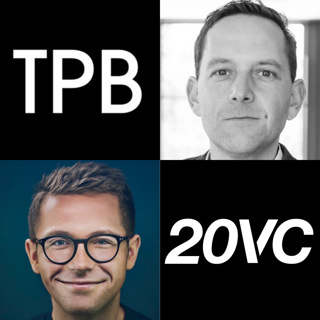


20VC: Affirm Max Levchin on Why Grading Talent by Letter (A or B) is Total BS | How to Create a Culture of Post Mortems and Writing | Why You Should Only Study Failure Not Success & The Biggest Surprises Scaling to $18.7BN Market Cap
Max Levchin is one of the great founders and technologists of our time. As the Founder and CEO of Affirm, he has built am $18.7BN monster in the buy no pay later space. Prior to Affirm he was one of the original co-founders of PayPal. Max is also the co-founder and Chairman of Glow, a data-driven fertility company. Max is also an immensely successful angel investor with a portfolio including the likes of Yelp, Pinterest and Evernote. In Today's Episode We Discuss: 04:19 How to Hire the Best People in the World 05:05 How to Manage Extreme Personalities 08:18 Biggest Lessons on Trust and What Happens When Lost 12:05 Is Grading Talent A and B Players Total BS? 15:31 How to Think About Calculated vs Uncalculated Risk 27:18 How to Create a Culture of Post Mortems: Step by Step 32:08 Why Every Person Must Write and How to Create a Writing Culture 36:01 Leadership Lessons from Layoffs 38:38 Is Affirm Losing or Beating Klarna in the US? 47:03 Peter Thiel or Elon Musk: Who Would Max Rather Start a New Company With? 48:37 Quickfire Round
5 Helmi 1h 2min

20VC: Lime's CEO on Going from Losing $3 on Every $1 to $90M in EBITDA | How Lime Built the Global Leader in Micromobility When Competitors Went Bust | Losing 90% of Revenues in COVID and The Uber Deal That Saved the Company with Wayne Ting
Wayne Ting is CEO of Lime. The global leader in micromobility, the first to achieve a fully profitable year (2022). Last year, Lime did over $600M in gross bookings, $90M in EBITDA. Their 4-year top-line CAGR is 30%. Before joining Lime, Wayne spent four years at Uber in various roles, including Chief of Staff to CEO Dara Khosrowshahi, and General Manager of Uber's Northern California business. Wayne previously served as a Senior Policy Advisor on the White House's National Economic Council under President Obama. In Today's Episode with Wayne Ting We Discuss: Is Lime Really a Good Business: How did Wayne turn Lime from losing $3 on every $1 to $90M in EBITDA? What worked? What did not work? What did Lime do that he wishes they had not done? What did they not do that he wishes they had done? The Moments that Changed Everything: COVID: Lime lost 95% of their revenues overnight. What did Wayne and Lime do to save the business in such a short space of time? Uber Deal: How did the Uber deal led by Uber CEO, Dara, save Lime as a business? Battery Innovation: How did an innovation on the transportability of batteries and replacing them change the entire Lime business? The Dangers of VC Funding and Capital Efficiency: Why does Wayne believe that VC hype cycles are so damaging for companies and sectors? How did the heat around micromobility damage Lime? What did Wayne and Lime do to increase their capital efficiency so much? What worked? What did not? AMA with the CEO of Lime: What company did Lime not acquire that Wayne wishes they had? How did having a stroke change the way that Wayne leads? Which competitor does Wayne most respect and admire? What were his biggest lessons from working with Dara @ Uber?
30 Tammi 1h 6min

20VC: Deepseek Special: Is Deepseek a Weapon of the CCP | How Should OpenAI and the US Government Respond | Why $500BN for Stargate is Not Enough | The Future of Inference, NVIDIA and Foundation Models with Jonathan Ross @ Groq
Jonathan Ross is the Co-Founder and CEO of Groq, providing fast AI inference. Prior to founding Groq, Jonathan started Google's TPU effort where he designed and implemented the core elements of the original chip. Jonathan then joined Google X's Rapid Eval Team, the initial stage of the famed "Moonshots factory," where he devised and incubated new Bets (Units) for Alphabet. The 10 Most Important Questions on Deepseek: How did Deepseek innovate in a way that no other model provider has done? Do we believe that they only spent $6M to train R1? Should we doubt their claims on limited H100 usage? Is Josh Kushner right that this is a potential violation of US export laws? Is Deepseek an instrument used by the CCP to acquire US consumer data? How does Deepseek being open-source change the nature of this discussion? What should OpenAI do now? What should they not do? Does Deepseek hurt or help Meta who already have their open-source efforts with Lama? Will this market follow Satya Nadella's suggestion of Jevon's Paradox? How much more efficient will foundation models become? What does this mean for the $500BN Stargate project announced last week?
30 Tammi 55min

20Sales: Why Every Sales Rep Should Do Pipeline Generation & How to Teach Them | Verticalised Sales Playbooks: When and How | How the Best Sales Reps and Leaders Structure Their Time with Carlos Delatorre, CRO @ Harness
Carlos Delatorre is one of the legendary go-to-market leaders of the last 20 years. Today, Carlos is the Chief Revenue Officer (CRO) at Harness, where he oversees global sales and go-to-market (GTM) operations. Before Harness, Carlos was the CRO @ MongoDB and Navan. Carlos is also an investor with a portfolio including the likes of Modern Treasury and Starburst to name a few. In Today's Sales Masterclass We Discuss: 03:48 The Art and Science of Sales 04:42 How to Hire Sales Talent 06:26 How to Build a Sales Team 15:28 Why Every Sales Rep Should do Pipeline Generation 19:45 How the Best Reps to Pipeline Generation 21:34 Biggest challenges of Pipeline Generation 22:44 Pipeline Generation Success Stories 34:59 Sales Metrics and Conversion Rates 35:32 Customer Acquisition Strategies 37:17 Evaluating Sales Performance 39:14 Effective Sales Training 43:10 Pipeline Generation and Deal Reviews 45:05 Maintaining Sales Team Morale 46:20 Verticalized Sales Playbooks 48:37 Addressing SaaS Churn Rates 49:49 Discounting and Deal Slippage 52:02 Transitioning to CEO Role 54:15 Hiring Mistakes and Sales Rep Evolution 57:03 In-Person vs. Remote Sales Teams 57:55 Account Management Strategies 01:02:47 Creative Sales Tactics 01:04:12 Final Advice for Sales Leaders 01:04:46 Adapting Sales Strategies During Crisis
24 Tammi 1h 8min

20VC: Why All AI Companies Are Under-Valued | The Future of Foundation Models: Scaling Laws, Generalised vs Specialised, Commoditised? | From Unable to Afford Rent to Raising $130M From Index and Peter Thiel with George Sivulka @ Hebbia
George Sivulka is the founder and CEO of Hebbia, is one of the fastest-growing gen AI companies and they recently raised a $130M series B. Investors include the company include hailed names such as a16z, Peter Thiel, Index, GV and others. In Today's Episode with George Sivulka We Discuss: 04:47 Three Traits The Best Founders All Share? 08:11 How Cold Calling NASA Changed My Life 12:01 From Stealing Food From Stanford to Pitching Peter Thiel 17:22 Lessons working with Peter Thiel 26:39 The Future of AI and Business Applications 33:03 The Future of Employment with AI 33:45 Debunking the Myths of AI Job Displacement 35:09 The Future of Models: Many specialised or few generalised? 35:56 Scaling at Inference: A New Frontier 38:10 The Impact of Scaling Laws on Foundation Models 40:40 The Future of AI and Enterprise Value 43:43 The Geopolitical Influence on AI 45:03 The Commoditization of AI Models 47:47 Why Foundation Models Will Not Follow the Same Path of Cloud 52:53 Why All Companies, Both AI and Non-AI Are Undervalued
22 Tammi 1h 6min

20VC: Why Large Seed Rounds Increase the Chances of Success | When to Sell in Venture | Why Multi-Stage Firms Do Not Do The Work | Is Europe Totally F****** and Why AI Means London Can Compete with the US with Hussein Kanji
Hussein Kanji is the Founder and Managing Partner of Hoxton Ventures, one of Europe's leading early-stage firms with mega wins in the form of Darktrace and Deliveroo. Hussein cut his teeth in venture at Accel Partners in his early years. In Today's Episode with Hussein Kanji We Discuss: 1. How to Raise a Fund: What are Hussein's biggest lessons from his first fund taking 39 months to raise? Why does Hussein believe you should fundraise for a set amount of time and not to achieve a certain amount of capital? Does Hussein believe governments should be investing in venture funds? What are the biggest mistakes Hussein sees emerging managers make when raising? 2. How to 10x a Fund: What is Hussein's formula for knowing when to sell an investment? How did Hussein miss out on making $400M in Darktrace? What did he learn from it? How much money did Hoxton make from Deliveroo? How did doing 37x on Deliveroo impact how Hussein invests today? 3. How to Build a Team in Venture: Why does Hussein believe the incentive mechanism for young VCs is broken? Why do they just want to get cash out the door and not worry about quality? Why is it hard to hire female partners today? What needs to happen for this to change? What are the single biggest ways that venture partnerships break down? What went wrong between Hussein and his partner, Rob? 4. Is Europe Totally F*******: Why does Hussein believe small seed rounds are a massive problem in the UK? Why does Hussein believe the dire state of the London Stock Exchange is not a problem? Why does Hussein advise companies that the best way to scale is in the US? What advice would Hussein give to Keir Starmer on how to stimulate growth in the UK? Why does AI mean that the UK can now compete with the US?
20 Tammi 1h 17min

20VC: Monday.com: Scaling from $6M to $120M in ARR in 3 Years | How Monday Have Built the Best Performance Marketing Engine in SaaS | Going Upmarket, International and Multi-Product; The Biggest Lessons and Mistakes with Eran Zinman
The story of Monday.com is insane, turned down by most VCs, then scaled from $6M to $120M ARR in just three years. Today the company is public with a market cap of $12BN. Joining us in the hotseat today is Monday's Co-Founder and CEO, Eran Zinman. In Today's Episode with Eran Zinman We Discuss: 03:03 The Role of Video Games in Founders' Success 04:12 The Fail That Taught a $10BN Founder Everything 09:40 Pivoting to a $12BN Company: How, When and Advice on Pivots 14:15 Why 99% of Investors Turned Monday Down: Fundraising Lessons 17:05 Building a Performance Marketing Engine 21:25 How to Scale ACV and Move Upmarket 28:54 What Have Been the Most Effective Marketing Strategies 29:08 How Have Monday Been So Successful with Youtube Ads? 29:43 Biggest Challenges and Lessons in Channel Spend 30:50 Building a Multi-Product Strategy: The Rise of Monday CRM 34:37 Competing in the SaaS Market: Is Competition Good? 39:30 The IPO Journey: Why Then? Pros and Cons of Being Public? 42:38 How a Co-CEO Structure Works 43:55 How to Manage a Board 45:04 Quick-Fire Q&A
17 Tammi 55min

20VC: Why Scaling Laws Will Not Continue | OpenAI vs Anthropic vs X.ai: Who Wins and Why | How Far Will Model Providers Go Into the Application Layer | The End State for Models: Many Specialised or Few Generalised with Victor Riparbelli @ Synthesia
Victor Riparbelli is the CEO and Co-founder of Synthesia, the world's leading AI video communications platform for enterprises. To date, Victor has raised over $250M from Accel, GV, NEA, and more. More than 1,000,000 users and 55,000 businesses, including 60% of the Fortune 100, use it to communicate efficiently and share knowledge at scale using AI avatars. In Today's Episode with Victor Riperbelli: 1. The Future of Models: Are we seeing the commoditisation of models? Will scaling laws continue to prove out? How far into the application layer will model providers go? Will we see a world of few large generalist models or many fragmented smaller models? X.ai, Anthropic, or OpenAI? Which would Victor most want to invest in and why? 2. The Future of Content: What will the future of content look like? In 5 years time will we have more AI or human made content? What will be the future of distribution for content? Why is TikTok the future for content distribution? How does Victor think about the future of identity verification? What is the right approach? What does everyone think will happen in the future with content that will never happen? 3. Startup Rules That are BS: Why does Victor believe it is total BS to say you have to be the first to a market? Why does Victor believe the speed of execution religion is BS? Why does Victor believe that London and Europe is a great place to start a startup? Does Victor believe Americans work harder than Europeans? Why does Victor believe Europeans are more loyal to their companies?
15 Tammi 1h 11min