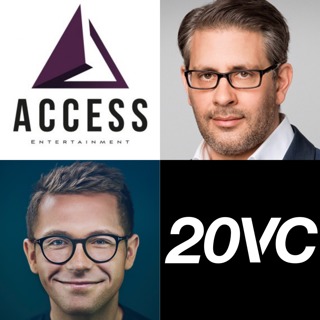
20VC: From Leading the BBC to Leading Venture Capitalist, The Biggest Similarities and Differences Between the Best Founders and the Best Actors & The Future of Media; Legacy vs New, The Creator Economy, The Rise of TikTok and more with Danny Cohen
Danny Cohen is the President of Access Entertainment, a division of Len Blavatnik's Access Industries. Access Entertainment's corporate investments include film and television studio A24; Europe's fastest-growing company Tripledot Studios; creator economy leader Spotter; and a new immersive arts' experience launched in collaboration with David Hockney and Lightroom. Before joining Access, Danny was the Director of BBC Television where he had responsibility for all of the BBC's network channels and the greenlighting and production of the BBC's drama, entertainment, comedy, arts, history, science, educational content and documentary. In Today's Episode with Danny Cohen We Discuss: 1. From Leading the BBC to Investing for Len Blavatnik: How did Danny make his way from leading the BBC to investing for Len @ Access? What was he most nervous about when making the transition to investing? What has been the hardest investing skill to learn? 2. Great Founders are Like Great Actors: What are the biggest similarities in what makes the best founders and the best actors? How are the best founders different from the best actors? Why does Danny believe the risk that an actor takes is so different to the risk founders take? How does Danny feel both founders and actors can and should be managed? 3. The Future of Media: What does Danny mean when he says he looks for "eyeballs and attention" when investing? How does legacy media respond to the threat created by social media today? How does AI change the future of content creation and distribution today? How do the strikes in Hollywood impact the future of content supply? 4. Marriage, Children and Loneliness: Why does Danny believe that loneliness will continue to be the biggest problem we face? What are Danny's biggest pieces of advice from 17 years of happy marriage? Why did Danny decide to not have children? What did that decision-making process look like?
8 Marras 202350min
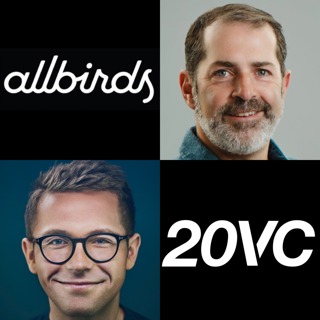
20VC: From $4.1BN to $142M Market Cap; Why Public Markets Have Written Allbirds Off, What Allbirds Need to Do to Get Profitable, Why Growth has Slowed and The Bull Case for Allbirds Next Five Years with Joey Zwillinger, Co-Founder @ Allbirds
Joey Zwillinger is the Co-Founder & CEO @ Allbirds, the company behind the world's most comfortable shoe. In Nov 2021, Joey took the company public and the stock soared to an all-time high of $4BN, today the company has a market cap of $137M. Prior to Allbirds, Joey spent six years at biotechnology firm, Terravia, leading its renewable chemical business, developing and selling high-performance algae-based chemicals into various industries such as CPG, personal care, and industrials. In Today's Episode with Joey Zwillinger We Discuss: The Founding Moment: How did Joey's wife's friendship lead to the co-founding of Allbirds? What does Joey know now that he wishes he had known at the founding moment? What does Joey believe he is running away from? What is he running towards? 2. Public Market Performance Review: Why has Allbirds lost 97% of it's value since going public? What mistakes were made? Why has revenue declined for the first time this year? What strategic investments have Allbirds pulled back on or paused entirely? When will Allbirds be profitable? 3. The Competition: How do Allbirds compete and catch up with On and Hoka? What strategic mistakes did Allbirds make in COVID that allowed others to take the crown? Was the movement into running and athletics a mistake for Allbirds? 4. Joey Zwillinger: The Leader and Person: Did Joey take secondaries out during the Allbirds journey? How does Joey reflect on his own relationship to money? How has Joey dealt with the last 12 months personally? How does he manage the stress effectively?
6 Marras 202344min

20VC Roundtable: Why Early Stage Founders Should Not be Investing, Why Great Founders Have Low EQ, How the Structure of VC Firms Will Change, Will Founder-Led Funds Compete with Sequoia & Is Investing a Team Sport?
Jack Altman is the Founder and CEO @ Lattice, the #1 people management platform, last valued at $3BN. Jack is an investor through his founding of Jack Altman Capital where he has invested in WorkOS, NexHealth, Owner.com, Mercury and more. Auren Hoffman is the Founder and CEO @ Safegraph, the most accurate database of global points of interest, last valued at $550M. Auren is an investor through his founding of Flex Capital where he has invested in Chime, Checkr, Coinbase, Flexport, Vercel and more. Jason Lemkin is the Founder and CEO @ SaaStr, the world's largest SaaS community. Jason is an investor through his founding of The SaaStr Fund. In the past, Jason has invested in Pipedrive, Algolia, Salesloft, Front, GreenHouse, Owner.com, Gorgias and more. In Today's Episode on Founder-Led Funds We Discuss: Why have we seen the rise of "Founder-led Funds"? Are founder-led funds more empathetic to the founders they invest in? How do founder-led funds source and pick investments in a way that traditional VC does not? Will we see founder-led Funds truly compete against the Sequoias of the world? How does being an operator make you a better investor? How does investing help you be a better founder and operator? How do you communicate your investing practice and firm to your company and team? What are the biggest excitements and concerns LPs have for Founder-led Funds? Will we see the face of venture changing much more broadly and structurally? How do founder-led funds manage both time and company conflicts?
3 Marras 202349min
20Product: Why You Should Not Go Into Product Management, Why the CEO is Always the CPO, How to Build the Best Product Teams & Why You Should Hire People Who Aren't In Product Already with Databricks SVP Product, David Meyer
David Meyer is the SVP Products at Databricks where he drives product strategy and execution. He previously ran Engineering and Product Management at OneLogin, where he grew the company to thousands of customers and market leadership. Before OneLogin, he cofounded UniversityNow, an accredited open university system, running Product and Engineering. Prior to that, David managed a $1 billion portfolio of business intelligence products at SAP and co-led cloud strategy. His first software journey was at Plumtree which went public before being acquired by BEA in 2005. In Today's Episode with David Meyer We Discuss: Entry into Product: How did David make his way into the world of product? Why did he not want to go into it? Why does David advise everyone "do not go into product management"? What does David know now that he wishes he had known when he entered product? 2. How to be a Great Product Leader: Why does David think most leaders suck at leading? Why is the most important thing to make your team feel seen? What can leaders do to ensure this? Why does David help his team members to find other roles outside of the company? 3. Building the Best Product Team: How does David hire for product today? What questions does he ask? What signals does he look for? What are David's biggest hiring mistakes? How did they change his approach? What are the biggest mistakes founders make when hiring for product? Why should you hire people who are not in product today? 4. David Meyer: The Art or Science of Product: Is product more art or science? If David were to put a number on it, what would it be? Is simple always better when it comes to product? Will AI remove the importance and focus on UI? Why are the most impressive companies business model innovations not product innovations?
1 Marras 20231h 2min
20VC: Should Large Crypto Funds Give Money Back to LPs | What Will the Next Generation of Crypto Funds Look Like | What Should Happen with FTX; Who Should be Held to Account | The Future of NFTs & What Happens to Opensea w/ Nick Tomaino @ 1confirmation
Nick Tomaino is the Founder and General Partner @ 1confirmation, one of the leading seed firms fueling the decentralization of the web and society. The fund started with $26M in backing from individuals including Peter Thiel and Mark Cuban and it has been reported that the firm now has over $1B in assets under management. Nick has led seed investments in OpenSea, dYdX, SuperRare, Polkadot and Cosmos among others. Prior to 1confirmation, Nick was a Principal @ Runa Capital and before that led business development and marketing at Coinbase in the early days of the company. In Today's Episode with Nick Tomaino We Discuss: From Cryptokitties to founding the Leading Seed Crypto Firm: How did Nick first come into contact with crypto and bitcoin specifically? How did getting fired from Coinbase catalyse his move into venture? What does Nick know today that he wishes he had known when he started investing? 2. The Landscape Today: Funds and SBF Are the current generation of crypto funds too large? Should they give money back to their LPs? Will the next generation of crypto funds be smaller? Are any crypto funds able to raise right now? Why does crypto Twitter hate crypto VCs? Who are the worst VCs for pump and dump? 3. SBF & FTX: What Actually Happened, Who is to Blame, What Happens from here? What is the biggest misconception on SBF and FTX today? Who should be held accountable? What else would Nick like to see? How should FTX change the way that LPs invest into venture managers? 4. How to Build the Best Crypto Portfolio in Venture: How large are the funds? How does Nick determine the right size for a fund? How many investments does Nick make per fund? How do loss rates look in crypto? What have been Nick's biggest investment hits and losses? How did that impact his mindset? 5. The Future for NFTs and Opensea: Why does Nick remain bullish on the future of NFTs? How is Nick able to remain optimistic about the future of Opensea given their volumes? Where does Nick believe the fair price for Opensea should be today? Did Nick sell their Opensea at the $13Bn round?
30 Loka 202355min
20VC: The Three Types of Seed Round Today, Why Seed Has Never Been More Competitive, Why Pricing Has Never Been Higher, Why Boards at Pre-Seed Can Be Helpful & How Too Much Cash Too Soon Can Harm Companies with Ed Sim, Founder @ Boldstart
Ed Sim is one of the best seed round investors in venture as the Founder and Managing Partner @ Boldstart, Ed focuses specifically on developer, infra and SaaS at pre-seed and seed round. Over the last decade, Ed has backed some of the best including Snyk, BigID, Kustomer, Front and Superhuman. In Today's Episode on Seed Rounds We Discuss: The Three Types of Seed Round: What are the three different types of seed round today? Has seed ever been this competitive? Will seed be unimpacted by the macro decline we are seeing? Why are growth and multi-stage funds being more active than ever in seed? 2. Too Much Cash Will Kill You! Why does Ed believe that too much capital can kill companies at the seed round? Why does Ed believe that the best founders are not always optimising for the highest price? What are the single biggest negatives of taking a high price at the seed round? What advice does Ed have for founders who have large offers from multi-stage funds at seed? 3. Is Growth Dead? Why does Ed disagree and suggest that growth is not dead? What do multi-stage and growth funds now what to see that they did not before? How will the growth market evolve over the next 12-18 months? 4. IPOs, AI and M&A: What will cause the IPO windows to crack open again? Why does Ed believe that many investing in AI are simply giving money to Nvidia? Does Ed agree that 95% of the cash going into AI from venture today will go to zero? Will we see more or less M&A in the next 12 months? How did Ed evaluate the Loom acquisition by Atlassian?
27 Loka 202347min
20Growth: Should Startups Hire Advisors? When is the Right Time? How Much Should They Be Paid? How Should Founders Approach the Hiring Process for Advisors? What Should They Expect From Them? What are the Biggest Mistakes Made and more with Ely Lerner
Ely Lerner is an EIR at Reforge and an advisor for startups transitioning from traction to hypergrowth. Previously he was Head of Consumer Product at Chime, and before that spent an incredible 8 years at Yelp in a number of different roles including Head of Product at Eat24, and Product Leader/GM at Yelp. In Today's Episode with Ely Lerner We Discuss: 1. Entry into Growth: How did Ely make his way from engineering manager to growth leader? What are a couple of his single biggest takeaways from his time with Yelp and Chime? Why do employees in large companies have to have P&L ownership when innovating within the larger company they are in? 2. Advisors: What, When and How: What are the three different types of advisors founders can work with today? When is the right time to engage with each of them? Should the advisor have had direct experience with the problem you need help with? How should these advisors be compensated; what is normal? What are 1-2 of the biggest reasons startup advisory roles do not work out? 3. Offense vs Defence: The Tricky Balance: What is the difference between offense and defense in product strategy? What should the resource allocation be between the two? What is the right amount of offensive strategies to have on at the same time? How can leaders prevent their defensive teams from feeling like second-class citizens? 4. Ely Lerner: AMA: Why does Ely disagree with many and suggest that horizontal products do have a core ICP? Should growth teams sit on their own or within functions in the org? What are the core reasons teams fail to ship fast? What state should your data be in when you bring in your first growth hire?
25 Loka 202351min
20VC: Scaling to $50M ARR in 3 Years, Scaling to $20M ARR with Just $2M Invested; The Story of PhotoRoom, Is This YC's Most Capital Efficient Company with Matthieu Rouif, Co-Founder & CEO @ PhotoRoom
Matthieu Rouif is the Co-Founder and CEO @ PhotoRoom, one of the fastest-growing YC companies having scaled to an astonishing $50M in ARR in just 3 years. Their capital efficiency is immense having scaled to $20M in ARR on just $2M of invested capital. Prior to founding PhotoRoom, Matthieu founded several start-ups, including an app for ski resorts, HeyCrowd, and Replay, a video editor which was ultimately acquired by GoPro. Whilst at GoPro, Mattheiu led all image editing products. In Today's Episode with Matthieu Rouif We Discuss: From GoPro to One of YC's Fastest Growing Companies: How did Matthieu make the move from GoPro to founding PhotoRoom? What are the big mistakes Matthieu made on prior companies that he did differently with PhotoRoom? What does Matthieu know now that he wishes he had known when he started PhotoRoom? 2. Scaling to $20M in ARR with $2M of Cash: What allowed Matthieu and PhotoRoom to be so capital-efficient in their scaling? What are the biggest mistakes founders make when it comes to resource allocation and capital efficiency? On reflection, what did Matthieu not spend money on that he wishes they had spent money on? 3. Consumer Subscription + Photo Editing: Is it a Good Business: What are the customer acquisition costs by channel for PhotoRoom? What are their payback periods on a per-customer basis? How can it be a good business when the churn rate annually is 30-40%? How does this space play out with Canva, Adobe, Veed, Kapwing? Who wins? 4. The Future of AI: Who wins; incumbents or startups? What matters more; data size or model size? Will UI be more or less important in an AI-first world? Why does Matthieu believe that everyone hates command line prompts? Will we see $BN revenue companies created with just 10 people?
23 Loka 202343min