Cal Newport | Digital Minimalism: Choosing Life in a Hyperconnected World
Hidden Forces11 Helmi 2019

Cal Newport | Digital Minimalism: Choosing Life in a Hyperconnected World

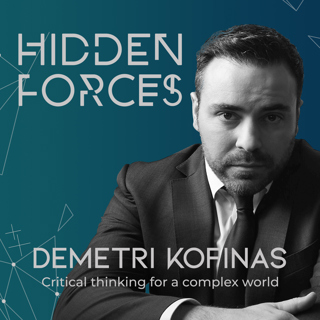
In Episode 77 of Hidden Forces, Demetri Kofinas speaks with Cal Newport about his latest book, Digital Minimalism and the act of "choosing life" in a hyperconnected world.

"The mass of men lead lives of quiet desperation," writes, transcendentalist author and essayist Henry David Thoreau, in the first chapter of Walden titled, "Economy." "But men labor under a mistake...the improvements of ages have had but little influence on the essential laws of man's existence." In an effort to uncover those "essential laws" Thoreau went to the woods: "I wished to live deliberately," he says, "to front only the essential facts of life, and see if I could not learn what it had to teach, and not, when I came to die, discover that I had not lived. I did not wish to live what was not life, living is so dear;"

What is often missed in Thoreau's reflections from his 2-year excursion into the woodlands of Concord, Massachusetts, is the rigor with which he calculated, measured, and weighed those "essential facts of life." Philosopher Frédéric Gros calls Thoreau's "New Economics," a theory that builds on the following axiom, which Thoreau establishes early in Walden: "The cost of a thing is the amount of what I will call life which is required to be exchanged for it, immediately or in the long run." "The striking thing with Thoreau," Gros argues, "is not the actual content of the argument. After all, sages in earliest Antiquity had already proclaimed their contempt for possessions…what impresses is the form of the argument. For Thoreau's obsession with calculation runs deep…he says: keep calculating, keep weighing. What exactly do I gain, or lose?"

In the century and a half since its publication, Thoreau's economics – his methodology for apprehending the cost of a thing by weighing and measuring it against the dearness of life's value – has been supplanted by allegiance to growth at all costs. But unlike the "mass of men" about which Thoreau writes in the mid-19th century, today's society is burdened by more than just the labor of miscalculation. In today's hyperconnected, surveillance economy, the mass of humanity has lost autonomy over that calculation, ceding authority to the commands of a new technocracy that governs the behavioral forces of our primitive biology through platforms scientifically engineered for addiction, supervision, and control.

Producer & Host: Demetri Kofinas

Editor & Engineer: Stylianos Nicolaou

Join the conversation on Facebook, Instagram, and Twitter at @hiddenforcespod

Jaksot(503)

How China Is Winning the Iran War | Jon Alterman

How China Is Winning the Iran War | Jon Alterman

In Episode 478 of Hidden Forces, Demetri Kofinas speaks with Jon Alterman, the Zbigniew Brzezinski Chair in Global Security and Geostrategy at the Center for Strategic and International Studies, abou...

30 Huhti 49min

US Grand Strategy & the Revenge of Geopolitics | Edward Luce

US Grand Strategy & the Revenge of Geopolitics | Edward Luce

In Episode 477 of Hidden Forces, Demetri Kofinas speaks with Edward Luce, columnist and US national editor at the Financial Times, about the history of American Grand Strategy and the revenge of geop...

20 Huhti 57min

Why America Cannot Afford to Lose Another War | Marvin Barth

Why America Cannot Afford to Lose Another War | Marvin Barth

In Episode 476 of Hidden Forces, Demetri Kofinas speaks with Marvin Barth, founder of Thematic Markets and former head of FX and EM macro research at Barclays, and Chief Economist for International A...

16 Huhti 49min

Who Wins and Who Loses in the AI Economy | John Burn-Murdoch

Who Wins and Who Loses in the AI Economy | John Burn-Murdoch

In Episode 475 of Hidden Forces, Demetri Kofinas speaks with John Burn-Murdoch, columnist and chief data reporter for the Financial Times, about AI's impact on the economy and jobs, the widening ideo...

13 Huhti 57min

The Last Ship Out of Hormuz: Why the REAL Supply Shock Is About to Hit | Rory Johnston

The Last Ship Out of Hormuz: Why the REAL Supply Shock Is About to Hit | Rory Johnston

In Episode 474 of Hidden Forces, Demetri Kofinas speaks with commodity economist and energy market analyst Rory Johnston — founder of CommodityContext.com and host of the Oil Ground Up Podcast — abou...

2 Huhti 51min

Here's Why Trump is in No Rush to Reopen the Strait of Hormuz | John Konrad

Here's Why Trump is in No Rush to Reopen the Strait of Hormuz | John Konrad

In Episode 473 of Hidden Forces, Demetri Kofinas speaks with Captain John Konrad — founder of gCaptain, the world's most-visited maritime and offshore news website, and one of the most influential vo...

1 Huhti 58min

The God Machine: Demis Hassabis and the Quest for Superintelligence | Sebastian Mallaby

The God Machine: Demis Hassabis and the Quest for Superintelligence | Sebastian Mallaby

In Episode 472 of Hidden Forces, Demetri Kofinas speaks with Sebastian Mallaby about Demis Hassabis, the co-founder of DeepMind and the man widely regarded as the most consequential figure in the dev...

30 Maalis 56min

Why There Are No Good Options Left in the US War Against Iran | Gregg Carlstrom

Why There Are No Good Options Left in the US War Against Iran | Gregg Carlstrom

In Episode 471 of Hidden Forces, Demetri Kofinas speaks with Gregg Carlstrom — Middle East correspondent for The Economist, based in Dubai and Riyadh, and a veteran reporter covering the region for f...

24 Maalis 48min

Suosittua kategoriassa Liike-elämä ja talous

sijotuskasti
mimmit-sijoittaa
rss-rahapodi
psykopodiaa-podcast
hyva-paha-johtaminen
rss-rahamania
rss-oivalluksia-rahasta-elamasta
rss-lahtijat
inderespodi
rahapuhetta
rss-startup-ministerio
rss-bisnesta-bebeja
rss-paasipodi
rss-inderes
oppimisen-psykologia
lakicast
rss-kaikki-somesta
rss-karon-grilli
rss-sisalto-kuntoon
rss-40-ajatusta-aanesta