Joanna Moncrieff - Challenging the New Hype About Antidepressants

Joanna Moncrieff - Challenging the New Hype About Antidepressants

This week, we interview Dr Joanna Moncrieff. Dr Moncrieff is a psychiatrist, academic and author. She has an interest in the history, philosophy and politics of psychiatry, and particularly in the use, misuse and misrepresentation of psychiatric drugs. As an author, Dr Moncrieff has written extensively on psychiatric drugs and her books include The Myth of the Chemical Cure, A Straight Talking Introduction to Psychiatric Drugs and The Bitterest Pills: the troubling story of antipsychotic drugs.

She is one of the founding members of the Critical Psychiatry Network which consists of psychiatrists from around the world who are sceptical of the idea that mental disorders are simply brain diseases and of the dominance of the pharmaceutical industry.

We talk about the recent meta-analysis of the efficacy and tolerability of 21 antidepressant drugs, widely reported in the UK news media on February 22nd.

In the episode we discuss:

  • The approach taken in the largest ever meta-analysis of efficacy and tolerability of 21 common antidepressant drugs.
  • The problems inherent in comparing antidepressants with each other, as opposed to trials that compare the active drug to a placebo.
  • That the main conclusion reached was that all the antidepressants studied were better than placebo at reducing depressive symptoms.
  • The limitations of the study, particularly how response rate was selected as the primary outcome measure.
  • That 'response' is mostly defined as a reduction in the Hamilton Depression Rating Scale (or other scale) rating of 50% or more during the study.
  • That the response rate can artificially inflate the difference between drug and placebo.
  • The problems with blinding in the supporting trials and the effects of including people who are already receiving antidepressant treatment.
  • That the study did not include adverse effects or withdrawal difficulties, only dropout rates which are not representative of the whole picture of taking the drugs.
  • The short-term nature of the supporting trials, mainly 8 weeks, with a range of 4 to 12 weeks, which cannot be easily compared with the real world experience of people taking the drugs for much longer periods.
  • That, when the primary data is analysed (the depression rating scale scores) the differences between placebo and antidepressants are very small and probably clinically insignificant.
  • The uncritical and sensational nature of the media reporting of the study and the link to the Science Media Centre.
  • The concerns about the reporting that depression is under-treated in the UK which is not supported by the results of the study.
  • That people should carefully consider the balance of benefit versus risk, taking into account the potential for adverse effects or difficulties stopping the drugs.

Relevant links:

Comparative efficacy and acceptability of 21 antidepressant drugs for the acute treatment of adults with major depressive disorder: a systematic review and network meta-analysis

Challenging the New Hype About Antidepressants

The Hamilton Depression Scale

Empirically derived criteria cast doubt on the clinical significance of antidepressant-placebo differences

Efficacy of antidepressants in adults

The Science Media Centre

Jaksot(290)

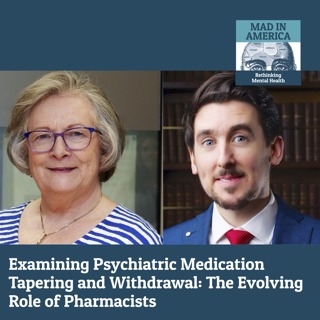
Examining Psychiatric Medication Tapering and Withdrawal: The Evolving Role of Pharmacists — A Conversation with Agnes Higgins and Cathal Cadogan

Examining Psychiatric Medication Tapering and Withdrawal: The Evolving Role of Pharmacists — A Conversation with Agnes Higgins and Cathal Cadogan

Welcome to the Mad in America podcast, my name is James. Today, we are discussing the experiences of people who have attempted to stop taking psychiatric drugs. These experiences are captured in a sur...

1 Huhti 32min
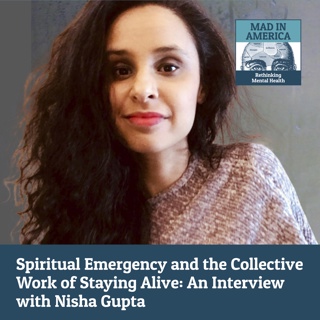
Spiritual Emergency and the Collective Work of Staying Alive: An Interview with Nisha Gupta

Spiritual Emergency and the Collective Work of Staying Alive: An Interview with Nisha Gupta

Nisha Gupta is an existential phenomenologist, a depth psychotherapist, a creativity scholar, and an artist. She's an Associate Professor of Psychology at the University of West Georgia and earned her...

25 Maalis 48min

The Political Systems Driving Abuse in Psychiatry: An Interview with Human Rights Lawyer Alicia Ely Yamin

The Political Systems Driving Abuse in Psychiatry: An Interview with Human Rights Lawyer Alicia Ely Yamin

Alicia Ely Yamin is the Director of the Global Health and Rights Project and a lecturer at Harvard Law School. She's also an adjunct senior lecturer on health policy and management at the Harvard T.H....

18 Maalis 45min
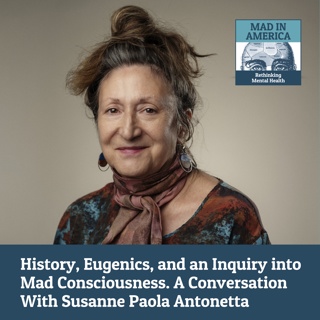
History, Eugenics, and an Inquiry into Mad Consciousness: A Conversation With Susanne Paola Antonetta

History, Eugenics, and an Inquiry into Mad Consciousness: A Conversation With Susanne Paola Antonetta

Susanne Paola Antonetta is an accomplished writer and poet, the author of numerous books, and in 2001 her book Body Toxic: An Environmental Memoir, won a prestigious American Book Award. Her latest bo...

11 Maalis 49min
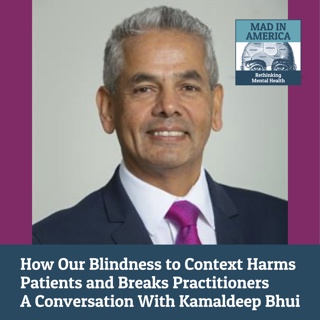
How Our Blindness to Context Harms Patients and Breaks Practitioners: A Conversation With Kamaldeep Bhui

How Our Blindness to Context Harms Patients and Breaks Practitioners: A Conversation With Kamaldeep Bhui

Kamaldeep Bhui is Professor of Psychiatry at the University of Oxford and Honorary Professor at Queen Mary University of London. He is internationally recognized for his groundbreaking work on cultura...

4 Maalis 51min
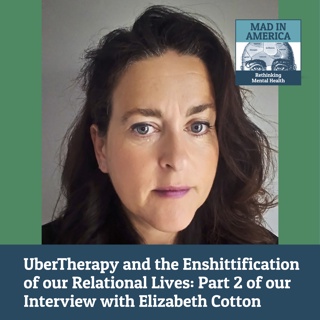
UberTherapy and the Enshittification of our Relational Lives: Part 2 of our Interview with Elizabeth Cotton

UberTherapy and the Enshittification of our Relational Lives: Part 2 of our Interview with Elizabeth Cotton

Elizabeth Cotton is Associate Professor of Responsible Business at the University of Leicester and the founder of Surviving Work, which carries out socially engaged research on mental health and work....

18 Helmi 39min
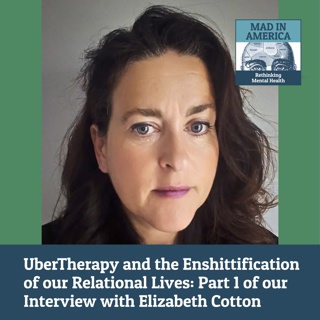
UberTherapy and the Enshittification of our Relational Lives: Part 1 of our Interview with Elizabeth Cotton

UberTherapy and the Enshittification of our Relational Lives: Part 1 of our Interview with Elizabeth Cotton

Elizabeth Cotton is Associate Professor of Responsible Business at the University of Leicester and the founder of Surviving Work, which carries out socially engaged research on mental health and work....

11 Helmi 46min
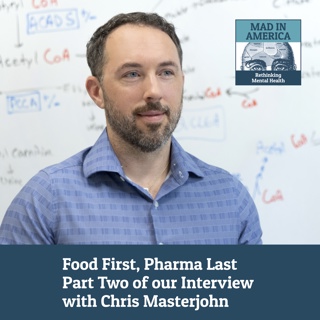
Food First, Pharma Last - Part Two of our Interview with Chris Masterjohn

Food First, Pharma Last - Part Two of our Interview with Chris Masterjohn

This week, we are joined by Chris Masterjohn, PhD. Chris is a nutritional scientist, a former professor, and the founder of Mitome. With a PhD in nutritional science and years of research in mitochond...

28 Tammi 44min

Suosittua kategoriassa Terveys ja hyvinvointi

unicast
tiedenaiset-podcast
psykopodiaa-podcast
voi-hyvin-meditaatiot-2
rss-pitaisko-erota
vakeva-elama-viisaampi-mieli-vahvempi-keho
meditaatiot-suomeksi
junnut-pelissa
rss-mighty-finland-podcast
puhu-muru
rss-narsisti
terapiassa
paritellen
aamukahvilla
mielen-puolikkaat
rss-uplevel-by-sonja-hannus
rss-pt-paahtio
rss-vapaudu-voimaasi
rss-adama-mindful-hetki
rss-nautinto