Kelly Brogan - The Science and Pseudoscience of Women's Mental Health

Kelly Brogan - The Science and Pseudoscience of Women's Mental Health

Science and Pseudoscience of Mental Health Podcast: Episode 3

This past week, I had the great pleasure to talk with Dr. Kelly Brogan, a leading voice in natural approaches to women's mental health. Dr. Brogan began her career as a conventional psychiatrist, but following the birth of her first child, she felt bereft of energy and mental clarity and was diagnosed with an autoimmune condition called Hashimoto's Thyroiditis. Informed by her doctor that she had a chronic illness that would require a lifetime of medication, she launched her own research into her condition which catalyzed a profound paradigm shift in her understanding of health and wellness. Her research led her to Robert Whitaker's Anatomy of an Epidemic after which time she permanently retired her prescription pad while turning towards natural interventions that support the body's innate capacity to heal.

With degrees from MIT and Weil Cornell Medical College, triple board certification in psychiatry, psychosomatic medicine and integrative holistic medicine, and direct experience practicing within the parameters of conventional psychiatry, Dr. Brogan is uniquely qualified to challenge the pseudoscience of the chemical imbalance theory and the drug regimens that it spawned. At the same time, her rigorous education conferred the investigative tools that enabled her to identify the scientific principles that support mental health. She focuses on the integrative nature of the gastrointestinal, immune, endocrine and nervous systems and their seamless communication with the ecosystem that resides within the body – the microbiome – and the ecosystem that surrounds us. This science is at the core of her thirty-day wellness protocol which she outlines in her New York Times bestselling book: A Mind of Your Own: The Truth About Depression and How Women Can Heal Their Bodies and reclaim Their Lives.

Our conversation addressed Dr. Brogan's grave concerns about the recent rollout of Zulresso (brexanolone), a drug specifically designed, and approved by the FDA for the treatment of Postpartum Depression. Drug trials that qualified Zulresso for FDA approval in fact revealed that its efficacy is weak at best, and not clinically significant. After 30 days, it was actually less effective than placebo. It requires an invasive 60-hour IV infusion with side effects that include sedation – sometimes to the point of loss of consciousness, separation of mother and infant, and cessation of breastfeeding. Women diagnosed with Postpartum Depression are suffering, but impactful interventions need to take into account the complex cultural, socioeconomic, personal and biological underpinnings of their symptoms. Masking symptoms with a drug that causes further disruption to their lives, lessens the likelihood that they will receive effective support. Dr. Brogan estimates that 80% of women who enter her practice having been diagnosed with Postpartum Depression have undetected and untreated thyroid conditions.

We also discussed the reckless prescribing of SSRI antidepressants to one in four American women, many of whom are pregnant, and the long-term epigenetic consequences of SSRIs following prenatal exposure. Dr. Brogan shared her approach to tapering from SSRIs both during pregnancy and as part of her general treatment protocol. Our conversation came to a close with a fascinating exploration of the science that informs the relationship between meditation and mental health. Dr. Brogan shared the transformative impact that her own daily meditation practice has had on her capacity to cope with stress.

To learn more about Dr. Brogan's clinical work and research, you can visit her website.

For other interviews in this series, click here.

© Mad in America

Jaksot(292)

Medical Organizations Turn Blind Eye to Harms of Maternal Antidepressant Use: A Conversation With Adam Urato and Joanna Moncrieff

Medical Organizations Turn Blind Eye to Harms of Maternal Antidepressant Use: A Conversation With Adam Urato and Joanna Moncrieff

On July 21st 2025, the FDA convened a hearing on maternal use of antidepressants during pregnancy and the impact this use has on fetal development. Around 400,000 children in the United States are bor...

8 Loka 202548min
Psychotherapy, Spirituality, and Democratic Socialism: A Conversation with Frank Gruba-McCallister

Psychotherapy, Spirituality, and Democratic Socialism: A Conversation with Frank Gruba-McCallister

Frank Gruba-McCallister is a clinical psychologist, educator, and scholar whose career spans more than three decades of teaching and academic leadership. He served as Vice President of Academic Affai...

24 Syys 202544min
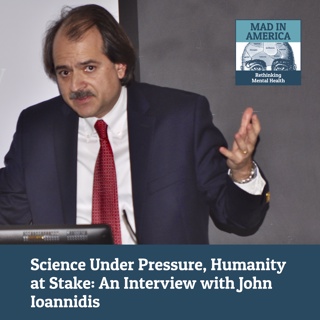
Science Under Pressure, Humanity at Stake: An Interview with John Ioannidis

Science Under Pressure, Humanity at Stake: An Interview with John Ioannidis

John Ioannidis is a Stanford professor, a physician, and one of the most eminent scholars in the world in the field of evidence-based medicine. Ioannidis has spent his career exposing the weak foundat...

10 Syys 202551min
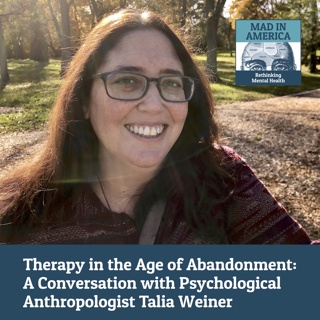
Therapy in the Age of Abandonment: A Conversation with Psychological Anthropologist Talia Weiner

Therapy in the Age of Abandonment: A Conversation with Psychological Anthropologist Talia Weiner

Talia Weiner is a psychological anthropologist, licensed professional counselor, and assistant professor of psychology at the University of West Georgia. As a medical and psychological anthropologist,...

3 Syys 202537min
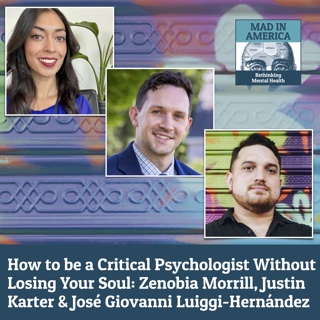
How to be a Critical Psychologist Without Losing Your Soul: A Conversation With Zenobia Morrill, José Giovanni Luiggi-Hernández and Justin Karter

How to be a Critical Psychologist Without Losing Your Soul: A Conversation With Zenobia Morrill, José Giovanni Luiggi-Hernández and Justin Karter

On the Mad in America podcast this week, we explore the importance of raising awareness of psychological approaches that challenge mainstream perspectives. Joining us today are three people who are pr...

13 Elo 202545min
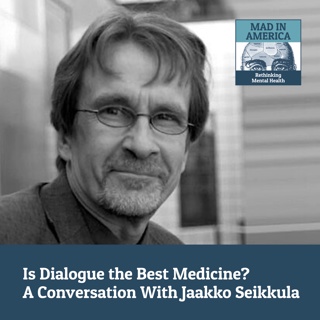
Is Dialogue the Best Medicine? A Conversation With Jaakko Seikkula

Is Dialogue the Best Medicine? A Conversation With Jaakko Seikkula

Welcome to MIA Radio. Today, we are pleased to have as our guest Jaakko Seikkula. Jaakko is a psychologist who helped develop the Open Dialogue practice at Keropudas Hospital in Tornio, Finland, in th...

30 Heinä 202545min
"I Made it Through the Horrors of Psychiatric Drug Withdrawal" A Conversation with Comedian Dex Carrington

"I Made it Through the Horrors of Psychiatric Drug Withdrawal" A Conversation with Comedian Dex Carrington

Jørgen Kjønø, whose stage name is Dex Carrington, is a Norwegian-American stand-up comedian based in Oslo, Norway. He is also an actor, host of the Truth Train podcast, and former travel show host who...

9 Heinä 202542min
Why Psychosis Is Not So Crazy: A Conversation with Stijn Vanheule

Why Psychosis Is Not So Crazy: A Conversation with Stijn Vanheule

Stijn Vanheule is a clinical psychologist, psychoanalyst, and professor of psychology at Ghent University. Trained in the Lacanian tradition, he has written widely on the structure of psychosis, the l...

25 Kesä 202544min

Suosittua kategoriassa Terveys ja hyvinvointi

unicast
voi-hyvin-meditaatiot-2
tiedenaiset-podcast
vakeva-elama-viisaampi-mieli-vahvempi-keho
psykopodiaa-podcast
rss-pitaisko-erota
katilon-kahvitunti
puhu-muru
rss-uplevel-by-sonja-hannus
rss-rakas-mielenterveyteni
rss-narsisti
terapiassa
rss-ehjaksi
rss-duodecim-lehti
rss-vapaudu-voimaasi
selviytyjat-tarinoita-elamasta
rss-pt-paahtio
rss-eropodi
rss-mighty-finland-podcast
rss-kyykkya-ja-kuoharia