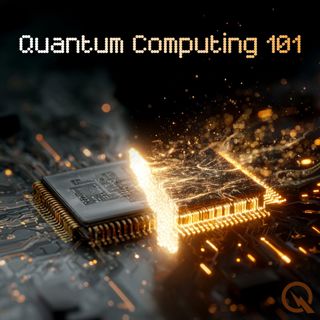
Quantum-Classical Fusion: Hybrid Architectures Accelerate Breakthroughs | Quantum Computing 101

Quantum-Classical Fusion: Hybrid Architectures Accelerate Breakthroughs | Quantum Computing 101

This is your Quantum Computing 101 podcast.

The news electrified my office this morning—the hum of quantum processors was practically drowned out by headlines of the latest hybrid solution poised to bridge quantum and classical computing once more. I’m Leo, Learning Enhanced Operator, and you’re listening to Quantum Computing 101.

Let’s cut right into what’s making my qubits tingle with excitement: the new hybrid architectures that go beyond theoretical promise, shaping real technological inflection points. This week, Diraq and Quantum Machines pulled off what many called impossible just months ago: a genuinely integrated quantum-classical architecture, centered on the NVIDIA DGX Quantum platform. Picture this—blindingly fast CPUs and GPUs, cradled with a quantum processing unit, linked over an ultra-low-latency interconnect that shaves response times to under 4 microseconds. It’s like having a conversation with the quantum world in real time, each decision echoing back before decoherence has a chance to intervene.

As a quantum specialist, I see it as choreographing a ballet where classical and quantum dancers switch seamlessly mid-performance. In these new experiments, classical reinforcement learning re-tunes quantum experiments as they happen. The result? Keeping fragile quantum states, like three-qubit GHZ states, perfectly orchestrated—using machine learning models that auto-correct drift, noise, and error in the same breath as the quantum calculation. This isn’t merely theoretical optimization. Early reports show hybrid workflows accelerating calibration, feedback, even quantum error mitigation, all within the fleeting windows where qubits remain coherent. It’s dramatic, it’s immediate, and it’s the future—right now.

There’s more: just published is a framework called hybrid sequential quantum computing. Think of it as a relay race for algorithms. Classical optimizers sprint the first lap, rapidly sifting through a mountainous problem space. As they tire, quantum processors leap in, tunneling through the most stubborn local minima—just as John Clarke, Michel Devoret, and John Martinis, this year’s Nobel Prize laureates, once envisioned in their pioneering work on quantum tunneling. When quantum hardware can’t quite cross the finish line—thanks to decoherence or hardware noise—a third lap of classical refinement closes the gap, guaranteeing the best performance in speed and solution quality. On advanced superconducting processors, this yields runtime improvements up to two orders of magnitude over classical solvers in complex optimization tasks.

The world outside may credit the International Year of Quantum Science for today’s fever pitch of innovation, but here in the lab, I see it as a manifestation of quantum-classical complementarity. Hybrids fuse the raw pattern-finding power of classical AI with quantum’s uncanny ability to breach what once seemed computationally insurmountable.

If you have burning questions or topics you’d love featured, email me at leo@inceptionpoint.ai. Make sure to subscribe to Quantum Computing 101, and remember, this has been a Quiet Please Production. For more, check out quiet please dot AI.

For more http://www.quietplease.ai


Get the best deals https://amzn.to/3ODvOta

This content was created in partnership and with the help of Artificial Intelligence AI

Jaksot(286)

Fugaku Meets Heron: How Japan's Quantum-Classical Supercomputer Fusion Cracked Chemistry's Hardest Problems

Fugaku Meets Heron: How Japan's Quantum-Classical Supercomputer Fusion Cracked Chemistry's Hardest Problems

This is your Quantum Computing 101 podcast.Imagine this: just two days ago, on February 18, 2026, RIKEN and IBM flipped the switch on a quantum revolution right here in Japan. Their pre-exascale super...

20 Helmi 3min

Euro-Q-Exa Unveiled: How 54 Qubits Just Merged With Classical Supercomputing to Crack Real World Problems

Euro-Q-Exa Unveiled: How 54 Qubits Just Merged With Classical Supercomputing to Crack Real World Problems

This is your Quantum Computing 101 podcast.Imagine this: just two days ago, on February 16, 2026, researchers at Spain's CSIC and Delft University of Technology cracked the code on reading Majorana qu...

18 Helmi 3min

Quantum Hybrids Crack the Code: How IBM's QeMCMC Solves Problems Classical Computers Can't Touch

Quantum Hybrids Crack the Code: How IBM's QeMCMC Solves Problems Classical Computers Can't Touch

This is your Quantum Computing 101 podcast.Imagine this: just days ago, on February 11, 2026, researchers at QuTech in Delft and CSIC in Spain cracked the readout code for Majorana qubits in a Nature ...

16 Helmi 3min

Quantum Goes Sovereign: How Hybrid SuperQ Hubs and Majorana Qubits Are Cracking the Code in 2026

Quantum Goes Sovereign: How Hybrid SuperQ Hubs and Majorana Qubits Are Cracking the Code in 2026

This is your Quantum Computing 101 podcast.Imagine this: just days ago, on February 11, 2026, researchers at QuTech in Delft unveiled single-shot parity readout for Majorana qubits in Nature—a breakth...

15 Helmi 3min

Quantum Meets Classical: How QACG Framework Solves Impossible Problems Without Waiting for Perfect Qubits

Quantum Meets Classical: How QACG Framework Solves Impossible Problems Without Waiting for Perfect Qubits

This is your Quantum Computing 101 podcast.Picture this: you're standing in a laboratory where quantum and classical computing shake hands like old rivals finally recognizing each other's worth. That'...

13 Helmi 3min

IBM's 117-Qubit Breakthrough: How Quantum-Classical Hybrids Are Solving Real Problems Today

IBM's 117-Qubit Breakthrough: How Quantum-Classical Hybrids Are Solving Real Problems Today

This is your Quantum Computing 101 podcast.Imagine this: just days ago, on February 10th, IBM Quantum researchers Kate V. Marshall, Daniel J. Egger, and Michael Garn unveiled a quantum-classical hybri...

11 Helmi 2min

H-QNN Breakthrough: How WiMi's Hybrid Quantum Neural Network Just Turbocharged AI Image Recognition in 2026

H-QNN Breakthrough: How WiMi's Hybrid Quantum Neural Network Just Turbocharged AI Image Recognition in 2026

This is your Quantum Computing 101 podcast.Imagine this: just days ago, on February 6th, WiMi in Beijing unveiled their Hybrid Quantum-Classical Neural Network—H-QNN for short—and it's rewriting the r...

9 Helmi 4min

Hybrid Quantum Computing Breakthrough: How D-Wave and Anduril Boosted Missile Defense by 12 Percent in 2025

Hybrid Quantum Computing Breakthrough: How D-Wave and Anduril Boosted Missile Defense by 12 Percent in 2025

This is your Quantum Computing 101 podcast.Imagine this: just days ago, on February 6th, D-Wave, Anduril, and Davidson Technologies unveiled a quantum-classical hybrid powerhouse that shredded missile...

8 Helmi 3min

Suosittua kategoriassa Politiikka ja uutiset

uutiscast
aikalisa
ootsa-kuullut-tasta-2
politiikan-puskaradio
rss-ootsa-kuullut-tasta
tervo-halme
rss-podme-livebox
rss-pinnalla
rss-vaalirankkurit-podcast
otetaan-yhdet
aihe
rss-asiastudio
rss-ulkopoditiikkaa
the-ulkopolitist
rss-raha-talous-ja-politiikka
et-sa-noin-voi-sanoo-esittaa
radio-antro
rss-tasta-on-kyse-ivan-puopolo-verkkouutiset
rss-girls-finish-f1rst
lotta-paakkunainen