20VC: Scaling to a $1.3Bn Valuation While in Stealth, The Power of Different Network Effects Within Payment Platforms & How To Leverage Your Board and Investor Base for the Most Value with Matan Bar, Founder & CEO @ Melio
Matan Bar is the Co-Founder & CEO @ Melio, the company that provides the simplest way to pay vendors and contractors. To date, Matan has raised over $254M for Melio from the likes of Accel, Bessemer, Aleph, Coatue and General Catalyst to name a few. Prior to founding Melio, Matan Bar was Head of PayPal Consumer Product Center and before that was a Head of Product and GM @ eBay in their Israel Innovation Center. In Today's Episode You Will Learn: 1.) How Matan Bar made his way into the world of startups and came to found one of the fastest-growing companies today in the form of Melio? 2.) What is the single most important thing in a financial transaction business? How does Matan think about the balance between optimising for transaction volume vs revenue? What does Matan believe are the core network effects within payments businesses? Why do most opt for closed network effects? How is Melio different? 3.) What have been some of the biggest challenges of adding 170 people in one year? What breaks first? What needs to be in place to ensure the culture can scale with the headcount? How does Matan structure the leadership team to manage this hyper-growth? Has Matan struggled with self-doubt in his leadership during this hyper-growth? 4.) What specifically has Melio and Matan done to achieve a 49% female to male ratio within the company? What works when it comes to implementing diversity at scale? Where do so many people make mistakes? What specific strateies have allowed Melio to hire some of the best female engineers? 5.) How does Matan most like to interact with his board? How does he determine the advice to ingest vs the advice to reject? What have been some of his biggest lessons when it comes to successful board management? Where do many first time founders make mistakes when it comes to investor value add and extraction? Item's Mentioned In Today's Episode Matan's Favourite Book: The Unbanking Of America: How the New Middle Class Survives As always you can follow Harry and The Twenty Minute VC on Twitter here! Likewise, you can follow Harry on Instagram here for mojito madness and all things 20VC.
11 Helmi 202134min
20VC: Aleph's Michael Eisenberg on Why Generalists Over Specialists, Why Boutique Smaller Firms Over Multi-Stage Firms, Portfolio Construction Theory, Capital Concentration Limits and How To Think Through Reserve Allocations with Market Cycles in Mind?
Michael Eisenberg is a Co-Founder and Equal Partner @ Aleph, with over $550M under management and a portfolio including the likes of Lemonade, Melio and HoneyBook, they are one of the leading early-stage firms of the last decade. Prior to founding Aleph, Michael spent 15 years as a General Partner @ Benchmark and before that, made his way into venture with Israel Seed Partners where he built an incredible portfolio over an 8 year period. If all of this was not enough, Michael is also an author having published 4 books. In Today's Episode You Will Learn: 1.) How Michael made his way into venture over 25 years ago and how his 15 years at Benchmark led to his founding Aleph? 2.) How has seeing multiple booms and busts impacted Michael's investing mindset? What do many misunderstand when it comes to reserve allocations in market cycles? Why does Michael believe busts are more psychologically impactful than financially impactful? 3.) How does Michael approach portfolio construction with Aleph today? How does Michael think about the right level of portfolio diversification? How does Michael think about the right level of capital concentrated into one company? How does Michael assess the difference between risk and uncertainty? What do many misunderstand between the two? 4.) Why does Michael believe in generalist VCs over specialist VCs? Why do they win? Why does Michael believe in small boutique firms vs large multi-stage firms? How does Michael think about the notion of ownership on first check? Is it possible to really build ownership across rounds today? 5.) How does Michael reflect on his own style of board membership today? How has it changed? What have been some of Michael's biggest lessons on board membership from Bruce Dunlevie @ Benchmark? What advice does Michael have to newer investors joining boards for the first time? Item's Mentioned In Today's Episode Michael's Most Recent Investment: Melio As always you can follow Harry and The Twenty Minute VC on Twitter here! Likewise, you can follow Harry on Instagram here for mojito madness and all things 20VC.
8 Helmi 202144min
20VC: Why VCs Should Care More About Cost of Capital and Less About Ownership, Investing Lessons from working with Peter Thiel at Founders Fund, Why Liquidity Aligns Incentives Between Founders and Investors & Why It Is The Last Double That Matters in Ven
Justin Fishner-Wolfson is founder and the managing partner of 137 Ventures, a growth-stage venture firm that provides customized liquidity solutions to founders, investors, and early employees of high-growth private technology companies. Their portfolio includes the likes of SpaceX, Wish, Anduril, Flexport, and Rigup to name a few. Previously, Justin worked on the investment team at Founders Fund and before that served in the US Department of State under Alan Larson, Undersecretary for Economic, Business and Agricultural Affairs. In Today's Episode You Will Learn: 1.) How Justin made his way into the world of venture with Founders Fund and how that led to his founding 137 Ventures? What specific lessons did he learn from Peter Thiel that he has applied to his investing mindset? 2.) What does Justin mean when he says, "it is the last double that matters"? Why does Justin believe that liquidity aligns incentives between VCs and founders? When is the right timing for this liquidity and are there limits to the sizes of secondaries founders and teams should take? 3.) How does Justin think about his own price sensitivity today? Why does Justin believe that the conventional VC views on ownership are outdated and no longer as relevant to this class of company? How does Justin think about diversification among the portfolio today? What is the right level? What is too diversified? What is too concentrated? 4.) Why does Justin believe that standard thoughts around CAC/LTV are wrong? How have they changed over time? How should founders think about this and present these metrics to investors? Given these metrics, how does Justin feel about the revenue multiples we are seeing today both in private and public markets? Item's Mentioned In Today's Episode Justin's Favourite Book: The Hitchhiker's Guide to the Galaxy Justin's Most Recent Investment: Lattice As always you can follow Harry and The Twenty Minute VC on Twitter here! Likewise, you can follow Harry on Instagram here for mojito madness and all things 20VC.
4 Helmi 202139min
20VC: Supercell Founder Ilkka Paananen on What it Means To Be "The Least Powerful CEO", His Relationship To Wealth and Risk & How To Create Environments of Safety Where Your Team Can Be Their Best and Most Ambitious Selves
Ilkka Paananen is the Co-Founder & CEO @ Supercell, the makers of some of the most wildly successful games of the last decade including Hay Day, Clash of Clans, Boom Beach and more. Prior to Tencent acquiring a majority stake in the company at a reported $10.2Bn acquisition, Ilkka raised over $143M for the company from Accel, Index, Atomico, IVP, LVP, Initial and Lifeline. Throughout his incredible leadership of Supercell he has coined the term, "the least powerful CEO", a fascinating concept and one we dig into in this episode. In Today's Episode You Will Learn: 1.) How Ilkka made his way into the world of startups and came to found one of Europe's most valuable companies in the form of Supercell? 2.) How does Ilkka think about his own relationship to risk? Why does Ilkka believe the No 1 reason companies die is due to their relationship to risk? How does Ilkka evaluate his relationship to money? How has it changed? How does Ilkka feel the weight of responsibility with his wealth? 3.) What does being "the least powerful CEO" mean in practice? What does Ilkka belive is key for leaders to really empower their team to be bold and ambitious? How can leaders create environments of safety where it is ok to fail? Where do many leaders go wrong here? 4.) The first 3 Supercell games were failures, how did Ilkka deal with those really hard times? How can leaders sustain morale in such hard times? Supercell then had 3 big hits in a row, how does one prevent ego and over-confidence in teams? What is the beer vs champagne culture? 5.) How does Ilkka think about the importance of focus? What has Ilkka done and learned to be a much more focused leader? How does Ilkka approach the aspect of competition today? Item's Mentioned In Today's Episode Ilkka's Favourite Book: What You Do Is Who You Are: How to Create Your Business Culture by Ben Horowitz As always you can follow Harry and The Twenty Minute VC on Twitter here! Likewise, you can follow Harry on Instagram here for mojito madness and all things 20VC.
1 Helmi 202129min
20VC: Why "Founder Insight" is Overrated, Why Big and Bold Product Visions Can Be Dangerous & Why Getting To Product Market Fit by Accident Can Lead to Danger with Hubert Palan, Founder & CEO @ ProductBoard
Hubert Palan is the Founder & CEO @ ProductBoard, helping product managers understand what customers need, prioritize what to build next, and rally everyone around the roadmap. To date, Hubert has raised over $64m for ProductBoard from the likes of Sequoia, Index, Kleiner Perkins, Bessemer and Credo Ventures to name a few. Prior to founding the company, Hubert was VP Product Management @ GoodData where he played an instrumental role in their scaling from 6 to 300 people. In Today's Episode You Will Learn: 1.) How Hubert made his way from Eastern Europe to SF, made his way into the world of product management and came to found ProductBoard? 2.) Why does Hubert believe that "founder insight" is overrated? What strategies and tactics does Hubert give to founders to be more mentally plastic and flexible? How does one know when to persist when things are not working vs when to give up? What is the decision-making framework? 3.) Why does Hubert believe that "big and bold product vision can be dangerous"? How does Hubert think about when is the right time to release a second product? What are the core elements to tackle when thinking about a second product? Where do many make mistakes here? 4.) Why does Hubert believe that, "if you get to product market fit by accident, you could be in trouble?" What does Hubert advise in terms of studying if and how you got to product market fit? How can one use post-mortem analyses here effectively? 5.) Why does Hubert believe that transparency is so necessary today with the team? Should founders be transparent when it comes to M&A, fundraising etc? Where are the limits? What makes it so hard to instil effectively? What do many founders misunderstand? Item's Mentioned In Today's Episode Hubert's Favourite Book: Elad Gil's High Growth Handbook As always you can follow Harry and The Twenty Minute VC on Twitter here! Likewise, you can follow Harry on Instagram here for mojito madness and all things 20VC.
29 Tammi 202139min
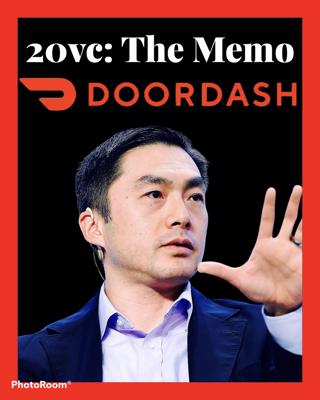
20VC: The Memo: Sequoia's Alfred Lin on Why Chasing GMV Leads To Bad Behaviours, How To Approach Competition and Capital Efficiency & The Core Importance of Understanding the Difference Between Input and Output Metrics
Alfred Lin is a Partner @ Sequoia Capital, one of the world's most renowned and successful venture firms with a portfolio including the likes of Google, Airbnb, Whatsapp, Stripe, Zoom, Doordash and many more. As for Alfred, he has led deals in the likes of Airbnb, Doordash, Instacart, Reddit and Houzz to name a few. Prior to the world of venture, Alfred was Chairman and COO @ Zappos for 6 years leading to their acquisition by Amazon. In Today's Episode You Will Learn: 1.) How Alfred made his way into the world of venture and came to be a Partner @ Sequoia? How Alfred first met DoorDash? Where did the meeting take place? Who was there? What were the first impressions? 2.) Market: How did Alfred breakdown the food delivery market when doing the diligence for the investment? How did Alfred forsee the market changing over time? What were some unexpected elements of the market Alfred did not forsee? What does Alfred look for in markets; size or growth? 3.) Competition: How did Alfred analyse the competitive landscape for food delivery at the time? Why does Alfred believe that great companies are not built by focusing on the competition? What does Alfred mean when he says, "you have to be customer-obsessed and competitor aware"? 4.) Traction: Does Alfred agree with Sarah Tavel in the dangers of chasing topline GMV? What negative behaviours can chasing GMV trigger? What does Alfred mean when he says, "founders have to be able to distinguish between input and output metrics"? 5.) Acquisition: What does Alfred believe DoorDash did so well in terms of acquiring drivers more efficiently? How did they retain them so effectively? What allowed DoorDash to compete so effectively when it came to merchant acquisition? What were some of Alfred's biggest takeaways when it came to DoorDash's customer acquisition journey? As always you can follow Harry and The Twenty Minute VC on Twitter here! Likewise, you can follow Harry on Instagram here for mojito madness and all things 20VC.
27 Tammi 202140min
20VC: Evernote & mmhmm Founder Phil Libin on Why We are Beginning a Multi-Trillion Dollar Restructuring of the World, Why Shortcuts are the Biggest Mistakes Startups Make & The Future of Video and The Unbundling of Zoom
Phil Libin is the Founder and CEO @ mmhmm, the app that allows you to level up your remote presentations, making high-quality video content in minutes. To date, Phil has raised over $30M for the company from an incredible investor base including Sequoia, Kevin & Julia Hartz, Tony Fadell, Instagram's Kevin Systrom and Mike Krieger and Brianne Kimmel. Prior to mmhmm, Phil was a Managing Director @ General Catalyst and prior to his time in venture, Phil most famously founded Evernote, where he led the business with phenomenal success, as CEO for over 8 years. In Today's Episode You Will Learn: 1.) How Phil made his way into the world of startups, came to found Evernote and how that led to his founding of mmhmm, most recently? 2.) How would Phil describe his management style today? How has it changed over time? Why does Phil believe shortcuts are the greatest mistakes startups make? What does Phil believe you can vs cannot take shortcuts on? What have been some real world lessons there? 3.) What were Phil's biggest takeaways from his time in venture? How did it change his operating mindset? Does Phil believe there is an incentive misalignment between founder and VC? Why is Roelof Botha the best board member Phil has worked with? What makes him so special? 4.) How does Phil think about the unbundling/verticalisation of Zoom? How does he predict the market evolving? How does Phil see the differing usage patterns between consumer and business? Why does Phil believe more can be learned from looking at similarities and not differences? 5.) What does Phil believe are the two classes of mistakes when scaling startups? What have been Phil's biggest lessons on acquiring and retaining the best talent? How does Phil create an environment of dissent where anyone can bring their entire self and beliefs to the table? Item's Mentioned In Today's Episode Phil's Favourite Book: Kafka on the Shore As always you can follow Harry and The Twenty Minute VC on Twitter here! Likewise, you can follow Harry on Instagram here for mojito madness and all things 20VC.
25 Tammi 202141min
20VC: Hims Founder Andrew Dudum on Hims Going Public, The Reasoning and Benefits of SPACs, The Biggest Misconceptions of Successful Company Building & Wall St's Changing Perceptions Towards Growth and Profitability
Andrew Dudum is the Founder & CEO @ Hims & Hers, offering a modern approach to health and wellness and one of the fastest-growing companies to reach $1Bn. Prior to their going public on Tuesday this week, Hims raised over $158M from some of the best including Thrive, Forerunner, Founders Fund, IVP, Redpoint and more. As for Andrew, alongside his role at Hims he is also Co-Founder of Atomic, a company builder and venture fund all in one, backed by Peter Thiel and Marc Andreesen to name two. Prior to Atomic, Andrew led product at TokBox managing a team of 30 leading to their acquisition by Telefonica in 2012. In Today's Episode You Will Learn: 1.) How Andrew made his way from Head of Product at Tokbox to venture capitalist with Atomic to changing healthcare with Hims? 2.) What are the biggest misconceptions people have with regards to what it takes to build a successful company? Why do you not need big teams? How can leaders drive efficiency within small teams? What have been Andrew's biggest lessons in acquiring the best talent in market? What works? 3.) Hims is the fastest company to scale to $1Bn, how does Andrew reflect on how he managed hyper-growth? What did he do well? What was the first to break? What would he do differently? When is the right time to go from generalist to specialist? When is the right time to add more products? 4.) Why did Andrew believe now was the right time to IPO just 4 years into the founding of the business? How did the SPAC process play out? What are the core advantages to Andrew of the SPAC over an IPO? Why will more founders use it in the future? How does Andrew assess the importance or lack of, when it comes to the pricing pop on IPO day? 5.) How does Andrew reflect on his relationship to money? Why does he feel more scared of it now than ever before? How does he think about bringing up his children with an appreciation and respect for money? What 3 traits would Andrew most like his children to have? Item's Mentioned In Today's Episode Andrew's Favourite Book: The Planet Remade: How Geoengineering Could Change the World As always you can follow Harry and The Twenty Minute VC on Twitter here! Likewise, you can follow Harry on Instagram here for mojito madness and all things 20VC.
21 Tammi 202135min