

20VC: Forerunner's Kirsten Green on The Biggest Challenges Scaling Both Teams and AUM, What Truly is High Performance in Fund Management & Why Parenting and Relationships are an Enabler To Your Best Work
Kirsten Green is the Founder and Managing Partner @ Forerunner Ventures, one of the leading firms of the last decade investing at the intersection of innovation and culture. As a founder, Kirsten has led efforts to raise over $2B+ from leading institutional investors and invest in more than 100 companies. She currently serves as a board member at Glossier, Ritual, Faire, Hims & Hers, and Curated, to name a few. She has also invested in other smash hits including Chime, Jet, Warby Parker, Hotel Tonight and many more. Due to her immense success, Kirsten has been honored in Time's 100 Most Influential People and named a Top 20 Venture Capitalists by The New York Times in 2018 & 2017. Prior to Forerunner, Kirsten was an equity research analyst and investor at Banc of America Securities. In Today's Episode with Kirsten Green We Discuss: 1.) Entry in Venture at 40 and Founding Forerunner: How did Kirsten make her way into VC at 40 with the founding of Forerunner having never had a role in VC before? What did everyone tell Kirsten when she was looking to break into venture? What did she tell herself when she heard this? What does Kirsten believe she is running from? What does she believe she is running toward? 2.) Fund Management and Leadership: How does Kirsten define high-performance today? What are the nuances of high performance in fund management? How would Kirsten describe her leadership style today? How has it changed over time? What have been some of Kirsten's biggest lessons in terms of what it takes to retain quality with scaling AUM and teams? What have been Kirsten's biggest lessons when it comes to giving hard feedback with kindness? 3.) The Venture Landscape Today and Forerunner's Position: Why does Kirsten believe the venture landscape is more dynamic today than ever? Does Kirsten agree with the statement that venture is less collaborative than ever? Why did Kirsten and Forerunner seem to amend strategy and move into B2B? Why does Kirsten disagree with the delineation between B2C and B2B? 4.) Parenting, Relationships and Life: What have been Kirsten's biggest lessons since becoming a parent? How has it impacted her mindset? Does Kirsten agree that relationships attract from sheer input on work? How does Kirsten separate relationships into two kinds of relationships? What does success in marriage mean for Kirsten? How has she seen that in her own marriage?
1 Elo 202241min

20VC: Yahoo CEO Jim Lanzone on The Yahoo Turnaround Plan; What Needs To Happen | Leadership 101: The 4 Things To Look For When Hiring | Surviving a Crash; Biggest Advice on Cuts, Layoffs, Investor Communications
Jim Lanzone is the CEO @ Yahoo, a company that today reaches nearly 900 million people around the world and is the third largest property on the Internet. Prior to Yahoo, Tim was the CEO of Tinder, the world's most popular app for meeting new people, downloaded by more than 400 million people. Before Tinder, Jim spent a decade as President and CEO of CBS Interactive, a top 10 global Internet company with brands ranging from CBS All Access to CNET. He joined CBS Interactive in 2011 when CBS Corporation purchased Clicker Media, where he was founder and CEO. Before founding Clicker, Jim served as CEO of Ask.com (formerly Ask Jeeves). In Today's Episode with Jim Lanzone 1.) Jim's Entry into the World of Startups: How did Jim go from law school to founding his first tech startup in the dot com boom? How did seeing the crash and the first company going bust, shape Jim's perspectives on great leadership? What does Jim know now that he wishes he had known when he started way back in 1999? 2.) Leadership 101: How does Jim define "high performance" in business today? What are the 4 things Jim always looks for when hiring new people? Why does Jim believe the standard interview process and questions are broken? How does he do it differently? What are his biggest lessons on how to hire effectively? How does Jim know when to let someone go? How long do you give under-performers? 3.) Crashes and Turnarounds: Jim has seen three crashes as a CEO, what are Jim's biggest lessons from 3 prior crashes? How does Jim advise founders to be acting today? What should they focus on? How can leaders maintain morale and optimism in the face of tough macro times? How does Jim advise founders to communicate both with their investors and board when it comes to reduced performance in harder times? 4.) The Yahoo Turnaround: What does Jim believe the 1-2 core things Yahoo needs to fix is? Why are they priorities? How does Jim approach turning round the Yahoo brand? How does he plan to make it attractive? What is the biggest misnomer that people have about Yahoo today? How does Jim think about running a portfolio approach with Yahoo moving forward? How has Jim changed the org structure and management of Yahoo most significantly? Items Mentioned in Today's Episode: Jim's Favourite Book: Team of Rivals: The Political Genius of Abraham Lincoln
29 Heinä 202246min

20VC: The Memo: What is a Sales Playbook? Does the Founder Need to Create It? Should the First Sales Hire Be a Leader or a Rep?
Today we deconstruct the canonical question in early-stage sales. Does the founder need to create the sales playbook? Then secondly, if not, should the first sales hires be reps or a sales leader? Today we are joined by 7 of the best sales leaders to share their thoughts. Jordan Van Horn is a Revenue Leader @ Montecarlo. Previously Jordan spent 4 years with Segment and before that spent another 4 years at Dropbox. Oliver Jay (OJ) most recently spent 6 years at Asana where he was hired as the company's first revenue leader. Before Asana, OJ spent 4 years at Dropbox where he scaled the sales team from 0 to 50 while tripling ARR. Dannie Herzberg is a Partner @ Sequoia Capital and previously spent 4 years at Slack as their Head of Enterprise Sales. Before Slack, Dannie spent 5 years at Hubspot building sales, opening an SF office, and then joining product to launch CRM & platform. Zhenya Loginov is the CRO @ Miro, where he runs the go-to-market team of 700+ people across 11 global offices. Prior to Miro, Zhenya was the COO @ Segment. Finally, before Segment, Zhenya led a 100-person team at Dropbox across numerous different functional areas. Kyle Parrish is VP Sales @ Figma, where he has scaled the sales team from 0 to over 100 people in sales. Before Figma, Kyle spent over 5 years at Dropbox in numerous different roles including Head of Sales, where he scaled the Austin, Texas office from 3 to over 80 people. Sam Taylor is the VP of Sales and Customer Success @ Loom, at Loom Sam leads Revenue Org including: Direct Sales, Customer Success, Self-Serve Revenue Growth/Assist. Prior to Loom, Sam spent over 4 years at Salesforce, following their acquisition of Quip, where he was the first sales leader. Before Salesforce and Quip, Sam spent over 3 years at Dropbox as a mid-market sales leader. Jeanne DeWitt Grosser is Head of Americas Revenue & Growth @ Stripe. Pre-Stripe, Jeanne was CRO @ Dialpad and also spent many years at Google in numerous different roles including most recently as Director of GSuite SMB & Mid-Market Sales, North America and LATAM. Mitch Tarica is Head of North America Sales at Zoom Video Communications. Before Zoom, Mitch spent over 5 years at RingCentral and before RingCentral, Mitch was at Oracle for over 7 years in numerous different sales roles. In Today's Discussion on Sales Playbooks We Learn: 1.) What is the right definition for a "sales playbook"? 2.) When is the right time to change your "sales playbook"? 3.) What are the biggest mistakes or misnomers made around the "sales playbook"? 4.) Should the founder be the one to create the first sales playbook or can it be a sales leader? 5.) When is the right time for founders to hire their first sales leaders? 6.) For the first sales hire, should founders hire sales reps or a sales leader? 7.) When should you hire a rep vs a sales leader? What are the nuances?
27 Heinä 202232min

20VC: Tony Fadell on The 3 Hats of Being a CEO, How the Best Leaders Inspire, How to Create Your Own Role within a Company, The Art of Parenting and Teaching Children Resiliency & New York Times' 36 Questions on Love!
Tony Fadell, often referred to as the father of the iPod is one of the leading product thinkers of the last 30 years as one of the makers of some of the most revolutionary products in society from the iPhone and iPod to more recently founding Nest, creating the Nest Thermostat, leading to their $3.2BN acquisition by Google. Tony recently released Build, a masterclass taking 30 years of product and company building lessons and packaging them for you, check it out here. In Today's Episode with Tony Fadell: New York Times' 36 Questions of Love 1.) On reflection, what would Tony most like to change about his childhood? How did moving so much as a child change who Tony was as a person? How can parents instill that same grit and desire in their kids today? What does Tony think is the biggest problem with modern parenting? 2.) As a leader, should the company you are building be a family or a team? What does Tony believe are the 3 hats of being a great CEO? What is the biggest challenge in the transition between hats? Where does Tony see many founders make the biggest mistake? Which hat was Tony strongest with? What was he weakest with? 3.) How to solve the loneliness of being a solo founder? Why does Tony believe that everyone needs a co-founder? Why does Tony not like to invest in teams with a solo founder or more than 4 founders? For Tony, what is the ideal composition of that founding team? How does he test for these skills and traits pre-investing? 4.) How to think differently in the face of adversity? Tony has made bold bets when everyone says he is crazy, how does he not question himself and remain strong in the face of criticism? How does Tony know when to change his mind? When to accept that the bold idea was not right? Is Tony concerned in the face of macro challenges today, investment and commitment to climate change will be cut heavily?
25 Heinä 202245min

20VC: Why Market Matters So Much More Than Founding Team | Why Crypto Investing is Less Collaborative Than Ever | Why Bitcoin is Not a Hedge Against Inflation | Why Solana Will Beat Ethereum | The Network Effects You Need To Understand with Kyle Samani, C
Kyle Samani is the Co-Founder and Managing Partner @ Multicoin Capital, one of the leading crypto native funds of the last decade with positions in Solana, FTX, Fractal, and Helium to name a few. As for Kyle, before moving to the world of venture and crypto, he founded Pristine, a health IT startup that raised more than $5M in VC, and was acquired by Upskill. In Today's Episode With Kyle Samani We Discuss: 1.) The Founding of Multicoin Capital: How did Kyle make his way from a healthcare startup to founding Multicoin? What was his a-ha moment with the realization of the opportunity we have ahead of us in crypto? What does Kyle know now that he wishes he had known when he started Multicoin? 2.) Crypto Investing in 2022: Why does Kyle believe the crypt investing landscape is less collaborative than ever? What are the biggest challenges of token issuances today? How does the option of liquidity help and hurt Kyle's investor psychology? Is Kyle concerned the volatility in the market will harm institutional investor sentiment for crypto? 3.) Constructing a Crypto Portfolio in 2022: Why does Kyle not believe in temporal diversification? Why does sector-centric company diversification suck? Why are the loss ratios in crypto so much lower than in traditional venture? Why does Kyle believe a no reserves model is optimal in crypto? 4.) Multicoin vs Traditional Venture Firms: Why does Kyle believe that every person over 10 people in a venture firm is a net negative towards the investment decision-making process? What do Kyle and Multicoin do reach the truth together? How do they aggressively use writing and word docs to progress their thoughts? Their discussions are "brutal", how brutal can one be in a discussion on a deal? How does one make team members feel safe but also really push them for the truth and debate? Item's Mentioned in Today's Episode: Kyle's Favourite Recent Reading: Eugene Wei Kyle's Most Recent Investment: Delphia
22 Heinä 202240min

20 Sales: The Biggest Challenges Building Outbound Sales Teams and How To Overcome Them | How The Best Sales Reps Do Customer Discovery | 2 Elements Sales Teams Are Always Responsible For | Sam Taylor, VP Sales and Customer Success @ Loom
Sam Taylor is the VP of Sales and Customer Success @ Loom, an essential tool for hybrid and remote teams allowing you to record quick videos of your screen and cam. At Loom Sam leads Revenue Org including: Direct Sales, Customer Success, Self-Serve Revenue Growth/Assist, Sales Development, Global Customer Support, Revenue Ops + Strategy and Sales Enablement. Prior to Loom, Sam spent over 4 years at Salesforce, following their acquisition of Quip, where he was the first sales leader. Before Salesforce and Quip, Sam spent over 3 years at Dropbox as a mid-market sales leader. In Today's Episode We Discuss: 1.) Entry into the World of Sales: How did Sam land his first big role in sales at Salesforce? How did the sales orgs differ when comparing Salesforce to Dropbox? What are 1-2 of Sam's biggest lessons from his time at Salesforce and Dropbox that shapes how he thinks today? 2.) Sales People Should Be Customer Therapists: What is the right way to approach customer discovery? How can sales reps get potential customers on a call in the first place? What are the right questions to ask? What engenders the most honesty? What are the wrong questions to ask? What are common mistakes? How do the best sales reps then feed that back to customer success and product? 3.) The When and The Who: When should founders consider hiring their first sales hire? Should this hire be a sales leader or a sales rep? What are the nuances? What are the characteristics of the best first sales hires? What are the first sales hires really on the hook for? Why does Sam disagree with the word "playbook" and instead suggest "frameworks"? 4.) How To Hire The Best: The Process What are Sam's lessons on what it takes to hire the very best sales reps? What are the right questions to ask in the interview process? What tangible case studies or tests are done to measure quality? Who is brought into the hiring process and at what stage?
20 Heinä 202252min
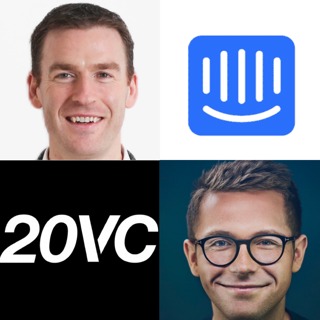
20VC: Why Being First Does Not Matter, Why Defensibility on Day 1 Does Not Exist, Three Core Elements To Move into Enterprise Effectively and What Makes Truly Great Product Marketing Today with Des Traynor, Co-Founder @ Intercom
Des Traynor is a Co-founder and the Chief Strategy Officer of Intercom, the modern customer communications platform that unifies every aspect of the customer journey. To date, Intercom has raised over $238M from some of the best including Index, ICONIQ, Kleiner, GV, and Bessemer. As for Des, before co-founding Intercom, he was a UX consultant, a university lecturer in computer science, and also a Ph.D. researcher. Des is also a prolific angel investor with a portfolio including the likes of Stripe, Algolia, Notion, Miro, and many more. In Today's Episode We Discuss: 1.) Origins of Intercom: How did Des make his way into the world of startups and come to co-found Intercom? When did they realize they really had something with Intercom and had to focus on it? What does Des know now that he wishes he had known at the start of Intercom? 2. Two of the Biggest Myths in Startups: Being First and Defensibility Why does Des believe that being the first does not matter? Why is it not an advantage? Why does Des believe that no company has defensibility on day 1? How does Des believe defensibility is built? What does Des mean when he says, when investing in companies he looks for a "long road to the starting line"? 3.) Product 101: A Masterclass on Product: How does Des answer the question of when to release a second product? How should the second product be resourced? MVP and lean or full budget and committed? What are the biggest mistakes people make when releasing a second product? What mistakes have Des and Intercom made when releasing new products? How does Des advise founders on when to stop working on a product? How do you know when it is not working? How does Des determine between a feature and a product both when building and when investing? 4.) Moving to Enterprise: What does Des believe are the three core things all companies need to scale into the enterprise effectively? Which should they do first? Which is most challenging? How does Des advise founders on when is the right time to move into the enterprise? How does the product need to change to meet enterprise needs and requirements? 5.) The Makings of Great Product Marketing: What does Des believe makes truly great product marketing? Who does it well today? How does your product marketing need to change as you scale from SMB to enterprise? If product marketing to both an end user and a separate buyer, which persona should one prioritise their messaging towards? How does Des advise founders on product marketing when they have a horizontal product with a very broad customer base? 6.) Angel Investing 101: From Stripe to Miro to Notion: Why does Des believe it is beneficial for operators to also be investing? What are the biggest lessons Des has learned from angel investing? How does Des approach both market sizing and outcome scenario planning today? How price sensitive is Des today? How has that changed over time? Item's Mentioned in Today's Episode with Des Traynor: Des' Favourite Book: How Will You Measure Your Life by Clayton Christensen
18 Heinä 20221h 4min

20VC: The Most Powerful Investor You Might Not Know | Why The Distinction Between Public vs Private is BS | The Misalignments Between GPs and their LPs | Portfolio Construction 101: Diversification, Capital Concentration, Loss Rates with Peter Singlehurst
Peter Singlehurst is the Head of Private Companies at Baillie Gifford. As of 31st March 2022, funds under Baillie Gifford's management and advice totaled £277bn. The firm is owned and run by 51 of its senior executives who operate as a partnership, a structure that has endured for over a century. As for Peter, he has been with Baillie Gifford since graduating from Durham University 12 years ago and has backed some astonishing breakouts such as Wise, Grammarly and Zymergen to name a few. In Today's Episode with Peter Singlehurst We Discuss: 1.) Entry into Venture: How Peter landed his role with Baillie Gifford straight out of university? Why does Peter and Baillie Gifford prefer to hire young people without backgrounds or studies in finance? Why do they tend to be better investors? What does Peter believe are the basic building blocks that can be taught in investing? What cannot be taught and needs to be learned with experience and time? 2.) The Biggest Misnomers and Misalignments in Venture: Why does Peter believe the distinction between public vs private markets is BS? Why does Peter believe it is an advantage to invest at the same time in both public and private markets? Why does Peter think there is an inherent misalignment in venture between GPs and their LPs? 3.) Baillie Gifford: Constructing a Portfolio with £277BN: How does Baillie Gifford approach portfolio construction today? How many lines do they want to have in their portfolio? What is the right level of diversification? How does Peter think about sizing each position? How does Peter think about capital concentration across rounds vs first check being the largest? How does Peter approach outcome scenario planning? How does Peter think about downside protection and loss rates? 4.) Peter Singlehurst: The Investor: How has Peter's investing style changed over the last 10 years? What has gotten easier? What has gotten harder? What is Peter's biggest miss? How did it change his approach? What is Peter's biggest hit? What did he learn and take from this? How did the crossover funds change and impact the way that later stage venture was conducted? Item's Mentioned In Today's Episode: Peter's Fave Book: The Myth of Sisyphus Peter's Most Recent Investment: Grammarly
15 Heinä 202245min