
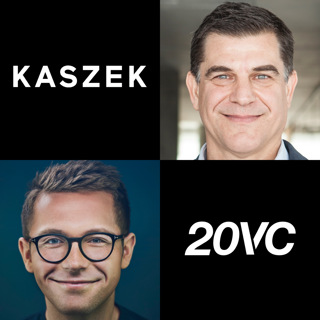
20VC LATAM: LATAM's Largest Fund, Kaszek Ventures on Scaling from $100M to $1BN, Why Capital is not a Source of Moat & Why LATAM is More Than Copycat Companies with Nicolas Szekasy, Co-Founder @ Kaszek Ventures
Nicolas Szekasy is a co-founder and Managing Partner of Kaszek Ventures, the largest venture capital firm in Latin America with a portfolio including the likes of Nubank, Notco, Creditas, Bitso and more. Before Kaszek, Nicolás was CFO for 10 years at MercadoLibre (Nasdaq: MELI), Latin America's largest online commerce and payments platform, where he led its $333 million IPO in 2007. Before MercadoLibre, Nico spent 7 years as CFO @ PepsiCo. If that was not enough, Nico is also on the board of Endeavour, empowering a global ecosystem of entrepreneurs. In Today's Episode with Nicolas Szekasy You Will Learn: 1.) How Nico made his way into the world of startups with MercadoLibre? What were the biggest takeaways from his 10 years with MELI? How did his time with MELI and seeing the boom and bust impact his investing mindset? 2.) What have been the most significant changes in the LATAM ecosystem over the last 20 years? What has improved? What has become more challenging? Is Nico concerned by the sheer amount of capital now flowing into the LATAM ecosystem at such speed? 3.) How does Nico respond to the statement that LATAM just produces "copycats" of successful companies from other geographies? How does Nico respond to the common suggestion of the challenges in scaling engineering teams in LATAM? How does Nico respond to the assumption that exit opportunities and IPOs are less available to LATAM companies? 4.) How was the experience of raising the first Kaszek fund? What has been the biggest challenging in the scaling from a $100M fund to a $1BN fund? How has Nico seen his own investing style change over the last decade? What does he know now that he wishes he had known when he started Kaszek? 5.) How does Nico reflect on his own style of board membership? What does Nico believe makes the best board members? What takeaways did he have from his time @ MELI on what makes the truly special board member? Item's Mentioned In Today's Episode with Nicolas Szekasy Nico's Favourite Book: Guns, Germs and Steel: A short history of everybody for the last 13,000 years Nico's Most Recent Investment: Notco
16 Elo 202137min

20VC: The Lyft Memo: Floodgate's Ann Miura Ko on Why Successful Seed Investing Is Not Investing In a Company But The Development of a Set of Secrets, Whether Capital Is a Defensible Moat Today &How Startups Should Approach Competition
Ann Miura Ko is the Co-Founding Partner @ Floodgate, one of the leading early-stage firms of the last decade with a portfolio including the likes of Twitter, Twitch, Lyft, Okta, Outreach and more. As for Ann, not only did she lead the round for Lyft but in the last 12 months has led rounds for 2 of the hottest companies in the valley; Popparazzi and Popshop Live. Due to her immense investing success, Ann is a multiple Forbes Midas Lister and is also a lecturer in entrepreneurship at Stanford, a co-director of the Mayfield Fellows Program at Stanford, and a member of the Board of Trustees for Yale University. In Today's Episode with Ann Miura Ko You Will Learn: 1.) How Ann made her way from a PhD in Quantitative Modelling at Stanford to co-founding one of the leading early-stage firms in the valley? 2.) What does Ann believe is the secret to successful seed investing? What insight development did Ann believe Lyft had? How had they approached customer development in such a unique way? What are the leading signals to Ann today that founders really understand the customer development process? What questions does she ask to discover this? 3.) Why does Ann not engage in the compression of fundraising timelines today? How does she build relationships of trust and honesty with founders so early? Does Ann worry that founders have such large capital injections too early today? Why should employees examine capital efficiency, not capital raised? How does Ann advise founders on pre-emptive rounds? 4.) How did Ann and the Lyft team approach prioritization in the early days? In what ways did Lyft decide to "play their own game" when it came to the competition? How did Uber and its growth impact the financing strategy for Lyft? In what deliberate ways did John and Logan set the culture for Lyft? What have been Ann's biggest lessons from them on culture building? 5.) Does Ann believe that capital in itself is a competitive moat today? What does Ann believe needs to be proven before capital can be used as a weapon to win? In the case of Lyft, what signals or measurements did Ann define as guiding metrics for success? How did they change over time? How can founders determine their own in their businesses?
12 Elo 202141min
20VC: Mike Lazerow on Why How You Operate As a VC Is More Important Than Who You Are and What You Have Done, Why Boards Are More Important for the Entrepreneur than Investor & How The Best Entrepreneurs Prep Their Boards & Extract Value From Them
Mike Lazerow is a serial entrepreneur and now Co-Founder and Managing Partner @ Velvet Sea Ventures alongside his wife, Kass. Prior investments from the Velvet Sea Partners include Twitter, Square, SpaceX, Snap Inc., Facebook, Pinterest, Domo, and more. Prior to becoming an investor, Mike founded Buddy Media in 2007, selling the company to Salesforce just 5 years later for $745M. Before Buddy Media, Mike co-founded Golf.com, a multi-million dollar profitable golf media property that Mike and Kass sold to Time Inc in 2006. In Today's Episode with Mike Lazerow You Will Learn: 1.) How Mike made his way into the world of startups way back in 1993, how that led to Golf.com and Buddy Media? Why did he decide he wanted to be a VC? How did seeing the dotcom era fundamentally impact Mike's approach to business and investing? 2.) Why does Mike believe how you operate as an investor is more important than who you are and what you have done? How does Mike aim to invest and operate with this in mind? What are 3 core elements that Mike looks for in every deal? How does Mike approach his own investment decision-making process? How has it changed over time? How does he use gut to make decisions? 3.) What does Mike believe are his biggest insecurities as an investor? How does Mike think about the challenge of moving from a collaborative angel to a competitive VC? How does Mike think about the importance of ownership today? What has Mike learned about how the best VCs engage with round construction? 4.) How does Mike analyse his own style of board membership today? Why does Mike believe that boards are more helpful for the entrepreneur than for the investor? As an entrepreneur, how did Mike prepare for his boards? How does Mike advise founders to get the most out of their boards? Where do many make mistakes? How can one optimize the board member/founder relationship? 5.) Why does Mike believe that "having sex with your partner is a feature, not a bug"? How do Kass and Mike work together in such a complementary fashion? How do they ensure that personal matters never intrude on work decisions? How does Mike think about his relationship to money today? How does Mike want to imbue the same hard work and ethics to his children? Item's Mentioned In Today's Episode with Mike Lazerow Mike's Favourite Book: Man's Search for Meaning Mike's Most Recent Investment: LeoLabs
2 Elo 202146min
20VC: A Masterclass in Leadership and Scaling Companies: The Decisions only the CEO Can Make, The Secret To Talent Acquisition and Retention and How To Find The Unscalable Things that are Fundamental To Scale with Christa Quarles, CEO @ Corel Corporation
Christa Quarles is the CEO @ Corel Corporation, building software solutions that simplify the task journey for knowledge workers. Prior to Corel, Christa spent close to 4 years as CEO @ Opendoor, driving a chapter of transformational change for the company. Before Opendoor, Christa was Chief Business Officer @ NextDoor, and finally pre-NextDoor, Christa spent 4 years at The Walt Disney Company where she led Disney Interactive to profitability as Senior Vice President, Interactive Games. If that was not enough, Christa is also on the board of Affirm and Kimberly Clark. In Today's Episode with Christa Quarles You Will Learn: 1.) How Christa made her way into the world of startups having spent close to 10 years in investment banking? What were the biggest takeaways from her time at Walt Disney? How did her 3 years as CEO @ Opentable impact how she approaches leadership today? 2.) Company Breakpoints: What are the different breakpoints in the scaling of companies? When did this start to happen at Opendoor? How does decision-making need to change with scale? How can leaders ensure teams feel safe to be the most ambitious they can be? In what ways can leaders create environments of safety for them to be their best selves? 3.) The Role of the CEO: What decisions can only the CEO make? How can leaders determine when a C-Suite hire is a stretch too far? How has Christa's board membership on other boards changed how she runs her board today? Given a board's limited information, how can leaders extract the most out of them? 4.) "Operating is a Full Contact Sport": When has Christa found operating and leading the hardest? When faced with hard times, how does she push through them? How does Christa advise leaders on the challenges of their own scaling process? Where do many make mistakes in their own scaling? What is a "stuck state" and why is it the worst state to be in? 5.) Team Building and Trust: How does Christa approach trust today? Does she start from a position of being fully trusting or not trusting and there to be gained? What is Christa's favourite interview question to ask? In what way does Christa believe truly special candidates represent their passions in interviews? Item's Mentioned In Today's Episode with Christa Quarles Christa's Favourite Book: Caste, The International Bestseller
29 Heinä 202145min

20VC: Ribbit Capital's Nick Shalek on How To Think Through Ownership and Price Sensitivity, When More Money and Pre-Emptive Rounds are Good vs Bad & Investing Lessons from Yale's David Swensen
Nick Shalek is a General Partner @ Ribbit Capital, specializing in fintech they are one of the most successful venture firms of the last decade with a portfolio including Robinhood, Coinbase, Revolut, Nubank and more. As for Nick, he started his career as a Senior Analyst @ Yale Investments Office before moving to the world of operations as Director of Business Operations @ Verne Global, a provider of 100% carbon neutral data centers. In Today's Episode with Nick Shalek You Will Learn: 1.) How Nick made his way from Senior Analyst at Yale's Investment Office to be one of the leading fintech investors in the world with Ribbit? What were Nick's biggest lessons from his time working with David Swenson @ Yale? How would Nick summarise Yale's investment algorithm? 2.) Entering Venture and Advice: Why does Nick tell many friends entering venture, to not join a new fund? What does Nick believe is takes to build an enduring firm in venture? What were the core reasons and inflection points in the success of Ribbit? What have been some of the biggest challenges in the professionalisation of Ribbit over the years? 3.) Pricing and Ownership: Is Nick concerned by the levels of pricing we are seeing in fintech today? How does Nick analyze his own relationship to price? How does Nick view the importance of ownership? Is it possible to build ownership across rounds? How does Nick advise founders now receiving very fast offers to pre-empt their rounds? 4.) Investment Decision-Making: How does Ribbit structure its investment decision-making process for initial investments? In what way does this process change for re-investments? Why does Nick believe in the benefits of not having attribution within venture partnerships? 5.) AMA: What has been Nick's biggest miss? How did it change his investment decision-making process as a result? What does Nick know now that he wishes he had known when he started in venture? What have been Nick's biggest lessons from his working with Micky? Item's Mentioned In Today's Episode with Nick Shalek Nick's Favourite Book: A Piece of the Action: When the Middle Class Joined the Money Class Nick's Most Recent Investment: Kavak
26 Heinä 202137min
20VC: Jeff Immelt on Leadership Lessons from 16 Years as CEO @ GE, Incumbent Innovation; Why Some Have Failed and Other Succeeded, When Boards Have A Positive vs Negative Impact on a Company & The One Fear Startup Founders Are Allowed To Have
Jeff Immelt is a Venture Partner @ NEA serving on both the technology and healthcare investing teams. Prior to entering the world of venture, Jeff served as chairman and CEO of GE for 16 years where he revamped the company's strategy, re-established market leadership and quadrupled emerging market revenue. As a result, Jeff has been named one of the "World's Best CEOs" three times by Barron's. In addition, Jeff is on the board of Sila Nanotechnologies and Twilio. In Today's Episode with Jeff Immelt You Will Learn: 1.) How did it feel when Jeff was told he was going to be CEO at GE? How did that come about? Did he feel the weight of responsibility when it was announced? 2.) When it comes to incumbents embracing innovation, what strategies work? Why do they work? What lessons does Jeff take from his time at GE on what worked? What strategies do not work? What are the biggest mistakes large incumbents make when adopting new products or strategies? What advice does Jeff continuously tell large company CEOs who ask this question? 3.) When does Jeff believe boards can be fundamentally impactful? In what circumstances do boards actually cause harm? What are the signs of the truly great board members? What are the causes of why board members can be misaligned with their founders? How should founders approach whether to listen or not to their board? 4.) How does Jeff think about trust in teams? Does he start fully trusting and it is their to be lost or start not trusting and it is their to be gained? What people do you want around you in a crisis? What are the signals of these people? What does Jeff mean when he speaks of "crisis accelerants and crisis absorbers"? 5.) How does David think about fear in leadership? What is the one thing that leaders are allowed to be afraid of? How do the best founders approach their relationship to paranoia? How do the best communicate their fears to their team?
22 Heinä 202132min
20VC: a16z's David George on Leading a16z's Growth Fund Today, The Biggest Misconceptions of Growth Investing, How a16z Think Through Portfolio Construction, Investment Decision-Making and Scenario Planning & How The Entrance of New Players Has Changed Th
David George is a General Partner @ Andreessen Horowitz where he leads their growth investing practice. Since joining in 2019 David has invested in the likes of Clubhouse, Coinbase, Databricks, Figma, Instacart, Robinhood and TripActions just to name a few. David also sits on the board of Current, Greenlight, and Workrise. Prior to a16z, David spent 7 years growth investing at General Atlantic where he invested in the likes of Airbnb, Crowdstrike, Opendoor, Slack and Uber. In Today's Episode with David George You Will Learn: 1.) How David made his way into the world of growth investing with General Atlantic and how that led to his leading the newest iteration of a16z growth funds? What were David's biggest takeaways from his time with General Atlantic? How did it impact his investing? 2.) Misconceptions of Growth Investing: Why does David believe that great business models are table stakes at growth today? What gives the best the edge? Why does David believe that people over-rotate on TAM? Why is it misleading in many ways? What is the right way to assess TAM at growth today? What does David look for when digging into unit economics? When is the right time to focus on unit economics? 3.) Portfolio Construction and Scenario Planning: How does David think about portfolio construction with the new a16z growth fund? What is the right level of diversification? How does David think about loss ratio today? How does David approach outcome scenario planning? What is an attractive level of upside for David to engage at growth? How has that expectation changed over time? 4.) Valuations and Crossover Funds: How does David assess the valuation landscape today? How does David determine whether he will pay up or sit out on an investment? How has the rise of crossover funds, PE funds and hedge funds entering growth impacted the valuations being paid and the investment process itself? What does David make of these new entrants? What challenges do they bring? 5.) Investment Decision-Making: How do a16z approach decision-making at growth? Who is on the core IC? Why does David strongly believe in the single trigger model in venture when it comes to decision-making? What are the biggest reasons for politics in venture firms today? What can be done to mitigate them? Item's Mentioned In Today's Episode with David George David's Favourite Book: Increasing Returns To Scale David's Most Recent Investment: Loom
19 Heinä 202133min
20VC's Therapist Thursday: We Are Not All Crushing It All The Time So Let's Stop Pretending, Working Through Challenges of Self-Worth and Self-Doubt & How To Find Joy in the Striving with Nick Mehta, CEO @ Gainsight
Nick Mehta is the CEO @ Gainsight, the leader in all things customer success helping you put your customer at the heart of your business. Last year, as a result of their incredible success, Gainsight was acquired by Vista for a reported $1.1Bn but prior to that had raised over $156M from Lightspeed, Battery, Bessemer, Insight and Bain to name a few. As for Nick, he has been named one of the Top SaaS CEOs by the Software report three years in a row and holds one of the highest Glassdoor approval ratings for CEOs. Prior to Gainsight, Nick was the CEO at LiveOffice, which grew substantially and eventually sold to Symantec. In Today's Episode with Nick Mehta You Will Learn: 1.) When did mental health really become a prominent thought for Nick? When was the first time Nick feels he really showed true vulnerability in leadership? 2.) Self-Worth: Does Nick feel like he is enough? What does he do when he questions himself severely? How does he talk to his wife about these challenging thoughts? Where does Nick believe this comes from? What are the dangers of people-pleasing? How does Nick try and counter people-pleasing in his role as a leader? 3.) Identity: How does Nick think about his own identity when it is so attached to Gainsight? In what ways does he try to detach? What has worked? What has not worked? How have children helped Nick in this way? 4.) Striving: Why does Nick believe that hunger and striving are fundamentally a good thing? How does Nick try and factor gratitude and appreciation into the work and success he experiences? How does Nick encourage this same striving in his children? 5.) Relationship to Money: How would Nick evaluate his relationship to money? How has it changed over time? How does Nick try to imbue the same values he had growing up in his children? Does Nick believe it is possible to "change" your children and have that impact?
15 Heinä 202145min