
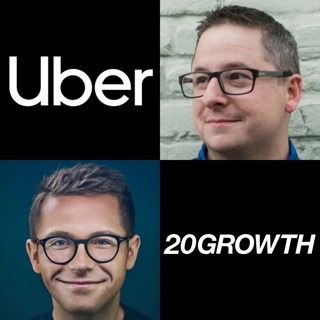
20Growth: The Inside Story to Uber's Hypergrowth Scaling; What Worked, What Did Not? | Spending a $1BN Budget at Uber and Why China was the Wild West for Uber | Why You Do Not Need a Growth Team with Adam Grenier
Adam Grenier is an OG of the growth world. His first role in growth, was none other than Uber where he was Head of Growth Marketing and Innovation building the global marketing growth infrastructure and team from the ground up. He then enjoyed successful spells at Lambda School and Masterclass as VP Growth and VP of Marketing, respectively. If that was not enough, Adam is also a prolific angel having made investments in Superhuman, Table22, and FitXR to name a few. In Today's Episode with Adam Grenier We Discuss: 1.) Entry into the World of Growth with Uber: How did Adam make his way into the world of growth with Uber and Ed Baker? What are the single biggest takeaways from his time at Uber, Lambda and Masterclass? What does Adam know now that he wishes he had known when he started in growth? 2.) Growth: What it is? Why You Do Not Need a Team for it? How does Adam define the term "growth" today? What is the role of "Head of Growth"? Why does Adam believe that you do not need a growth team? How can leaders infuse growth principles, mindsets and metrics into existing teams? WHat are the single biggest mistakes founders make when thinking about growth? 3.) Hiring Growth Mindsets: How to Ask the Right Question: What are the clearest signs to Adam that someone has a growth mindset? What are the right questions to ask to see how they think? How does Adam use tests and case studies to determine the growth mindset of a person? What did Uber teach Adam about the best practices to hire for growth? 4.) Uber: Scaling a Monster and Spending $1BN on Ads: What are some of Adam's biggest lessons from spending $1BN on advertising at Uber? Why at anytime were there 200 people paying for ads with their personal credit cards? Why does Adam believe China was "the wild-west"? How did all of their competitors in China have Uber data? How do growth mechanics, channels and disciplines compare between US vs China?
15 Maalis 202354min
20VC: SVB: What Happened? What Happens Now? Will Depositors Have Deposits Guaranteed? How Long Will It Take? Will There Be a Buyer? Who is the Most Likely Buyer? What is the Best and Worst Outcome?
Jackie Reses is the CEO of Lead Bank and previous Exec Chair of Square Financial Services and Head of Lending and Banking. One of only people to have started a bank as a de no; Only tech company to get approved for a de novo. Chair Economic Advisory Council of SF Federal Reserve. Kris Dickson is the CFO of Lead Bank and previously the CAO / CFO of post-BK Lehman Brothers parent co-estate for 10 years. Lehman Holdco estate has liquidated and distributed $129 billion to unsecured creditors through the end of 2022. In Today's Episode on SVB We Discuss: What Happened? How and why did SVB fail so fast? Was it the result of systemic problems or a series of management mistakes? What role did VCs play in the downfall of SVB? What role did social media and online banking play in the failing of SVB? What Now? What happens now? Will depositors have their deposits guaranteed? Will there be a buyer for SVB? Who is the most likely? Should founders be worried about moving their money to neo-banks? Should founders in any circumstances transfer money to their personal accounts? What is the best and worst outcome?
12 Maalis 202337min
20VC: Why AI Will Lead to Thousands of Billionaires and Elon Musk's, Will TikTok Be Banned and How Facebook Should Be Investing in AI & Why Startups Have Become Too Soft; We Need a Spiritual Reform with Amjad Masad, Founder & CEO @ Replit
Amjad Masad is the Founder and CEO @ Replit, whose mission is to bring the next billion software creators online. With Replit, Amjad has raised over $100M from the likes of Peter Thiel, a16z, Coatue and Addition, to name a few. Before founding Replit, Amjad was a tech lead on the JavaScript infrastructure team at Facebook. Before Facebook, Amjad was #1 employee at Codecademy. In Today's Episode with Amjad Masad We Discuss: 1.) From Troublemaker Child in Iran to Silicon Valley Founder: How did Amjad make his way into the world of tech and Silicon Valley having grown up as a misbehaving child in Iran? In what ways did Amjad show early signs of exceptionalism? Why does he always look for this in people he is hiring for Replit? What does Amjad know now that he wishes he had known when he started Replit? 2.) The Future: A New World with AI at the Centre: Why does Amjad believe we will see thousands of billionaires created from the innovation in AI? Why does Amjad believe AI will lead to 100 more Elon Musks? If Amjad were CEO of Facebook, what would he do? Why and how do they have to invest in AI? Will TikTok be banned in the US? How will this be resolved? Why does Amjad believe that 300 people control the future of AI? Is that not concerning? 3.) The Future of Society, Employment and Wages: Why does Amjad believe in 10 years, 1 engineer will be able to do what 100 do today? What will happen to the real wages of engineers? How does Amjad see the inclusion of universal basic income in the future? Is Amjad concerned about societal and civil unrest with wealth disparity widening further? 4.) Building the Replit Army: Why does Amjad believe that so many in tech have gotten too soft in the last few years? Why does Amjad release a "Why You Should Not Join Replit" page and share it with all candidates? How can a founder know if they have good company values or not? Why does Amjad feel we need a spiritual reform in company building? Why are startups and religion the same?
10 Maalis 202345min

20Product: Shopify's VP Product on Why the Founder is Always the Head of Product, What Makes Truly Special Product Managers, Why The Majority of Product Managers Need to Change, Why Top-Down Decision-Making in Product is Good & How Shopify Will Be Bigger
Glen Coates is the VP of Product @ Shopify, leading the development of Shopify's core commerce platform. He also oversees the core developer platform and Shopify's partner ecosystem, which includes over 10,000 publicly available apps in the Shopify App Store. Originally a CompSci grad, Glen moved from Sydney to San Diego in 2008 to run US distribution and e-commerce for an Australian eco-products company. In 2010, he attended Columbia Business School for one whole day before quitting to start Handshake, a SaaS B2B e-commerce platform. Glen joined Shopify in May 2019 when the company acquired Handshake. Glen has been in the Vice President role since October 2020. In Today's Episode with Glen Coates We Discuss: 1. From Game Developer in Sydney to Running E-Commerce Warehouse in NYC: How Glen made his way into the world of product and e-commerce having started life as a game developer? Why does Glen believe that the best founders and product people often have their roots in gaming? What does Glen know now that he wishes he had known when he joined Shopify? 2. The Art of Product and Product Management: Is product more an art or a science? If you had to put a number on it, what would it be? What is "product management"? Why can it not be reduced to frameworks? What are "product principles"? How do Shopify use them? How should product teams set them? What makes the very best PMs today? What are the commonalities in them? What is the sign of a poor PM? What would Glen most like to change about the world of PMs? 3. The Art of Product Marketing: What does Glen believe is the true art of product marketing? How did a CEO group teach Glen how to tell truly great stories? How can one tell great stories when you have to cater to multiple different customers/personas? How does Glen evaluate the current state of Shopify's product marketing? 4. Shopify and The Future of Shopify: Why does Glen think it is important for Shopify to have a tops down decision-making process for product strategy? What does Glen believe is the #1 reason why Shopify is such a large and successful company? What is the single hardest element of Glen's role today? How does Glen believe that Shopify will be larger than Amazon in 5-10 years time?
8 Maalis 202350min
20VC: Meta CMO Alex Schultz on The Crucible Moments Scaling Facebook to 1BN Users, Turning Facebook Reels Into a Monetisation Engine, Competing Against TikTok and SNAP, Coming Out in the World of Tech; The Challenges and What Needs to Change
Alex Schultz is the Chief Marketing Officer and VP of Analytics for Meta (formerly Facebook), leading Marketing, Analytics, and Internationalization. Previously, Mark Zuckerberg stood up and said, "Facebook would not be a BN user company without Alex". At Meta, Alex has pioneered the integration of product and direct response marketing at Meta and helped launch many of the company's most impactful products and initiatives. Alex is gay and is the executive sponsor of Facebook's LGBTQ+ Employee Resource Group. In Today's Episode with Alex Schultz We Discuss: 1. From Paper Planes to CMO of Facebook: How Alex started his career in the world of paper planes and how that led to his getting a role at an early eBay? What are 1-2 of his biggest lessons from eBay? How did the role at Facebook come about in 2008? Why did he decide to join the early Facebook? What does Alex know now that he wishes he had known when he started his time at Facebook? 2. The Secret to Scaling to 1 Billion Users: Mark Zuckerberg has said that "Facebook would not be a billion-user company without Alex". So what does Alex believe are the 1-2 biggest needle movers in FB scaling to 1 billion users? Why does Alex believe that the best leaders are patiently right? How can management be direct and effective but also show they care and be kind? What have been some of Alex's biggest lessons on people management across different phases of the company? 3. Crucible Moments in Facebook History: Facebook Messenger Split: What was the decision-making process behind splitting Messenger from the core Facebook App? What did they do right and well in the split? What mistakes were made? Rebrand to Meta: Why did Facebook decide it was right to rebrand to Meta? Has the rebrand gone well? How does Alex define success with the rebrand? Reels vs TikTok vs SNAP: Does Alex believe we are moving away from the social graph and moving to content discovery only? How does Alex feel Reels is doing in the race against TikTok? What have they done well? Why does Alex believe SNAP hasn't innovated in the way people think and copied Kakao in cases? What is the key to turning Reels into a monetization machine for Facebook? 4. Alex Schultz: The Person and Leader: How was the coming out process for Alex in the tech community? How did his parents respond to the news? What does Alex mean when he says, "everyone has to mourn their own version of your future self"? Why when he moved to the states was Alex advised to go back in the closet? Does Alex feel we have a long way to go in equalizing the playing field both for homosexuality and trans-gender participation?
6 Maalis 202349min

20VC: Will LPs Pull Out of Existing Managers, How Will Fund Sizes Change Moving Forward, Is Now The Time to be Aggressive on Secondaries, What is the Discount on Secondaries Today, Who Will Win and Lose in the Next Five Years with Hunter Somerville, Partn
Hunter Somerville is a Partner @ Stepstone, one of the largest secondary buyers, fund investors and players in our ecosystem with over $600BN in capital responsibility and over $100BN AUM. Additionally, Hunter serves on the LP Advisory Boards for Felix Capital, Foundry Group, Imaginary Ventures, Scale Venture Partners, Boldstart Ventures, Ludlow Ventures, and more. Prior to StepStone, Hunter was a general partner with Greenspring Associates, a venture capital and growth equity investment firm that merged with StepStone in 2021. Before that, he worked as an associate for Camden Private Capital. In Todays Episode with Hunter Somerville We Discuss: 1. Three Types of Secondaries: What are the three different types of secondaries? What is the current situation with company secondary opportunities today? What is the current landscape for fund secondary opportunities today? What are GP-led restructuring or strip sales? How do they work? 2. LPs Today and Moving Forward Investing in Funds: Will we see a wave of LPs not commit to their existing managers? What is the denominator effect and how does that impact LP deployment into funds? What are the top 3 reasons why LPs will not re-commit to existing managers? Do LPs feel VCs have fairly marked down their venture books in the last 6 months? Does Hunter agree that if you have not returned cash to your LPs when you could have done ijn the last 5 years, then you are most in trouble? Why does Hunter believe we will see more international LPs entering venture than ever before? 3. Liquidity: When Does the Cash Hit: Why was liquidity so bad in 2022? How did that compare to 2021? How does Hunter forecast liquidity environments in 2023? What could drive them? How active were Stepstone in secondary buying over the last few years? Is now the time to be greedy when others are fearful in secondaries? What discount was Hunter seeing both on fund and company side secondaries in 20-22? What is the current level of discount being applied to both company and fund secondaries? 4. AMA with One of the Largest Secondary Buyers: Which LP class will be hurt the most from the last fund cycle? What would Hunter most like to change about the world of venture? What was Hunter's biggest mistake on a company investment? What are the biggest mistakes LPs make when they do direct investing? Why are big-name people entering firms as GPs not always a good sign?
3 Maalis 202351min

20VC: The Story of Ring: Scaling from an Idea in a Garage to Richard Branson Investing and a Reported $1BN Amazon Acquisition | Why Building a Brand is Like Making Great Wine | The Secret to Hiring Success; Hire Marathoners and more with Jamie Siminoff
Jamie Siminoff is the Founder and Chief Inventor @ Ring, with Ring Jamie, created the world's first Wi-Fi video doorbell while working in his garage in 2011. Since Ring's launch in 2013, Ring has helped make thousands of neighborhoods safer all around the world. As part of the journey, Jamie raised over $385M from the likes of True Ventures, Felicis, First Round, CRV, Upfront and more. In 2018, Amazon acquired Ring for a reported $1BN. Prior to Ring, Jamie founded several successful ventures including PhoneTag, the world's first voicemail-to-text company, and Unsubscribe.com, a service that helped email users clean commercial email from their inboxes. He successfully sold both companies in 2009 and 2011 respectively. In Today's Episode with Jamie Siminoff We Discuss: 1.) From Creating the First Wi-Fi Doorbell to $BN Acquisition: When was the moment Jamie realized he had to create the world's first Wi-Fi-enabled doorbell? How di Richard Branson come to be an investor in Ring? What was the process? How does Jamie advise other founders when it comes to the question of whether it is valuable having business moguls as investors in their business? 2.) Crucible Moments: From Lawsuits and Near-Death to $22M in Sales in a Day: When Jamie hears the words "near-death experience" what is the moment in the Ring journey that comes to mind? How did Jamie get through a crippling lawsuit and come out selling $22M in 24 hours on QVC? How did Jamie feel when he placed a $500M order with manufacturers when he only had $100M? What does Jamie believe was the hardest phase of the business? 3.) Jamie Siminoff: The Leader: Why does Jamie want to hire marathon runners? Why does the analogy make for good hires? Does Jamie start from a position of trust with new hires and it is there to be built or start with no trust and it is there to be gained? Does Jamie believe he is a tolerant leader? What does he mean when he says, "I want to see the dirt under your fingernails"? Why does Jamie believe that building a brand is like making great wine? Why does Jamie really hate customer surveys? What should be done instead? 4.) Selling for $1BN to Amazon: How did the Amazon acquisition come to be? How did the discussion go? Why did Jamie decide then was the right time? When you sell for a $1BN, does the cash hit your account soon? When did Jamie actually receive the money? How did he feel when he saw it is in his account? What does Jamie believe Ring did so well to make the acquisition a success? What did Amazon do well to ensure Ring was integrated most effectively? What are 1-2 of the biggest lessons Jamie has learned from being within Amazon?
1 Maalis 202357min
20VC: How Multi-Stage Funds Changed The Game For Seed Rounds, Why Signalling Risk is BS, The Three Most Important Variables for Founders When Raising Rounds & A Debate on Portfolio Construction: Does Ownership Matter with David Tisch
David Tisch is the Managing Partner of BoxGroup, one of the leading seed-stage investment firms of the last decade having invested in over 500 seed-stage startups, including Plaid, Ro, Ramp, PillPack, Amplitude, Flatiron Health, Stripe, Warby Parker, Harry's, Oscar, Flexport, Classpass, Vine, GroupMe, Airtable and more. David is also the Chairman of GoodDog, a marketplace to find pets online. In Today's Episode with David Tisch We Discuss: 1.) From Techstars To Founding BoxGroup: How did David start his own firm in the form of Box having started at Techstars? What advice from Brad Feld does David always remember and hold close? What does David know now that he wishes he had known when started investing? 2.) The Debate: The Math Does Not Work: Portfolio Construction: Ownership Does not Matter: How does David justify writing $100K checks from a $127.5M early-stage fund? Even if it is a home run, it does not make a difference to the fund? Level of Diversification: If David is writing small checks like this, with his fund size he will have hundreds of companies, what does David believe is the right level of diversification? Reserves management: How does David think about the ratio of initial to reserves when deploying the funds today? How does reserves management change in a recession? How does David prevent other VCs from using this to try and push him down to always writing a $100K check? Why does David believe that the size of check he is able to invest is the VC's problem and not the founders? Price Sensitivity: How does David assess his own relationship to price today? Why does he believe that company valuation is not something that the investor controls? 3.) Advice to Founders Raising Rounds: What does David believe is the #1 role of the CEO? What are the three most important variables for founders to focus on when raising their round? How should founders analyze the tradeoff between the brand of the VC and the size of the round? Does signaling really make a difference when a large fund invests at seed? How did multi-stage funds change the seed landscape forever with a new product? Who does David believe are the tourists in early-stage venture? Will they leave in the recession? 4.) David Tisch: AMA: Why does David believe that consumer social is not fun anymore? Who when they send him a deal does David take it most seriously? How does David want to ensure that bad VC behaviour is exposed? What would David most like to change about the venture landscape today?
27 Helmi 20231h 1min