
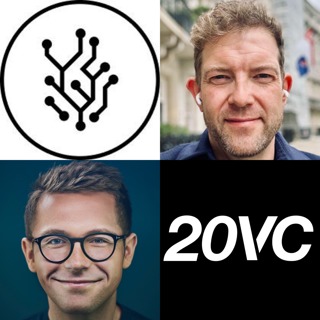
20VC: "How Being a Founder Almost Killed Me"; We Have Lied to a Generation of Founders | The Hardest Truths About Being a Founder Revealed | Why AI Co-Pilot is BS, Seat Pricing is Over & User Interfaces are Stupid with Christian Lanng
Christian Lanng is the Founder and Former CEO @ Tradeshift, a company he took from garage to unicorn raising over $900M for with a latest price of $2.7BN in 2021. Just last month, Christian stepped away from the company and is now Chairman @ Beyond Work, building a better work experience through AI native software. In Today's Episode with Christian Lanng We Discuss: 1. Burnout: When it Hits: How did Christian know when something was really seriously wrong? What were the signs? How did being a founder literally almost kill Christian? How was that not a wakeup moment? How does being a founder make you so out of touch with reality? 2. The Things We Are Never Told: Why does Christian think one of the biggest crimes is the myth that everyone can be a founder? What are the single biggest things about VCs that founders are not told? Why does Christian believe fundraising is absolutely a game? What are the rules to win it? What makes the best VCs? What makes the worst VCs? Why does Christian not like to take a discount for a brand name VC? 3. The Chaos That Happens Inside a Company: Why does Christian believe politics should not be discussed within companies? What are Christian's biggest lessons on working with friends? Why after 14 years does Christian only have 3 friends that still talk to him? How did Christian fire 50% of his leadership team and productivity not change at all? Why does Christian believe US startups are inherently better than European ones? 4. Parenting and Relationship to Money: Does Christian regret not being a present father for his child when building Tradeshift? What are the two options as a founder you have when bringing up kids? Was Christian scared to leave Tradeshift? How does he reflect on his relationship to money? 5. AI: Co-Pilot is BS, The Future Business Model and more... Why does Christian believe co-pilot is the last dying breathe attempt from incumbents? Why does Christian believe that per-seat pricing will die? What will replace it? Why does Christian believe that AI will negate the importance of consumer-facing brands? In what way does Christian believe that UI is total BS? How does it change over time?
27 Syys 20231h 9min
20VC: Marc Benioff on The Future of San Francisco and What He Would Do if in Charge? Marc Benioff's Five Step Process to Priorities and Why Money Does Not Make You Happy & Work From Home vs In-Person; How to Manage in Changing Worlds
Marc Benioff is Chair, Chief Executive Officer and Co-Founder of Salesforce and a pioneer of cloud computing. Under Benioff's leadership, Salesforce is the #1 provider of CRM software globally and one of the world's fastest-growing enterprise software companies. Benioff founded Salesforce in 1999, and it is now a Fortune 150 company with 70,000+ employees. Benioff is the owner and co-chair of TIME, and the founder of TIME Ventures. Benioff is the author of the New York Times bestseller Trailblazer: The Power of Business as the Greatest Platform for Change. Benioff was named "Innovator of the Decade" by Forbes and is recognized as one of the World's 25 Greatest Leaders by Fortune. In Today's Episode with Marc Benioff We Discuss: 1. The Future of San Francisco: What would Marc do if he were in charge of San Francisco today? What would he change with regards to housing, policing and crime? Why does Marc believe there are doomsday proclaimers on SF? What do they have to gain? Will Dreamforce always be held in San Francisco? 2. Money and Ambition: The Mind Behind a $200BN Machine Does Marc believe that money makes you happy? How has Marc's relationship to money changed over time? How does Marc think about bringing children up in a more affluent home? What does Marc advise anyone who is seeking "happiness" today? 3. Mastering Decisions and Prioritisation: How does Marc assess his own decision-making framework today? Has it changed with time? What is Marc's 5 step process to understand your own priorities today? What does Marc believe are the three biggest priorities for Salesforce today? What are the single biggest blockers that would prevent Salesforce from achieving their goals? 4. Marc Benioff: AMA: What does great fatherhood mean to Marc? Who would win the cage fight, Zuck or Elon? What does a day in the life of Marc Benioff look like? What does Marc think about work from home?
25 Syys 202332min
20VC: Are Foundation Models Becoming Commoditised? Do OpenAI and Anthropic of the World Have a Sustaining Moat? Why Smaller Models May Work Better? Why Incumbents with Data Power Win the AI War with Christian Kleinerman, SVP Product @ Snowflake
Christian Kleinerman is the SVP of Product @ Snowflake. Before Snowflake, Christian spent close to 5 years at Google as a Senior Director of Product Management @ YouTube working on their infrastructure and data systems. Before YouTube, Christian spent over 13 years at Microsoft serving as General Manager of the Data Warehousing product unit where he was responsible for a broad portfolio of products. In Today's Episode with Christian Kleinerman We Discuss: 1. Lessons from the Greats: How did Christian first make his way into the world of product? What are 1-2 of his biggest lessons from working with Satya Nadella and Frank Slootman? What are 1-2 of hs biggest product lessons from Google and Microsoft? 2. Generative AI: Real vs Fake: How does Christian analyze the current generative AI landscape? Which segments will be the fastest to adopt? Which will be the slowest? What aspects of the ecosystems are overblown? Which are under-appreciated? How does Christian respond to many VCs who suggest that many startups are simply wrappers on GPT? 3. Models 101: Why Size is Not Everything! What matters more, the size of the data or the size of the model? Will any of the models used today be used in a year? Does Christian believe Alex @ Nabla is right in saying that "the most successful companies will be those that are able to transition between models the easiest"? How are we seeing the evolution of model size impact the accuracy of result snad size of data required? 4. Incumbent vs startup & Open vs Closed: Who is best positioned to win; startups or incumbents? What are the nuances; which spaces are best served for startups to win vs incumbents? Will open or closed source be the dominant mode? What are the single biggest challenges preventing open from being successful?
22 Syys 202344min
20VC Roundtable: Is the VC Model Broken? The Biggest Disconnect Ever Between TVPI & DPI, Why Market Size is Dangerous, Why "Go Fast" is Terrible Advice, The Dangers of Raising Large Rounds at High Prices & Why Next Year Will See the Biggest Hiring Spree i
Eric Paley is the Managing Partner at Founder Collective, one of the world's most successful seed funds with investments in the likes of Uber, The Trade Desk, Coupang and Airtable. Mike Maples is one of the OGs of seed investing. As the Co-Founder of Floodgate, he has backed the likes of Twitch, Okta, Lyft, Twitter and more. Jason Lemkin is the Founder @ SaaStr one of the best-performing early-stage venture funds with a portfolio including Algolia, Pipedrive, Salesloft, TalkDesk, and RevenueCat to name a few. In Today's Episode on Is the Venture Model Broken? : Is the classic seed model dead? Can seed funds play in a world of $25M valuations? Why is having a firm grasp of the present the best thing an early-stage investor can have? Why does Mike Maples believe no company with true product-market-fit has ever failed? Why does Eric Paley believe "go faster" is the worst startup advice? Why does Mike Maples believe there is a direct relationship between price and risk? Why does Mike Maples believe that outliers by their very nature are lower priced? Why does Eric Paley not focus on ownership? Why can it be dangerous? What are the biggest risks for founders raising at valuations that are too high? Why does Eric Paley believe we will have the biggest chasm between TVPI and DPI in the prior vintage of venture capital returns? Why does Eric believe the majority of SPACs were BS and great companies can always go public? Why does Jason believe that if multiples do not reflate, the venture model is broken? Why does Jason believe we will see the biggest hiring spree in tech next year? How has illiquidity allowed Eric Paley to make some of the best investment decisions? What is Mike Maples biggest lesson from selling Twitter stock early at $1BN?
20 Syys 20231h 17min

20VC: Benchmark General Partner, Miles Grimshaw on The Five Pillars of Venture Capital, Why Data Can Be a Trap When Early-Stage Investing, Investing Lessons from Missing Figma and Plaid & The New Business Model for AI & Why Co-Pilot is an Incumbent Strate
Miles Grimshaw is a General Partner @ Benchmark, widely considered one of the best venture capital firms in history. Prior to joining the Benchmark Partnership, Miles was a General Partner @ Thrive Capital where he led investments in Airtable, Monzo, Lattice, Github, Segment, Slack and Benchling to name a few. In Today's Episode with Miles Grimshaw We Discuss: 1. Straight into VC From University: From Yale to Thrive How did Miles come to land a role with Josh Kushner and Thrive right out of Yale? What are 1-2 of his biggest lessons from working with Josh @ Thrive for 8 years? What does Miles know now that he wishes he had known when he started in venture? 2. The Pillars of Venture Capital: Sourcing, Selecting, Servicing: What does Miles believe are the 5 core pillars of successful venture capital? 1-5, what is his strongest and what is his weakest? Does Miles really believe that VCs add value today? What are the most clear ways that Miles have seen VCs destroy value in portfolio companies? 3. Investment Decision Making: From Github to Segment: What is the single most important question that Miles has to answer to say yes to an investment? How does Miles think about both market sizing risk and market timing risk? What have been Miles' biggest hits? What did he learn from making those investments? What have been Miles' biggest misses? What did he learn from missing Figma and Plaid? What have been 1-2 of Miles's biggest lessons so far from working with Bill Gurley and Peter Fenton? 4. AI: What Happens Next: Does Miles believe we are in an AI bubble today? How does he assess the landscape? Why does Miles believe that the "Co-Pilot" strategy is an incumbent strategy? Where does Miles believe the value will accrue; the application layer or the infrastructure layer? What does Miles mean when he says the future is in "selling the work and not the software"? What business model disruption and adoption disruption does Miles believe AI will enable? Why does Miles believe that the analogy of AI to the rise of mobile is wrong?
18 Syys 20231h 20min
20VC: The Biggest AI Leaders on What Matters More; Model Size or Data Size & Where Does The Value in AI Accrue; to Startups or to Incumbents
Richard Socher is the founder and CEO of You.com. Richard previously served as the Chief Scientist and EVP at Salesforce. Douwe Kiela is the CEO of Contextual AI, building the contextual language model to power the future of businesses. Previously, he was the Head of Research at Hugging Face, and before that a Research Scientist at Facebook AI Research. Alex Lebrun is the Co-Founder and CEO of Nabla, an AI assistant for doctors. Prior to Nabla, he led engineering at Facebook AI Research. Alex founded Wit.ai, acquired by Facebook in 2015. Tomasz Tunguz is the Founder and General Partner @ Theory Ventures, just announced last week, Theory is a $230M fund that invests $1-25m in early-stage companies that leverage technology discontinuities into go-to-market advantages. Sarah Guo is the Founding Partner @ Conviction Capital, a $100M first fund purpose-built to serve "Software 3.0" companies. Prior to founding Conviction, Sarah was a General Partner at Greylock where she made investments in the likes of Figma, Coda and Neeva. Emad Mostaque is the Co-Founder and CEO @ StabilityAI, the parent company of Stable Diffusion. Stability are building the foundation to activate humanity's potential. To date, Emad has raised over $110M with Stability with the latest round reportedly pricing the company at $4BN. Clem Delangue is the Co-Founder and CEO @ Hugging Face, the AI community building the future. To date, Clem has raised over $160M from the likes of Sequoia, Coatue, Addition and Lux Capital to name a few. Cris Valenzuela is the CEO and co-founder of Runway, the company that trains and builds generative AI models for content creation. To date, Cris has raised over $285M for the company from the likes of Lux Capital, Felicis, Coatue, Amplify, and Nvidia to name a few. Noam Shazeer is the co-founder and CEO of Character.AI. A renowned computer scientist and researcher, Shazeer is one of the foremost experts in artificial intelligence (AI) and natural language processing (NLP). The Two Most Pressing Questions in AI: What matters more the size of the model or the size of the data? Where does the value accrue in the next 5-10 years; to startups or to incumbents?
15 Syys 202331min
20VC: The Dubsmash Memo: Scaling to 43M Users in 10 Days, Why TikTok Was a Competitor Like Never Seen Before, Good vs Great Consumer Products and What Every Consumer Product Needs & The Future of Consumer Social with Suchit Dash
Suchit Dash is the VP of Core Product Experience at Reddit, responsible for the surfaces that millions of users interact with daily. Prior to Reddit, Suchit was a cofounder at Dubsmash, a short video platform that was used by millions globally and acquired by Reddit in December 2020. In just 10 days, Suchit scaled the product to an immense 43M users, and gained fans such as Neymar and Jimmy Fallon. Suchit previously held roles at Soundcloud and PayPal. In Today's Episode with Suchit Dash We Discuss: 1. The Founding of Dubsmash & V1: How did the founding of Dubsmash come to be? Suchit scaled V1 of the product to 43M users in 10 days, what was the secret? What worked? What were the first signs that all was not right? How did the team respond to the realization that their retention numbers were terrible? What are Suchit's biggest lessons and pieces of advice from this massive V1 and launch? 2. Data: Retention, Cohorts and The Smiley Face: What specific data did Suchit and the team really use to understand their level of product market fit? What level of retention were they looking for? What is average, good, and great in terms of retention in consumer social? What is really important for founders to try and observe and analyze in net new user cohorts? When and why did the team start to see the hailed smiley face of consumer returning to the app? 3. Battling TikTok: Despite the resurgence, TikTok was roaring, what did TikTok do so well to take the market? How did TikTok leverage both FB and Snap's ad platform to acquire so many users so fast? What did TikTok not do well? What could they have done better? How did TikTok pay and incentivize the creator community? What are some of Suchit's biggest lessons and advice for founders battling a better-funded incumbent? 4. The Decision to Sell: Being Acquired by Reddit: Ultimately, why did Suchit decide to sell the company to Reddit? Why did the first two acquisition attempts fail? What are 1-2 of the biggest pieces of advice Suchit has for founders debating whether it is right to sell their company? What do all founders being acquired need to remember? With the benefit of hindsight, if Suchit could do the acquisition process again, what would he do differently?
13 Syys 202355min
20VC: Lessons Building Nubank to the Largest Neobank in the World, How AI Changes The Future of Finance, Leadership Lessons from Sequoia's Doug Leone & What European and US Fintech Can Learn From LATAM with David Velez, Founder @ Nubank
David Velez is the Founder and CEO of Nubank, one of the largest and fastest-growing financial institutions in the world. 1 in 2 people in Brazil alone have a Nubank account. Nubank's purple credit card in Mexico is the highest-rated NPS product of any consumer product in the world. Before founding Nubank in 2013, David was a partner at Sequoia Capital between 2011 and 2013, in charge of the firm's Latin American investments group. Before Sequoia, David worked in investment banking and growth equity at Goldman Sachs, Morgan Stanley and General Atlantic. In Today's Episode with David Velez We Discuss: 1. From Sequoia Partner to Creating One of the Largest Financial Institutions: What was the Sequoia interview process like? What questions did Doug Leone really dive into when hiring David? What impressed David most about how Sequoia interview and win talent? What are 1-2 of David's biggest lessons from working with Doug Leone? 2. From a Small House to a $BN Public Company: What does David believe are the 1-2 core but non-obvious reasons why Nubank scaled so fast? What does David believe are the most non-obvious but massive opportunities Nubank has to 10x from here? Why does David believe emerging market fintech providers will be more valuable than Western fintechs? What does David believe Western fintechs and regulators can learn from BRIC economy fintechs? 3. How AI Changes The Future of Financial Services: How does David believe AI will change financial services? What products are the lowest-hanging fruit? Which products will be harder for AI to serve? How will AI handle the ambiguity of which master to serve; the consumer and their experience or the bank and their fees and profit motive? Will banks need to own and operate their own models? If using other models, what will differentiate them when they are layers on top of someone else's technology? 4. David Velez: The Leader and Father: What does it mean to be a great listener? How does David approach it? What has been David's biggest lessons from Sequoia on culture? What works? What does not? What are David's biggest pieces of advice to raise kids that are not spoiled and are hard-working and humble? How does David think about "efficient giving" with the philanthropy he does today? What is the big paradox and challenge in philanthropy today?
11 Syys 20231h 4min