Heredity, Oldest Bread, Jupiter's Moons. July 20, 2018, Part 2
Science Friday20 Heinä 2018

Heredity, Oldest Bread, Jupiter's Moons. July 20, 2018, Part 2

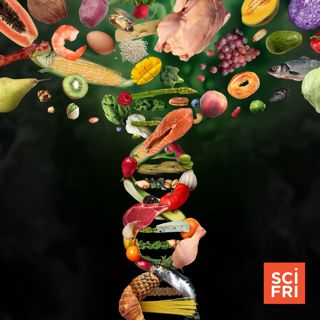
Have you ever taken a peek at your family tree? If you trace back along those branches, you might discover some long ago celebrities, kings, and philosophers among your ancestors. But what does it even mean to be “related” to an ancient queen when it’s hard to know what’s lurking inside our own DNA? It turns out even one generation back, the question of who we are gets made complicated. “We’re primed to think of our genomes as some kind of magical book. We just understand so little about genetics. Period.” says Carl Zimmer, author of the new book She Has Her Mother’s Laugh: The Powers, Perversions, and Potential of Heredity. Zimmer joins Ira to discuss Mendel’s Law, the history of eugenics, the power of CRISPR and the boundaries of what we understand of human heredity today.

Bread is a staple food today. You can find dozens of varieties at the supermarket—tortillas and pita, naan and focaccia, rye bread and wonder bread and baguettes too. Bread is so ubiquitous that it’s hard to imagine it was once a rare commodity, a labor-intensive specialty that could be made only by husking the seeds of wild grasses, hand-pounding and grinding them, then mixing the resulting flour with water and scorching on a hearth. Archaeologists working at a 14,000-year-old site in Jordan have now found evidence of an early bakery in the form of burned crumbs, similar to the ones at the bottom of your toaster. After analyzing the crumbs’ structure with a scanning electron microscope, the researchers were able to characterize the crumbs as the charred remains of a flatbread, similar to pita, baked with ingredients like wild einkorn wheat, barley, oats, and the roots of an aquatic plant similar to papyrus. They also determined that the crumbs predate the dawn of agriculture.

When Galileo first saw Jupiter through a telescope, he also discovered “stars” that would orbit around the planet in the night sky. While Galileo named them the Medicean stars—after his future patron Cosimo II de’ Medici—we know them today as Jupiter’s moons Io, Europa, Ganymede and Callisto. Since Galileo’s initial discovery, astronomers have found dozens more moons around Jupiter, and this week, researchers announced an additional 12 moons, bringing the total number up to a whopping 79.

Subscribe to this podcast. Follow our show on Instagram, TikTok, Facebook, and Bluesky @scifri and sign up for our newsletters. Got a science question that’s keeping you up at night? Call us: 877-472-4374


Hosted by Simplecast, an AdsWizz company. See pcm.adswizz.com for information about our collection and use of personal data for advertising.

Tämä jakso on lisätty Podme-palveluun avoimen RSS-syötteen kautta eikä se ole Podmen omaa tuotantoa. Siksi jakso saattaa sisältää mainontaa.

Jaksot(1338)

Why do sports announcers talk like that?

Why do sports announcers talk like that?

If you watch sports, whether the recent NBA finals or the ongoing World Cup matches, you may have noticed that the athletes aren’t the only ones putting on a show. The announcers seem to be playing a ...

19 Kesä 13min

Swords, cannibalism, poison: inside the world of killer microbes

Swords, cannibalism, poison: inside the world of killer microbes

There is a murderous crime spree happening right under—and perhaps inside—our noses. Killer microbes armed with weapons are eviscerating, assassinating, and detonating their fellow microbes. And the n...

18 Kesä 21min

When music transports you to a different place

When music transports you to a different place

Do you ever hear a song that transports you to a specific place and time? This auditory wormhole has a name: musical daydreams. Music cognition expert Elizabeth Margulis studies why they happen, and w...

17 Kesä 18min

A vast whale graveyard + Zombie sea cucumbers

A vast whale graveyard + Zombie sea cucumbers

Researchers just published details of a massive undersea graveyard of whales deep in the Indian Ocean. Spanning about 1,200 kilometers (745 miles), it contains whale remains dating back more than 5 mi...

16 Kesä 18min

Should we bring mountain lions back to the Northeast?

Should we bring mountain lions back to the Northeast?

Big cats used to roam the entire United States. You might know them as mountain lions, pumas, cougars, or catamounts. Though they go by many names, they're actually all the same species.  Their curren...

15 Kesä 12min

Blue Origin explosion hits NASA timeline + Artemis III crew

Blue Origin explosion hits NASA timeline + Artemis III crew

When Blue Origin’s New Glenn spacecraft exploded in an enormous fireball during a ground test a couple weeks ago, it sent shockwaves not only through the air, but through NASA’s timeline for the upcom...

12 Kesä 12min

Why can I handle tequila but not rum?

Why can I handle tequila but not rum?

‘Tis the season for porch beers and happy hours, and we’re taking on listener questions about how alcohol affects us. Like, is a glass of wine at dinner really good for you? And why do sugary drinks g...

11 Kesä 21min

AI + turfgrass science in the most high-tech World Cup yet

AI + turfgrass science in the most high-tech World Cup yet

The 2026 World Cup will be the largest one yet, and FIFA is trying to make it the most high-tech, too. The federation has partnered with tech giant Lenovo to launch Football AI Pro, which is designed ...

10 Kesä 19min

Suosittua kategoriassa Tiede

rss-mita-tulisi-tietaa
utelias-mieli
rss-hereilla
rss-duodecim-lehti
rss-poliisin-mieli
rss-totuuden-liepeilla
rss-laakaripodi
rss-lihavuudesta-podcast
tiedekulma-podcast
docemilia
sotataidon-ytimessa
radio-antro
rss-totta-vai-tuubaa
rss-tiedetta-vai-tarinaa
rss-ilmasto-kriisissa
rss-jyvaskylan-yliopisto
rss-kasvikutsut