Space Junk, Chronobiology, Mistletoe. Dec 20, 2019, Part 2
Science Friday20 Joulu 2019

Space Junk, Chronobiology, Mistletoe. Dec 20, 2019, Part 2

As more commercial companies are getting into the satellite launching game, space is becoming a crowded place and all of these objects are creating space debris. Right now, there are approximately 2,000 satellites floating in low-Earth orbit. Space agencies have estimated that are over 100 million small particles floating in low-Earth orbit, but there are no large scale projects to clean up these pieces of space trash.

Aerospace engineer Moriba Jah and space archeologist Alice Gorman talk about framing the idea of space as another ecosystem of Earth and what environmental, cultural and political issues come along with cleaning up our space junkyard.

Saturday’s Winter Solstice, which marks not just the arbitrary beginning of a season, but also the slow return of daylight to the Northern hemisphere. Or the coming decade, as many reflect back on everything that’s happened since 2010, and prepare to mark the beginning of 2020—a completely human invention.

But there’s also an invisible timekeeper inside our cells, telling us when to sleep and when to wake. These are the clock genes, such as the period gene, which generates a protein known as PER that accumulates at night, and slowly disappears over the day, approximating a 24-hour cycle that drives other cellular machinery. This insight won its discoverers the 2017 Nobel Prize in Medicine and Physiology.

These clock genes don’t just say when you snooze: from the variability of our heart rates to the ebbs and flows of the immune system, we are ruled by circadian rhythms.

Erik Herzog, who studies the growing field of chronobiology at Washington University in St. Louis, explains how circadian rhythms are increasingly linked to more than our holiday jet lag or winter blues, but also asthma, prenatal health, and beyond. And he explains why the growing movement to end Daylight Savings Time isn’t just about convenience, but also saving lives.

This time of year, it’s not uncommon to see a little sprig of greenery hanging in someone’s doorway. It’s probably mistletoe, the holiday decoration that inspires paramours standing beneath it to kiss.

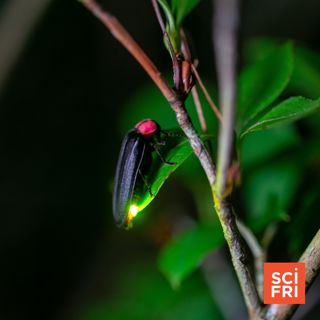
But as it turns out, we may have miscast mistletoe as the most romantic plant of the Christmas season. In reality, the plant that prompts your lover’s kiss is actually a parasite. Ira talks with evolutionary biologist Josh Der about the myth and tradition behind the parasitic plant, and what it may be up to the other 11 months of the year.

Subscribe to this podcast. Follow our show on Instagram, TikTok, Facebook, and Bluesky @scifri and sign up for our newsletters. Got a science question that’s keeping you up at night? Call us: 877-472-4374


Hosted by Simplecast, an AdsWizz company. See pcm.adswizz.com for information about our collection and use of personal data for advertising.

Tämä jakso on lisätty Podme-palveluun avoimen RSS-syötteen kautta eikä se ole Podmen omaa tuotantoa. Siksi jakso saattaa sisältää mainontaa.

Jaksot(1338)

Why do sports announcers talk like that?

Why do sports announcers talk like that?

If you watch sports, whether the recent NBA finals or the ongoing World Cup matches, you may have noticed that the athletes aren’t the only ones putting on a show. The announcers seem to be playing a ...

19 Kesä 13min

Swords, cannibalism, poison: inside the world of killer microbes

Swords, cannibalism, poison: inside the world of killer microbes

There is a murderous crime spree happening right under—and perhaps inside—our noses. Killer microbes armed with weapons are eviscerating, assassinating, and detonating their fellow microbes. And the n...

18 Kesä 21min

When music transports you to a different place

When music transports you to a different place

Do you ever hear a song that transports you to a specific place and time? This auditory wormhole has a name: musical daydreams. Music cognition expert Elizabeth Margulis studies why they happen, and w...

17 Kesä 18min

A vast whale graveyard + Zombie sea cucumbers

A vast whale graveyard + Zombie sea cucumbers

Researchers just published details of a massive undersea graveyard of whales deep in the Indian Ocean. Spanning about 1,200 kilometers (745 miles), it contains whale remains dating back more than 5 mi...

16 Kesä 18min

Should we bring mountain lions back to the Northeast?

Should we bring mountain lions back to the Northeast?

Big cats used to roam the entire United States. You might know them as mountain lions, pumas, cougars, or catamounts. Though they go by many names, they're actually all the same species.  Their curren...

15 Kesä 12min

Blue Origin explosion hits NASA timeline + Artemis III crew

Blue Origin explosion hits NASA timeline + Artemis III crew

When Blue Origin’s New Glenn spacecraft exploded in an enormous fireball during a ground test a couple weeks ago, it sent shockwaves not only through the air, but through NASA’s timeline for the upcom...

12 Kesä 12min

Why can I handle tequila but not rum?

Why can I handle tequila but not rum?

‘Tis the season for porch beers and happy hours, and we’re taking on listener questions about how alcohol affects us. Like, is a glass of wine at dinner really good for you? And why do sugary drinks g...

11 Kesä 21min

AI + turfgrass science in the most high-tech World Cup yet

AI + turfgrass science in the most high-tech World Cup yet

The 2026 World Cup will be the largest one yet, and FIFA is trying to make it the most high-tech, too. The federation has partnered with tech giant Lenovo to launch Football AI Pro, which is designed ...

10 Kesä 19min

Suosittua kategoriassa Tiede

rss-mita-tulisi-tietaa
utelias-mieli
rss-duodecim-lehti
rss-hereilla
rss-poliisin-mieli
rss-totuuden-liepeilla
rss-laakaripodi
rss-lihavuudesta-podcast
tiedekulma-podcast
sotataidon-ytimessa
radio-antro
rss-tiedetta-vai-tarinaa