NSF Director, Soylent Green In 2022, Colorado Snowpack, Springtime On Neptune. April 15, 2022, Part 2
Science Friday15 Huhti 2022

NSF Director, Soylent Green In 2022, Colorado Snowpack, Springtime On Neptune. April 15, 2022, Part 2

Did ‘Soylent Green’s’ Predictions About 2022 Hold Up?

In the spring of 1973, the movie Soylent Green premiered. The film drops us into a New York City that’s overcrowded, polluted, and dealing with the effects of a climate catastrophe. Only the city’s elite can afford clean water and real foods, like strawberry jam. The rest of the population relies on a communal food supply called Soylent. There’s Soylent Red, Soylent Yellow… and a new product: Soylent Green.

The year the film takes place? 2022. And spoiler alert: Soylent Green is people.

While the 2022 the film depicts is—thankfully—much darker than our current situation, the message still holds up. When the film premiered, Rachel Carson’s Silent Spring and the Clean Air Act were very much in the country’s consciousness. 50 years later, warmer temperatures, soil degradation, and social inequality are more relevant than ever.

Joining Ira to talk about the importance of Soylent Green 50 years later is Sonia Epstein, associate curator of science and film at the Museum of the Moving Image in New York City. Also joining is soil scientist Jo Handelsman, director of the Wisconsin Institute for Discovery in Madison, Wisconsin.

The National Science Foundation Has A New Goal: Entrepreneurship

The South By Southwest festival in Austin this year was the site of at least one unusual event: a press announcement by the head of the National Science Foundation, the primary federal agency tasked with funding and supporting fundamental research and investing in the education of young scientists in those fields.

NSF director Sethuraman Panchanathan announced he was creating a new directorate for Technology, Innovation, and Partnerships (TIP) to focus on “use-inspired” research that can be brought to commercial markets, in partnership with businesses and entrepreneurs. The goal, Panchanathan said in a press release in March, was to “accelerate the development of new technologies and products that improve Americans’ way of life, grow the economy and create new jobs, and strengthen and sustain U.S. competitiveness for decades to come.”

Panchanathan talks to Ira about what this new chapter means for the NSF, the future of basic research with no immediate commercial uses, and the challenges of persuading the public that failure, as much as success, is inherent to science.

The Colorado River Misses Its Snow

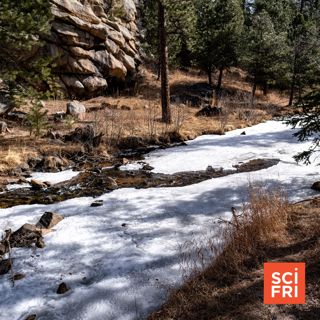
High in the Rocky Mountains, under thin air and bluebird skies, the Colorado River basin is slowly filling its savings account. Craggy peaks become smooth walls of white and piles of snow climb conifer trunks, covering even the deepest, darkest corners of the woods with a glimmering blanket.

The snow that accumulates in the mountains of Colorado and Wyoming will eventually become water in the Colorado River. Some of it will flow as far south as Mexico, running through kitchen faucets in cities and suburbs along the way, or watering crops that keep America fed through the winter.

Year by year, those piles are getting slightly smaller and melting earlier — slowly exhibiting the sting of a warming climate. The way we measure the snow is changing too, as a shifting baseline for what counts as “average” paints a somewhat deceptive picture of how much snow is stored up in the mountains.

Read the rest at sciencefriday.com.

Exploring Neptune’s Unusual Seasons

Planetary scientists monitoring how the outer planets change over time have made a surprising observation of springtime on the planet Neptune. As the planet moves towards summer in its southern hemisphere, one might expect it to get warmer—but in data taken over 17 years, researchers observed that the average temperature actually seems to be declining. One theory involves the conversion of atmospheric methane, which traps heat, to ethane or other hydrocarbon compounds that release heat more readily, but more research is needed.

The researchers also spotted the rapid formation of a hot-spot at the south pole of Neptune, with an increase of some 11 degrees C over just two Earth years. Models had predicted a temperature swing of perhaps 15 degrees over the entire seasonal cycle.

These findings were reported this week in the Planetary Science Journal. Scientists don’t know very much about Neptune—it’s over 30 times Earth’s distance from the sun, and gets only one nine-hundredth of the sunlight. It takes around 165 Earth years to complete an orbit, meaning that the researchers’ 17 years of data account for only a small fraction of one season. Because of the planet’s tilt and its long orbit, the last time the planet’s north pole was visible from Earth was in the 1960s. And we’ve only visited once, via the Voyager spacecraft, over 30 years ago.

Michael Roman, a planetary scientist at the University of Leicester in the UK, and one of the authors of the report, joins Ira to talk about the strange springtime on Neptune—and the planet’s many remaining mysteries.

Transcripts for each segment will be available the week after the show airs on sciencefriday.com.

Subscribe to this podcast. Follow our show on Instagram, TikTok, Facebook, and Bluesky @scifri and sign up for our newsletters. Got a science question that’s keeping you up at night? Call us: 877-472-4374


Hosted by Simplecast, an AdsWizz company. See pcm.adswizz.com for information about our collection and use of personal data for advertising.

Tämä jakso on lisätty Podme-palveluun avoimen RSS-syötteen kautta eikä se ole Podmen omaa tuotantoa. Siksi jakso saattaa sisältää mainontaa.

Jaksot(1340)

Can you learn to love the scorpion?

Can you learn to love the scorpion?

If you have arachnophobia, consider this your opportunity to try exposure therapy: A new study suggests that 415 million years ago, in modern-day England and Wales, a scorpion the length of a golden r...

23 Kesä 18min

FDA approves a well-known sunscreen ingredient—finally

FDA approves a well-known sunscreen ingredient—finally

The FDA recently approved a sunscreen ingredient called bemotrizinol, or BEMT, that’s been used in Europe and Asia for years. This is the first new sunscreen ingredient approved in the United States i...

22 Kesä 12min

Why do sports announcers talk like that?

Why do sports announcers talk like that?

If you watch sports, whether the recent NBA finals or the ongoing World Cup matches, you may have noticed that the athletes aren’t the only ones putting on a show. The announcers seem to be playing a ...

19 Kesä 13min

Swords, cannibalism, poison: inside the world of killer microbes

Swords, cannibalism, poison: inside the world of killer microbes

There is a murderous crime spree happening right under—and perhaps inside—our noses. Killer microbes armed with weapons are eviscerating, assassinating, and detonating their fellow microbes. And the n...

18 Kesä 21min

When music transports you to a different place

When music transports you to a different place

Do you ever hear a song that transports you to a specific place and time? This auditory wormhole has a name: musical daydreams. Music cognition expert Elizabeth Margulis studies why they happen, and w...

17 Kesä 18min

A vast whale graveyard + Zombie sea cucumbers

A vast whale graveyard + Zombie sea cucumbers

Researchers just published details of a massive undersea graveyard of whales deep in the Indian Ocean. Spanning about 1,200 kilometers (745 miles), it contains whale remains dating back more than 5 mi...

16 Kesä 18min

Should we bring mountain lions back to the Northeast?

Should we bring mountain lions back to the Northeast?

Big cats used to roam the entire United States. You might know them as mountain lions, pumas, cougars, or catamounts. Though they go by many names, they're actually all the same species.  Their curren...

15 Kesä 12min

Blue Origin explosion hits NASA timeline + Artemis III crew

Blue Origin explosion hits NASA timeline + Artemis III crew

When Blue Origin’s New Glenn spacecraft exploded in an enormous fireball during a ground test a couple weeks ago, it sent shockwaves not only through the air, but through NASA’s timeline for the upcom...

12 Kesä 12min

Suosittua kategoriassa Tiede

rss-mita-tulisi-tietaa
rss-hereilla
rss-lihavuudesta-podcast
utelias-mieli
rss-poliisin-mieli
rss-duodecim-lehti
rss-laakaripodi
rss-totuuden-liepeilla
tiedekulma-podcast
ihanat-ipanat
sotataidon-ytimessa
rss-astetta-parempi-elama-podcast
rss-tiedetta-vai-tarinaa
rss-alycast-alykasta-laakehoitoa-yksilollisesti