Unmasking Owls’ Mysteries | Why It Feels So Good To Eat Chocolate
Science Friday29 Joulu 2023

Unmasking Owls’ Mysteries | Why It Feels So Good To Eat Chocolate

Unmasking Owls’ Mysteries

Don’t let owls’ cute faces fool you—they’re deadly predators. This duality is part of what makes them so mysterious to humans. And their contradictions don’t end there: Their hoots are among the most distinctive bird sounds, yet owls are nearly silent when gliding through the air to catch their prey.

Scientists are learning more about why owls are such good predators—how their hearing and night vision are so sharp, and their flight so silent. With new technology, researchers are also decoding owl communications, increasing our understanding of their social structures and mating habits.

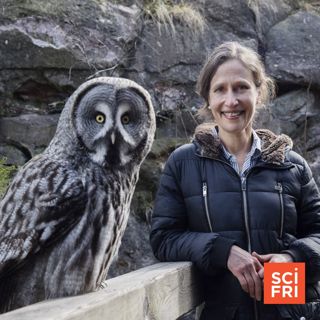
John Dankosky talks about all things owls with Jennifer Ackerman, author of the new book, What An Owl Knows: The New Science of the World’s Most Enigmatic Birds.

Why It Feels So Good To Eat Chocolate

When you eat a piece of good chocolate, chances are you don’t just bite down and chew away. There’s a good chance you hold the chocolate in your mouth for a moment, feeling the silkiness as it softens, melting into a molten mass and mixing with your saliva. That gradual phase change process—as fats in the chocolate melt from solid to liquid—is a big part of the chocolate mouthfeel experience.

Researchers at Leeds University in the UK have constructed an artificial tongue that doesn’t focus on the taste of a food, but rather its texture, and how that texture changes over time. Using the artificial tongue, they explored the textures of materials that can change phase in the mouth, such as chocolate, butter, and ice cream.

They reported their findings in the journal ACS Applied Materials & Interfaces. The researchers found that in dark chocolate, the sensation in the mouth is governed largely by the fat content, as the surface of the chocolate begins to soften. A few moments later, as the chocolate melts completely and mixes with saliva, the fat content of the treat is less important to the mouthfeel experience.

Dr. Anwesha Sarkar, an author of the report, joins Ira to talk about the research, the challenge of designing a lower-fat chocolate that might exploit these findings, and the importance of learning about textures to determine why people like—and don’t like—certain foods.

Transcripts for each segment are available on sciencefriday.com.

Subscribe to this podcast. Follow our show on Instagram, TikTok, Facebook, and Bluesky @scifri and sign up for our newsletters. Got a science question that’s keeping you up at night? Call us: 877-472-4374


Hosted by Simplecast, an AdsWizz company. See pcm.adswizz.com for information about our collection and use of personal data for advertising.

Tämä jakso on lisätty Podme-palveluun avoimen RSS-syötteen kautta eikä se ole Podmen omaa tuotantoa. Siksi jakso saattaa sisältää mainontaa.

Jaksot(1340)

Can you learn to love the scorpion?

Can you learn to love the scorpion?

If you have arachnophobia, consider this your opportunity to try exposure therapy: A new study suggests that 415 million years ago, in modern-day England and Wales, a scorpion the length of a golden r...

23 Kesä 18min

FDA approves a well-known sunscreen ingredient—finally

FDA approves a well-known sunscreen ingredient—finally

The FDA recently approved a sunscreen ingredient called bemotrizinol, or BEMT, that’s been used in Europe and Asia for years. This is the first new sunscreen ingredient approved in the United States i...

22 Kesä 12min

Why do sports announcers talk like that?

Why do sports announcers talk like that?

If you watch sports, whether the recent NBA finals or the ongoing World Cup matches, you may have noticed that the athletes aren’t the only ones putting on a show. The announcers seem to be playing a ...

19 Kesä 13min

Swords, cannibalism, poison: inside the world of killer microbes

Swords, cannibalism, poison: inside the world of killer microbes

There is a murderous crime spree happening right under—and perhaps inside—our noses. Killer microbes armed with weapons are eviscerating, assassinating, and detonating their fellow microbes. And the n...

18 Kesä 21min

When music transports you to a different place

When music transports you to a different place

Do you ever hear a song that transports you to a specific place and time? This auditory wormhole has a name: musical daydreams. Music cognition expert Elizabeth Margulis studies why they happen, and w...

17 Kesä 18min

A vast whale graveyard + Zombie sea cucumbers

A vast whale graveyard + Zombie sea cucumbers

Researchers just published details of a massive undersea graveyard of whales deep in the Indian Ocean. Spanning about 1,200 kilometers (745 miles), it contains whale remains dating back more than 5 mi...

16 Kesä 18min

Should we bring mountain lions back to the Northeast?

Should we bring mountain lions back to the Northeast?

Big cats used to roam the entire United States. You might know them as mountain lions, pumas, cougars, or catamounts. Though they go by many names, they're actually all the same species.  Their curren...

15 Kesä 12min

Blue Origin explosion hits NASA timeline + Artemis III crew

Blue Origin explosion hits NASA timeline + Artemis III crew

When Blue Origin’s New Glenn spacecraft exploded in an enormous fireball during a ground test a couple weeks ago, it sent shockwaves not only through the air, but through NASA’s timeline for the upcom...

12 Kesä 12min

Suosittua kategoriassa Tiede

rss-mita-tulisi-tietaa
rss-hereilla
rss-lihavuudesta-podcast
utelias-mieli
rss-poliisin-mieli
rss-duodecim-lehti
rss-laakaripodi
rss-totuuden-liepeilla
tiedekulma-podcast
ihanat-ipanat
sotataidon-ytimessa
rss-astetta-parempi-elama-podcast
rss-tiedetta-vai-tarinaa
rss-alycast-alykasta-laakehoitoa-yksilollisesti