
Snakes Are Evolutionary Superstars | Whale Song Is All In The Larynx
Science Friday5 Maalis 2024

Snakes Are Evolutionary Superstars | Whale Song Is All In The Larynx

In the trees, through the water, and under the dirt: Snakes evolve faster than their lizard relatives, allowing them to occupy diverse niches. Also, researchers are working to understand just how baleen whales are able to produce their haunting songs.

Snakes Are Evolutionary Superstars

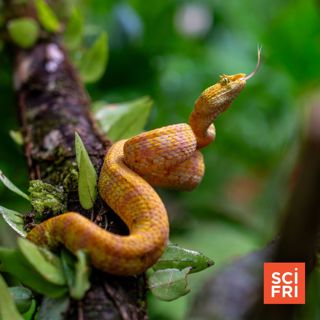
Love ‘em or hate ‘em, new research shows that snakes deserve our recognition as evolutionary superstars. The study, published last week in the journal Science, found that snakes evolve faster than other reptiles, allowing them to thrive in a wide range of environments.

It shouldn’t be too surprising: Many of the nearly 4,000 snake species occupy extremely specialized niches in their ecosystems. The blunt-headed tree snake, for example, eats through batches of treefrog eggs in Central and South America. Pythons, which can grow to 20 feet long, can take down large mammals like antelopes.

Joining Ira to talk about the evolutionary speed of snakes is study co-author Dr. Daniel Rabosky, evolutionary biologist and curator of the Museum of Zoology at the University of Michigan.

Whale Song Is All In The Larynx

Whale songs can be both beautiful and haunting. But the exact mechanism that the 16 species of baleen whales, like humpback and minke whales, use to make those noises hasn’t been well understood. The finer points of whale anatomy are hard to study, in part because the soft tissues of beached whales often begin to decompose before researchers can preserve and study them. And until the relatively recent advent of monitoring tags that can be attached to individual whales, it’s been hard to associate a given underwater sound with any specific whale.

For a recent study, published in the journal Nature, researchers took advantage of several well-preserved beached whales to investigate the mysteries of the baleen whale larynx and its role in whale song. Dr. Coen Elemans of the University of Southern Denmark joins Ira to discuss the work, which included a MacGyveresque contraption involving party balloons and exercise bands that blew air at controlled pressures through preserved whale larynx tissues. The researchers found that there are limits to both the frequencies these whales can produce, and the depths at which they are physically able to sing.

Transcripts for each segment will be available after the show airs on sciencefriday.com.

Subscribe to this podcast. Follow our show on Instagram, TikTok, Facebook, and Bluesky @scifri and sign up for our newsletters. Got a science question that’s keeping you up at night? Call us: 877-472-4374


Hosted by Simplecast, an AdsWizz company. See pcm.adswizz.com for information about our collection and use of personal data for advertising.

Tämä jakso on lisätty Podme-palveluun avoimen RSS-syötteen kautta eikä se ole Podmen omaa tuotantoa. Siksi jakso saattaa sisältää mainontaa.

Jaksot(1340)

Can you learn to love the scorpion?

Can you learn to love the scorpion?

If you have arachnophobia, consider this your opportunity to try exposure therapy: A new study suggests that 415 million years ago, in modern-day England and Wales, a scorpion the length of a golden r...

23 Kesä 18min

FDA approves a well-known sunscreen ingredient—finally

FDA approves a well-known sunscreen ingredient—finally

The FDA recently approved a sunscreen ingredient called bemotrizinol, or BEMT, that’s been used in Europe and Asia for years. This is the first new sunscreen ingredient approved in the United States i...

22 Kesä 12min

Why do sports announcers talk like that?

Why do sports announcers talk like that?

If you watch sports, whether the recent NBA finals or the ongoing World Cup matches, you may have noticed that the athletes aren’t the only ones putting on a show. The announcers seem to be playing a ...

19 Kesä 13min

Swords, cannibalism, poison: inside the world of killer microbes

Swords, cannibalism, poison: inside the world of killer microbes

There is a murderous crime spree happening right under—and perhaps inside—our noses. Killer microbes armed with weapons are eviscerating, assassinating, and detonating their fellow microbes. And the n...

18 Kesä 21min

When music transports you to a different place

When music transports you to a different place

Do you ever hear a song that transports you to a specific place and time? This auditory wormhole has a name: musical daydreams. Music cognition expert Elizabeth Margulis studies why they happen, and w...

17 Kesä 18min

A vast whale graveyard + Zombie sea cucumbers

A vast whale graveyard + Zombie sea cucumbers

Researchers just published details of a massive undersea graveyard of whales deep in the Indian Ocean. Spanning about 1,200 kilometers (745 miles), it contains whale remains dating back more than 5 mi...

16 Kesä 18min

Should we bring mountain lions back to the Northeast?

Should we bring mountain lions back to the Northeast?

Big cats used to roam the entire United States. You might know them as mountain lions, pumas, cougars, or catamounts. Though they go by many names, they're actually all the same species.  Their curren...

15 Kesä 12min

Blue Origin explosion hits NASA timeline + Artemis III crew

Blue Origin explosion hits NASA timeline + Artemis III crew

When Blue Origin’s New Glenn spacecraft exploded in an enormous fireball during a ground test a couple weeks ago, it sent shockwaves not only through the air, but through NASA’s timeline for the upcom...

12 Kesä 12min

Suosittua kategoriassa Tiede

rss-mita-tulisi-tietaa
rss-hereilla
rss-lihavuudesta-podcast
utelias-mieli
rss-poliisin-mieli
rss-duodecim-lehti
rss-laakaripodi
rss-totuuden-liepeilla
tiedekulma-podcast
ihanat-ipanat
sotataidon-ytimessa
rss-astetta-parempi-elama-podcast
rss-tiedetta-vai-tarinaa
rss-alycast-alykasta-laakehoitoa-yksilollisesti