Metal-Absorbing Plants Could Make Mining Greener | A Tiny Fern's Gigantic Genome
Science Friday12 Kesä 2024

Metal-Absorbing Plants Could Make Mining Greener | A Tiny Fern's Gigantic Genome

Plants called “hyperaccumulators” have evolved to absorb high levels of metals. Scientists want to harness them for greener metal mining. And, a little fern from New Caledonia is just a few inches tall, but its genome has 160.45 billion base pairs—50 times more DNA than a human.

How Metal-Absorbing Plants Could Make Mining Greener

Scientists are exploring a somewhat unusual green energy solution: mining metals from the earth using plants.

Typically, if soil has high levels of metal, plants will either die or do everything they can to avoid it. But, one group has taken a different path: evolve to be able to safely absorb large amounts of the metals. These special plants are called hyperaccumulators. And their ability to suck metals like nickel from the earth is called phytomining.

The Department of Energy’s Advanced Research Projects Agency-Energy announced in March up to $10 million in funding for phytomining research.

Ira talks with Dr. David McNear, professor of plant and soil sciences at the University of Kentucky, about these fascinating flora and their promise as a greener option to metal mining.

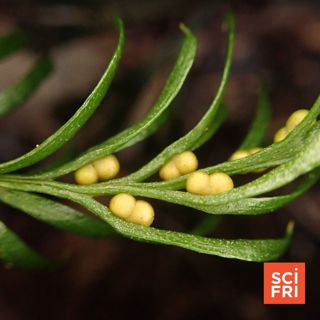
A Tiny Fern Has The Largest Genome Ever Discovered

Scientists just discovered the largest genome of any living thing on Earth, and it belongs to a small, unassuming fern called Tmesipteris oblanceolata. If you were to split open one of its cells and unwind the DNA that’s coiled up in the nucleus, it would stretch out more than 300 feet—taller than the Statue of Liberty.

Scientists reported the finding last week in the journal iScience. The fern is only a few inches tall and is found on the island of New Caledonia in the Southwest Pacific. Its DNA is made up of 160.45 billion base pairs—50 times more than the human genome.

This finding has left scientists scratching their heads, wondering how and why a fern ended up with so much DNA. Ira Flatow talks with co-lead author of this study Dr. Jaume Pellicer, evolutionary biologist at the Botanical Institute of Barcelona, about this research and why this fern’s DNA is so puzzling.

Transcripts for each segment will be available after the show airs on sciencefriday.com.

Subscribe to this podcast. Follow our show on Instagram, TikTok, Facebook, and Bluesky @scifri and sign up for our newsletters. Got a science question that’s keeping you up at night? Call us: 877-472-4374


Hosted by Simplecast, an AdsWizz company. See pcm.adswizz.com for information about our collection and use of personal data for advertising.

Tämä jakso on lisätty Podme-palveluun avoimen RSS-syötteen kautta eikä se ole Podmen omaa tuotantoa. Siksi jakso saattaa sisältää mainontaa.

Jaksot(1339)

FDA approves a well-known sunscreen ingredient—finally

FDA approves a well-known sunscreen ingredient—finally

The FDA recently approved a sunscreen ingredient called bemotrizinol, or BEMT, that’s been used in Europe and Asia for years. This is the first new sunscreen ingredient approved in the United States i...

22 Kesä 12min

Why do sports announcers talk like that?

Why do sports announcers talk like that?

If you watch sports, whether the recent NBA finals or the ongoing World Cup matches, you may have noticed that the athletes aren’t the only ones putting on a show. The announcers seem to be playing a ...

19 Kesä 13min

Swords, cannibalism, poison: inside the world of killer microbes

Swords, cannibalism, poison: inside the world of killer microbes

There is a murderous crime spree happening right under—and perhaps inside—our noses. Killer microbes armed with weapons are eviscerating, assassinating, and detonating their fellow microbes. And the n...

18 Kesä 21min

When music transports you to a different place

When music transports you to a different place

Do you ever hear a song that transports you to a specific place and time? This auditory wormhole has a name: musical daydreams. Music cognition expert Elizabeth Margulis studies why they happen, and w...

17 Kesä 18min

A vast whale graveyard + Zombie sea cucumbers

A vast whale graveyard + Zombie sea cucumbers

Researchers just published details of a massive undersea graveyard of whales deep in the Indian Ocean. Spanning about 1,200 kilometers (745 miles), it contains whale remains dating back more than 5 mi...

16 Kesä 18min

Should we bring mountain lions back to the Northeast?

Should we bring mountain lions back to the Northeast?

Big cats used to roam the entire United States. You might know them as mountain lions, pumas, cougars, or catamounts. Though they go by many names, they're actually all the same species.  Their curren...

15 Kesä 12min

Blue Origin explosion hits NASA timeline + Artemis III crew

Blue Origin explosion hits NASA timeline + Artemis III crew

When Blue Origin’s New Glenn spacecraft exploded in an enormous fireball during a ground test a couple weeks ago, it sent shockwaves not only through the air, but through NASA’s timeline for the upcom...

12 Kesä 12min

Why can I handle tequila but not rum?

Why can I handle tequila but not rum?

‘Tis the season for porch beers and happy hours, and we’re taking on listener questions about how alcohol affects us. Like, is a glass of wine at dinner really good for you? And why do sugary drinks g...

11 Kesä 21min

Suosittua kategoriassa Tiede

rss-mita-tulisi-tietaa
rss-hereilla
rss-duodecim-lehti
utelias-mieli
rss-poliisin-mieli
rss-lihavuudesta-podcast
rss-laakaripodi
rss-totuuden-liepeilla
sotataidon-ytimessa
rss-tiedetta-vai-tarinaa
rss-alycast-alykasta-laakehoitoa-yksilollisesti