
Earth May Once Have Had A Ring Like Saturn | An AI For Sand
Science Friday20 Syys 2024

Earth May Once Have Had A Ring Like Saturn | An AI For Sand

The ring would have gradually fallen to Earth as meteorites, correlating to a spike of impacts seen in the geological record. Also, a new AI tool can judge whether sand came from a beach, a river, a glacial deposit, or a wind-blown dune.

Earth May Once Have Had A Ring Like Saturn

Hundreds of millions of years ago, Earth may have looked quite different when viewed from space: Scientists propose it may have had a Saturn-like ring, made up of lots of smaller asteroids.

The new paper, published in Earth and Planetary Science Letters, proposes that this ring formed around 466 million years ago. A major source of evidence is a band of impact craters near the equator. The researchers also posit the ring would have shaded this equatorial area, possibly changing global temperatures and creating an icehouse period.

Ira speaks to Rachel Feltman, host of the Popular Science podcast “The Weirdest Thing I Learned This Week,” about this and other top science stories of the week, including how lizards use bubbles to “scuba dive” underwater, and ancient cave art that possibly shows a long-extinct species.

An AI To Identify The Environment A Grain Of Sand Came From

If you were given a bucket of sand and asked to determine where it came from, you’d probably have a hard time guessing if it was from a beach, a riverbank, the playground down the street, or a Saharan sand dune.

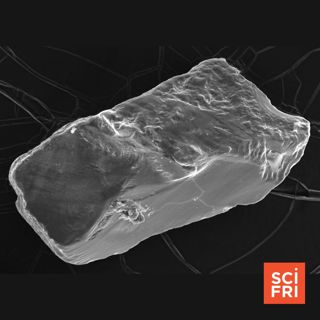
There are experts who can make a guess at that sort of ID, using a categorization process that takes skill, a scanning electron microscope, and hours of time. Now, however, researchers report in the Proceedings of the National Academy of Sciences that they’ve developed an AI model that can quickly judge whether a sample of sand came from a beach, a river, a glacial deposit, or a wind-blown dune.

That type of identification isn’t just of interest to geologists. Sand is one of the world’s most in-demand resources, second only to water in use. And different applications need different types of sand—for instance, making concrete and mortar requires angular sand for good adhesion and stability. These kinds of needs have given rise to illicit sand mining, sand theft, and sand smuggling. A way of rapidly identifying the origins of a sample of sand could be useful to investigators, or to companies seeking to ensure sustainability goals.

Michael Hasson, a PhD candidate in Stanford’s Department of Earth and Planetary Sciences, joins SciFri’s Charles Bergquist to discuss the new SandAI, and the challenges of tracking grains of sand.

Transcripts for each segment will be available after the show airs on sciencefriday.com.

Subscribe to this podcast. Follow our show on Instagram, TikTok, Facebook, and Bluesky @scifri and sign up for our newsletters. Got a science question that’s keeping you up at night? Call us: 877-472-4374


Hosted by Simplecast, an AdsWizz company. See pcm.adswizz.com for information about our collection and use of personal data for advertising.

Tämä jakso on lisätty Podme-palveluun avoimen RSS-syötteen kautta eikä se ole Podmen omaa tuotantoa. Siksi jakso saattaa sisältää mainontaa.

Jaksot(1338)

Why do sports announcers talk like that?

Why do sports announcers talk like that?

If you watch sports, whether the recent NBA finals or the ongoing World Cup matches, you may have noticed that the athletes aren’t the only ones putting on a show. The announcers seem to be playing a ...

19 Kesä 13min

Swords, cannibalism, poison: inside the world of killer microbes

Swords, cannibalism, poison: inside the world of killer microbes

There is a murderous crime spree happening right under—and perhaps inside—our noses. Killer microbes armed with weapons are eviscerating, assassinating, and detonating their fellow microbes. And the n...

18 Kesä 21min

When music transports you to a different place

When music transports you to a different place

Do you ever hear a song that transports you to a specific place and time? This auditory wormhole has a name: musical daydreams. Music cognition expert Elizabeth Margulis studies why they happen, and w...

17 Kesä 18min

A vast whale graveyard + Zombie sea cucumbers

A vast whale graveyard + Zombie sea cucumbers

Researchers just published details of a massive undersea graveyard of whales deep in the Indian Ocean. Spanning about 1,200 kilometers (745 miles), it contains whale remains dating back more than 5 mi...

16 Kesä 18min

Should we bring mountain lions back to the Northeast?

Should we bring mountain lions back to the Northeast?

Big cats used to roam the entire United States. You might know them as mountain lions, pumas, cougars, or catamounts. Though they go by many names, they're actually all the same species.  Their curren...

15 Kesä 12min

Blue Origin explosion hits NASA timeline + Artemis III crew

Blue Origin explosion hits NASA timeline + Artemis III crew

When Blue Origin’s New Glenn spacecraft exploded in an enormous fireball during a ground test a couple weeks ago, it sent shockwaves not only through the air, but through NASA’s timeline for the upcom...

12 Kesä 12min

Why can I handle tequila but not rum?

Why can I handle tequila but not rum?

‘Tis the season for porch beers and happy hours, and we’re taking on listener questions about how alcohol affects us. Like, is a glass of wine at dinner really good for you? And why do sugary drinks g...

11 Kesä 21min

AI + turfgrass science in the most high-tech World Cup yet

AI + turfgrass science in the most high-tech World Cup yet

The 2026 World Cup will be the largest one yet, and FIFA is trying to make it the most high-tech, too. The federation has partnered with tech giant Lenovo to launch Football AI Pro, which is designed ...

10 Kesä 19min

Suosittua kategoriassa Tiede

rss-mita-tulisi-tietaa
rss-hereilla
rss-duodecim-lehti
utelias-mieli
rss-poliisin-mieli
rss-lihavuudesta-podcast
rss-laakaripodi
rss-totuuden-liepeilla
sotataidon-ytimessa
rss-tiedetta-vai-tarinaa
rss-alycast-alykasta-laakehoitoa-yksilollisesti